How to Learn Faster: The Science-Backed Method
You've always been the one who takes more time to understand. When others understand something quickly, you are still confused. You think that you are just not a "fast learner." Some people are born like that, you tell yourself. You are not one of them.
That is a lie you've been telling yourself.
The speed of your learning is not a closed book. It is not some genetic characteristic that you have to carry. Your ability to learn things more rapidly is a skill. And just like any skill, you can become immensely better at it if you use the right methods.
Most people try to learn by doing what is natural to them: they read, re-read, watch videos, and hope that the material will stick. When it doesn't, they get frustrated. They think that their brain is the problem. It isn't. Their method is the problem.
The difference between a person who learns quickly and one who doesn't is not intelligence. Most of the time that one person simply knows the techniques that the other doesn't. They realize how their brain really works. They organize their learning in accordance with the way memory works. They do the right thing when it comes to practice rather than the difficult way.
This article reveals to you those techniques. Not theory. Real methods that allow you to learn anything—languages, skills, concepts, domains—at twice or thrice the speed of traditional learning.
Why You Think You're Bad at Learning
Let us begin with the mental block. You think that you are slow at learning because you have compared yourself to others who seem to be able to get things very quickly.
However, what you don't realize is that these people are not doing what you think they're doing. They are not necessarily understanding more quickly than you. Oftentimes they are just better at pretending that they understand. Or they are better at recognizing patterns because they have already studied similar things. Or they are more confident therefore they start quicker and learn through doing.
The actual reason why you feel slow is that you haven't learned how to learn.
Conventional education feeds you with content. It seldom teaches you the meta-skill of efficient learning. Hence, you resort to default strategies that are average: reading once, relying on memory. Watching a video and expecting to remember it. Studying for long hours with the hope that something will stick.
None of these are efficient. They are just what people usually do by default.
Everything changes when you move to methods that are in fact in line with the functioning of your brain. You are not slower. You have just been using the wrong technique.
The Three Pillars of Fast Learning
One can learn quickly only if fast learning factors are in synergy. These factors are explicated below:
1. Clear Deconstruction (What to Learn)
Learning everything about a single topic is impossible. The first and foremost thing you need to do is to figure out which 20% of that skill or knowledge is capable of producing 80% of the results.
For example, if your goal is to learn writing, grammar rules study for a year is not necessary. What you really need to know are: structure, clarity, and revision. These three aspects make up 80% of good writing.
Similarly, when you're learning a foreign language, you don't have to memorize 10,000 words. Instead, you need 1,000 high-frequency words plus key phrases. This will account for 80% of the daily conversation.
The main challenge is to figure out which 20% is that. One way to do this is to consult people who excel in that skill and ask them: "What are the three most important things I need to know?" Most of them will be able to give you the core concepts. Begin with those.
2. Spaced Repetition (When to Review)
This is probably the most significant shortcut. One can speed up the learning process by reviewing at the precise time rather than doing a cram session or randomly spacing reviews.
The forgetting curve demonstrates that within an hour you forget 50% of the information if you do not review it. However, if you review before forgetting, the curve becomes flatter. You forget at a slower rate. Every time you review, your memory becomes stronger.
The best spacing is approximately: review after 1 day, then 3 days, then a week, then two weeks.
This is not random. It depends on the way your brain processes information for long-term memory.
Secondly, the speed of knowledge application increases drastically. Once you get a grasp of micro-lessons, you quickly understand the core concept and then you can nearly immediately start using it. There is no need for waiting until the whole course is completed.
Thirdly, the spacing is done without any intervention. You are not required to remember the review sessions. The system takes care of it. Therefore, you just have to show up daily.
That is the principle of NerdSip: rather than letting you spend two hours learning something new, you spend five minutes. Your brain can easily manage five minutes. It is not intimidating. You are more willing to show up. And when you show up regularly, learning speeds up significantly.
Moreover, there is the social element. When you realize that there are also three other people who are learning the same thing, when you get XP for the completion of lessons, when you are building a streak—suddenly there is energy. You are not only learning alone. You are part of a community of people who are becoming smarter together.
The gamification is not only motivational. It is learning architecture. It helps to maintain consistency, which is the main factor that separates fast learners from slow ones.
The Method: How to Apply This Today

If you want to learn something faster starting right now, here's the system.
Step 1: Identify the 20%
Choose a skill or a topic that you want to learn. Now ask yourself: "What are the main concepts? What do I absolutely have to know?" Note down 3–5 things.
This is not everything about the topic. This is the foundation. Master the foundation first.
Step 2: Find the Optimal Resource
Do not spend weeks hunting for the perfect course. Find something that explains your 20% very clearly. If you are a beginner, a 5-minute explanation is much better than a 2-hour deep dive.
Micro-learning resources are actually more suitable for this purpose because they are created to teach one concept clearly in a short period. You come in, get the core idea, and leave. There is no filler.
Step 3: Learn, Then Test Immediately
Don't just watch or read. After the information consumption, immediately test yourself. Tell the information to someone. Answer practice questions. Try to use it.
This retrieval practice is what really transfers the information from short-term to long-term memory.
Step 4: Review at Intervals
Plan your reviews. Tomorrow, then three days later, then a week later. If you are using a tool, it does this automatically for you. If you are not, then put reminders in your calendar.
Each review session lasts 5–10 minutes. You are not re-learning. You are retrieving and reinforcing.
Step 5: Apply It
The quickest way to learn is to practice what you've learned. Don't wait until you feel ready. Keep using it while you're still learning. This both speeds up learning and application.
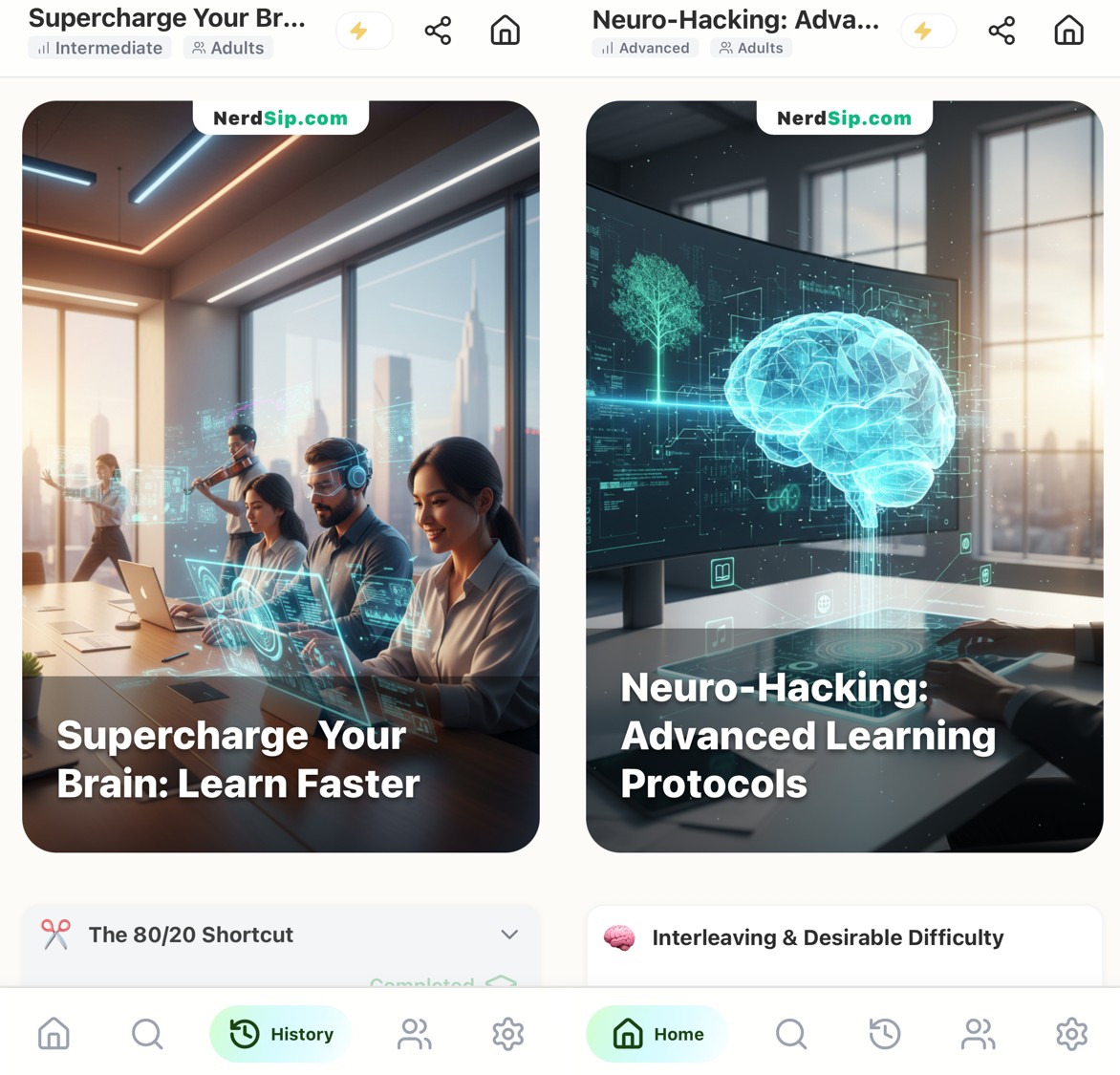
Supercharge your brain: Learn faster
Master the core 20% of learning science and double your retention speed with this foundational protocol.
Start Learning →Neuro-Hacking: Advanced Learning Protocols
Deep dive into cognitive optimization, flow states, and biological shortcuts for rapid skill acquisition.
Start Learning →The 30-Day Fast Learning Challenge
If you really want to learn faster, try this for 30 days.
Choose one skill or topic. Figure out the core 20%. Daily 15 minutes: five minutes learning, ten minutes reviewing or applying what you've learned.
Use a resource with a clear structure (e.g., micro-learning lessons) that takes care of spacing. Test yourself immediately after learning.
On the seventh day, you will see that you have a much better understanding of the subject than if you had done a one-day intensive study.
By the 30th day, you will have developed subconscious knowledge. It will be very natural. You will, without thinking, use it.
Afterward, select the skill you want to work on next. Repeat the process.
The gain from the compounding effect after a year is twelve times deep learning instead of zero.
The Truth About Learning Speed
What fast learners have that slow learners don't is not intelligence. It is not some genetic gift.
It is usually one of three things:
- They know what to focus on (the 20%)
- They review at the right time (spaced repetition)
- They practice the right way (active retrieval)
These are teachable. Learnable. You can become skilled in them.
Consistency is another factor. Fast learners are always there. They do not cram. They do a little each day. This creates momentum and retention.
You can also do it. From today. Decide on something you want to learn. Use this method.
You are not bad at learning. You have just been doing it incorrectly. If you change the method, your speed will change itself.
Ready to learn faster?
Join NerdSip and master any skill in just 5 minutes a day with science-backed micro-learning.
Join the Waitlist →