
How to Master Your Attention Span
You start working by sitting down. Especially during the holiday season, the distractions are everywhere. Your phone lies on the table, not in your pocket, but on the table. You can actually see it—buzzing with gift delivery updates and festive group chats.
You promise yourself that you will not touch it. You are a person of discipline. You open your laptop and start working. After 30 seconds, you look at your phone. Maybe someone has sent you a holiday greeting. I doubt it, but maybe.
You don't touch it. You return to your work. After another 15 seconds, you check it again. There were no notifications. You put it down and try again.
In fact, you have checked your phone seven times by the time you have actually focused for five minutes.
This is your baseline now. This is what normal looks like. And it is ruining your productivity, your capacity to learn, and your mental health.
The average person checks their phone 96 times a day. That is once every 10 minutes. Each and every notification, ping, or message possibility splits your attention into smaller and smaller pieces. And here is the horrible part: every task switch costs you. Studies indicate that multitasking and constant switching may lower your productivity by as much as 40%.
However, it is not only about productivity. Fragmented attention actually makes you less intelligent. You cannot think deeply if you are continuously interrupted. You cannot learn effectively. You cannot solve problems. You cannot make things that have value.
Your attention span is not broken because you are weak. It is broken because the whole world is made in such a way that it takes your attention away.
The Architecture of Distraction
You are not up against fair odds. These billion-dollar companies have whole teams whose sole job is to capture and retain your attention. They have gone through psychology, neuroscience, and behavioral economics to make their applications as addictive as possible.
Every notification is a device to elicit a dopamine response. The red badge count generates urgency. The infinite scroll overrides your natural stopping point. The algorithmic feed guarantees there is always something new, always a reason to keep scrolling.
Your phone is not a tool. It is a slot machine in your pocket.
And you are not weak because you are addicted to it. You are human. You are acting in the very way these systems were designed to make you act.
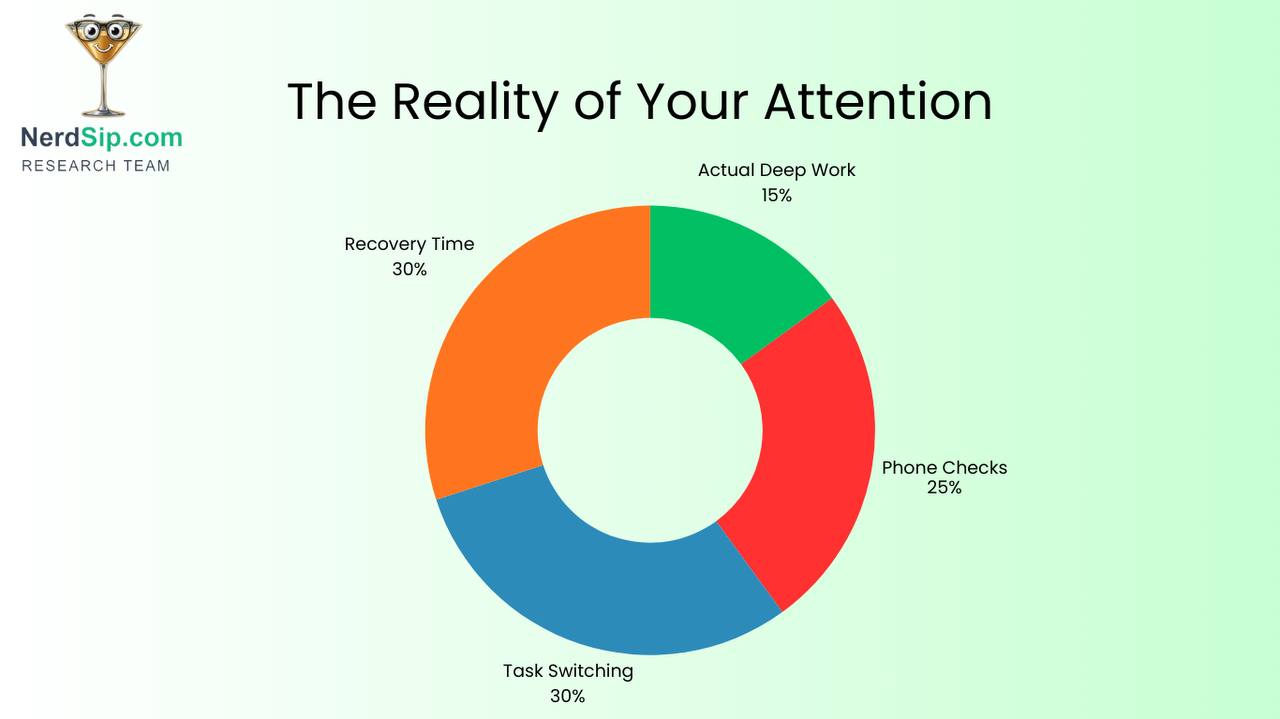
The issue is that the price of this diversion is enormous. Each time you're pulled away from deep work, it takes, on average, 23 minutes to get back into the flow state. If you are being interrupted every 10 minutes, you are never really focused. You are always in recovery mode.
That means you are always stressed, always behind, always feeling that you are not achieving enough. Because you are not. It is not because you lack discipline, but because your attention is being systematically fragmented.
What Happens When You Lose Focus
Let's face it, a lack of focus is not free. It affects your learning, your work, your mental health, and your relationships.
When it's your learning that is affected, it means that you are not going to be able to learn new things efficiently. Especially when it comes to acquiring a new skill, concept, or language, focus is a must. Our brain needs to hold multiple ideas in its working memory and draw connections between them. This requires at least 15–20 minutes of continuous concentration. If you are always switching every 10 minutes, you never get that time. Therefore, you read but don't retain what you have read. You watch tutorials but forget what you saw. You keep yourself busy with learning but you are not actually learning.
Deep work is the kind of work that actually leads to results but requires flow state. Flow state is a mental state where you are not aware of the process of thinking and just doing. In this state, ideas come to you. Solutions to problems are found automatically. This state is very valuable and easily destroyable. Just one notification can end it.
Switching constantly from one task to another also puts your mind under constant low-level stress which over time leads to poor mental health. Under these circumstances your cortisol level is always elevated. Half of your attention is given to everything around you and none is fully concentrated on a single task. Your brain is overworked. You feel scattered even when you are not doing much.
Moreover, losing focus has also negative impact on your relationships. It is true that you are there but only physically and not mentally. People can see that. They feel it. They know that you are not really there with them.
There is also a meta-problem behind this: you are always one notification away from giving up on finishing a task. You often start things but only rarely finish them. This is how your brain is being trained that completion is not necessary. This in turn makes it even harder to get started with something new because you know that you won't finish. This vicious cycle of incompletion keeps growing.
The Science of Deep Focus
What's really fascinating about this is that your attention span isn't something that is biologically predetermined. It's a skill. You can definitely train it.
Basically when you train the ability of sustained focus, you are in fact building up the neural pathways that are responsible for attention. Your prefrontal cortex becomes more powerful. So, in reality, you get better at concentrating as time goes by.
Point of understanding focus is that it operates in cycles. No man or woman could focus for 8 hours straight. Our brain is in dire need of a short rest. However, the break should be chosen and not a response to the situation.
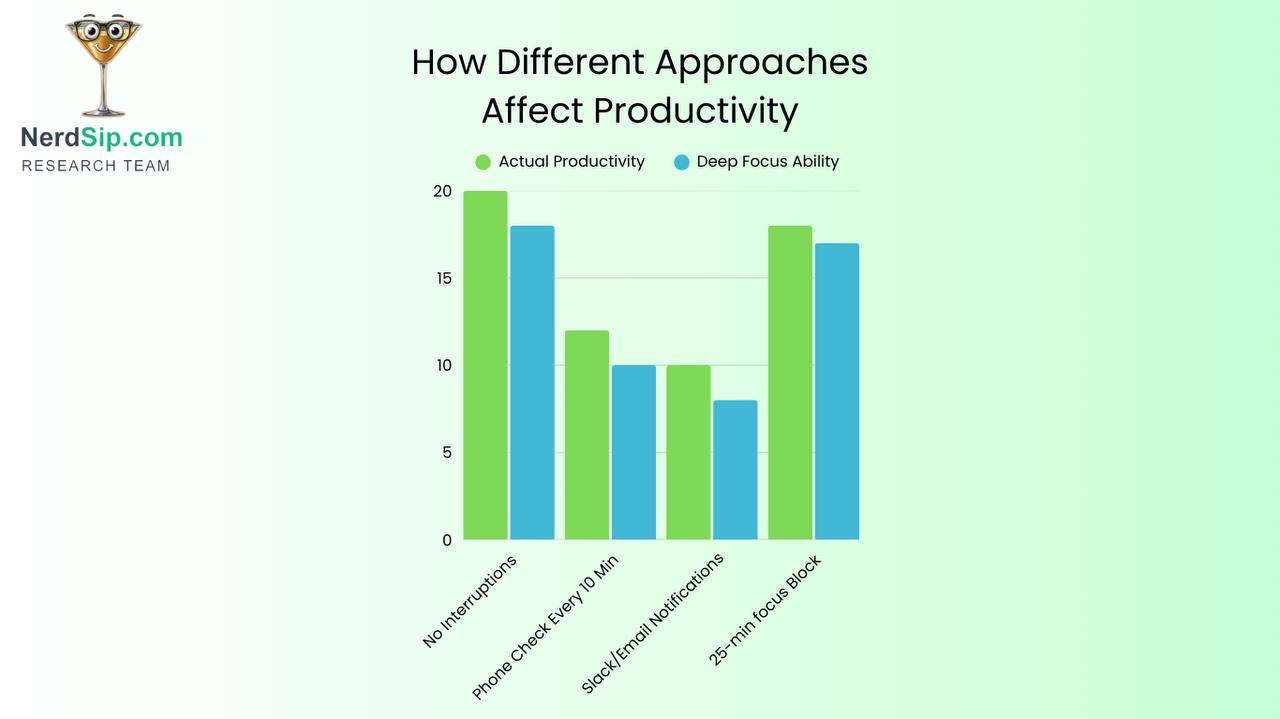
Most people can work rhythmically best if they work for 25–90 minutes and then take a break afterward. The Pomodoro technique makes use of 25 minutes. Some people work for 50 minutes and others 90 minutes. The exact number of minutes is of no importance. What is important is the work cycle: dedicated work, break, then work again.
During the work block, it's a must that you are completely focused on the task. Putting away your phone, you don't hear it ringing. Closing your tabs, you are not disturbed. There is nothing other than the task. You are not forcing your willpower. You are simply taking away the choice.
During the break, it is allowed to check a phone and go for some water. You can walk around too. The attention system is being given the time and space that is needed for it to rest. After the rest, you come back.
This is quite a simple thing but it manages to work because it doesn't try to change the brain but rather it supports the brain's existing functioning.
The Micro-Learning Advantage
There's something quite surprising about this: the best way probably to restore your attention span is actually to work with smaller focus chunks.
If you were constantly distracting yourself, then trying to focus for 90 minutes straight will be something that you find very difficult. Most likely, you will try, fail, and feel worse. The only way to fix this problem is to gradually rebuild the focus muscle.
Micro-learning here plays a great role. Your brain understands: "I need to focus for 5 minutes. Yes, I am capable of that." You finish it. You get a sense of achievement. You come back tomorrow and do another 5-minute lesson.
After a certain period, something changes. Your five-minute focus blocks become a walk in the park. It is therefore possible that you do two of them back to back. Then three. Your attention span is increasing. And since every session is complete and digestible, you are actually learning rather than being bombarded with information.
One of the most important reasons why platforms like NerdSip are structured this way is the respect they pay to human attention span in 2025 apart from the fact that micro-learning modules are very convenient for people with a busy schedule. You are not trying to impose on yourself a learning model that is no longer effective. You are tackling your real capacity and starting from there.
The gamification feature (streaks, leaderboards, completion notifications) is also there to help. When you realize that you have been consistent for 7 days in a row, when you see "Sarah just completed a 5-minute course on Decision Making," it leads to social motivation. You want to be able to keep your streak going. You want to be at the top of the leaderboard.
Which means you physically get there. And physically getting there regularly is the way you renew your focus.
The Practical System: How to Regain Your Focus
If you're really determined to get your attention back, this is the way to do it.
Step 1: Investigate Your Distractions
For one whole day, note every instance when your attention is diverted. Every notification, every time you grab your phone, every time you change the task. Just record it. You don't have to change anything straight away. Just be conscious of it. Most people are surprised. They estimate that they are distracted five times a day. In reality, they are distracted more than 50 times.
Step 2: Create a Focus Environment
The environment in which you work physically influences your productivity. Find out where you can work with full concentration and focus. Perhaps it is a coffee shop. A library. Your home office. A place where your phone is not within reach and there are only a few distractions. Now, promise yourself that you will do your deep work there. Not occasionally. Regularly. Your brain will get used to that place and focus there.
Step 3: Implement a Notification Blackout
- Phone in another room or if possible turned off completely
- Email closed
- Slack/Teams off
- Browser notifications disabled
- No music with lyrics (if anything is played, it should be instrumental)
Step 4: Use the Timer Method
Start with 25 minutes. Put a timer on. Work. When the timer goes off, you are finished. Take a 5-minute break. Repeat this 3–4 times and then take a longer break for 15–30 minutes.
Step 5: Be Ruthless About Your Task List
You cannot focus on three things simultaneously. Choose one. Just one. That is what you focus on during the work block.
Step 6: Track Your Progress
Note down what you achieved in each focus block. At the end of the week, looking back, you will see progress. This is energizing. This creates momentum.
The Weeks Ahead
If you started putting this into practice today, this is what you would experience.
Week 1: You will feel strange. Your phone will seem like a lost limb. You will want to check it all the time. Resist. By day 4–5, it gets easier.
Week 2: You will begin to realize that you are actually getting more work done. Things that used to take the whole day now take 2–3 hours because you are really focused.
Week 3: Your sleep gets better. Your anxiety decreases. You become aware of how much mental energy you were using for distractions.
Week 4: You will look back and hardly see that you were so scattered a month ago. Your attention span has really grown.
The Deeper Win
Most productivity advice fails to see this: changing your attention span is not only about doing more, but mainly it is about getting your life back. When you are able to focus, then you can think. When you think, you can plan. When you plan, you can lay the steps to something. You are not reactive anymore. You are not a victim of your notifications. You are the one who decides where to put your attention.
What that does, is it changes everything. Your relationships become better because you are really there. Your learning speeds up because you are absorbing the material. Your work gets better because you are coming from a concentrated rather than a broken state. Your mental health gets better because you are not under constant low-level stress.
You are the one who actually finishes things. And that person has choices. That person has the power of movement. That person has inner calm.
Therefore, initiate the process today. Take a look at your distractions. Put your phone away from you. Set a timer for 25 minutes. Do your work without interruptions.
It is the easiest thing you can accomplish. And maybe it is the most important one.
Give yourself the gift of focus.
Join thousands of learners who are beating distractions with bite-sized knowledge this holiday season.
Join the Waitlist →
