How to Stop Procrastinating (The Science-Backed Way)

You should really start that project. For the last three days, you've known it. You keep telling yourself you'll do it the next day. The following day also leaves without you doing the task. It's Friday now and your deadline is Monday. You're stressed out, full of coffee, and rushing to finish something you could have done any other time during the week.
This is the story of your life. And, you despise it.
Procrastination is not laziness. The very first lie you need to stop telling yourself is that you're lazy. You are not lazy. You are emotionally avoidant. There is a distinction.
Procrastination is when a task makes you feel some kind of negative emotion such as the fear of failure, perfectionism, feeling overwhelmed, being bored, and sometimes just being confused about where to start. The moment your brain faces such an emotion, it does what it has been trained to do: avoid. Instead of checking your phone, you could be calling a friend. But no, you are on your phone. While scrolling, you remember that you have to tidy up your desk. Anything but the task.
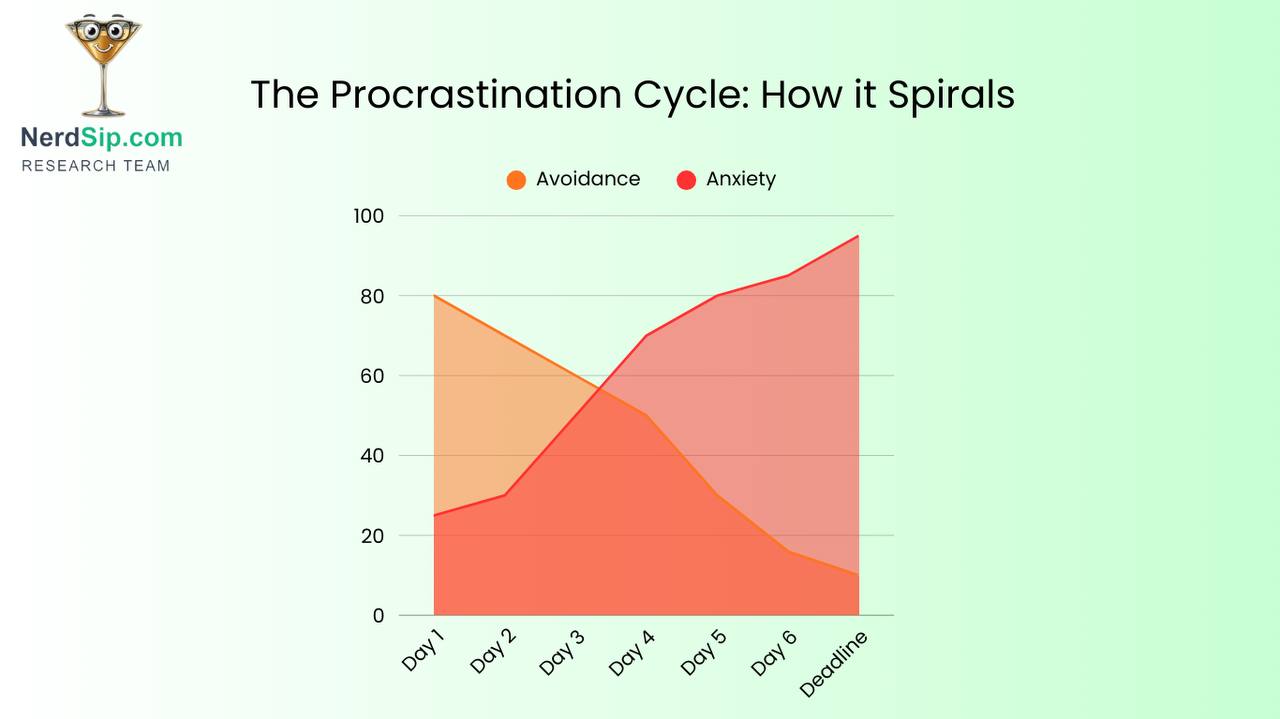
What happens is that it works for a short time. The anxiety disappears. The trouble is that the task is still there. It just gets bigger and scarier until the deadline is so close that fear becomes stronger than avoidance. At that time, you do it, finally.
This cycle makes you tired of life. And, it doesn't have to be like that for you.
Why You Are Procrastinating
Let's really talk about it. The truth is you are not avoiding the task, you are just avoiding how the task makes you feel. A research is there to prove that procrastination is mostly an emotional regulation problem rather than a time management issue. Even if you have the perfect schedule, you can still procrastinate because the core problem is not about planning your day. It's about the discomfort that comes from starting something difficult.
Maybe the task is too big or too boring for you. Maybe you are not sure whether you will do it well. Or it requires focus and you are already mentally tired. Your brain decides that the short-term relief of avoidance is worth more than the long-term benefit of doing the work.
So, it picks the option of running away.
The harsh part? This cycle in fact gets worse with time. The more you avoid something, the more it frightens you. The anxiety increases. When you finally get down to it, you are so worried that you either do a mediocre job or have a breakdown.
There is a way out of this problem. It actually starts with the realization that the first few minutes are the most difficult ones.
The Real Barrier: Starting, Not Doing
Most people misunderstand procrastination greatly: they believe the problem is the doing. It is not. The problem is getting started.
After getting into the flow state, the actual work is not that bad. Your mind acknowledges that the work is not as dreadful as it thought. You get in. You may even find it fun.
However, the point, the moment of starting, is where the struggle is. That's where emotion dominates.
Hence the strategy is not "work longer" but "start smaller".
Writing a 2,000-word report might be a task that your brain rejects immediately, thinking it's like climbing a mountain. But writing only the introduction seems like something you can do. You take a seat with that limited target. And then the magic happens: you complete the intro, you are already warmed up and you keep going. In thirty minutes you have written way more than you planned.
This is the reason the Pomodoro technique is effective. It is not about the 25-minute timer. It is about making the commitment so small that your brain cannot argue with it. "Just 25 minutes." Any one can do 25 minutes of work.
The Four Procrastination Types (And How to Beat Each)
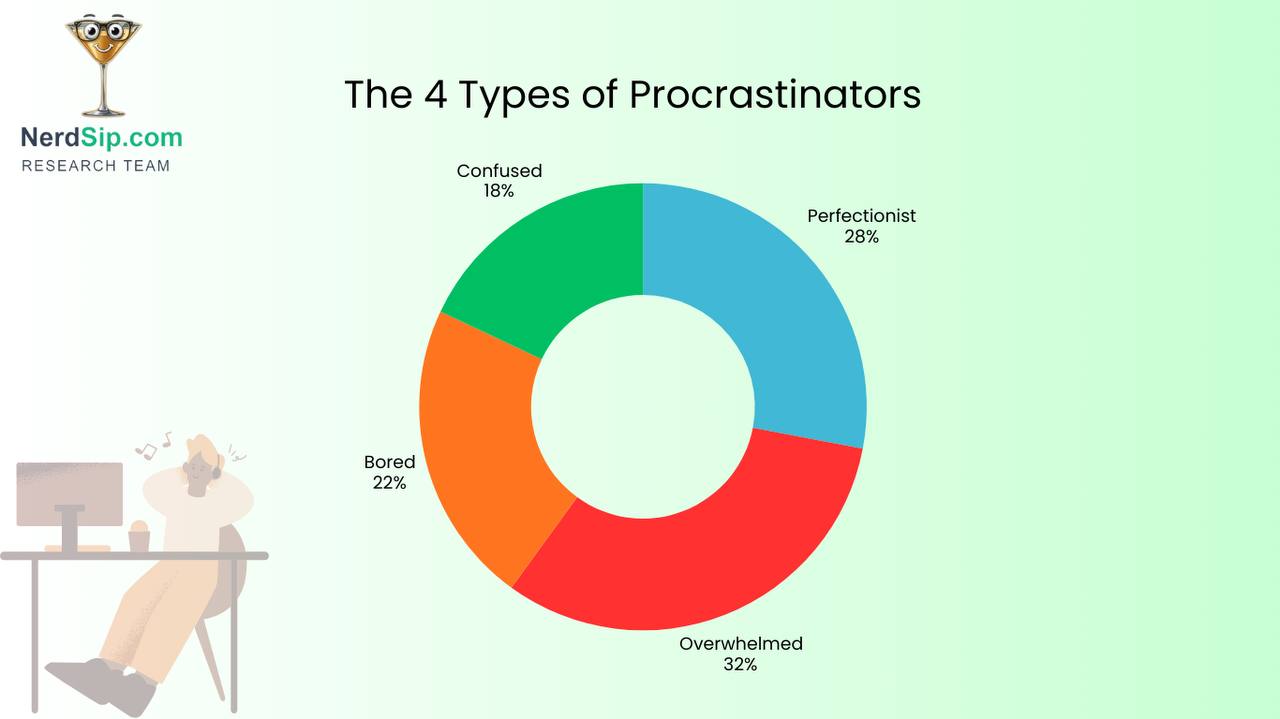
The Perfectionist Procrastinator
You are afraid that the work will not meet the standard. So you don't start. If you don't try, you can't fail. It seems like a safe place.
The fix: Start loving "good enough." Your first draft doesn't have to be perfect. It only needs to be there. You can always revise it later. Allow yourself to do mediocre work at first. Perfection is the enemy of done.
The Overwhelmed Procrastinator
The assignment seems too huge. You are so lost that you do not even think of starting. The feeling of being overwhelmed leads you to be stuck.
The fix: Divide it into ridiculously small pieces. Not the pieces of medium size. Stupidly small pieces. If even your first step frightens you, it means you haven't broken it down enough. Your first step should actually be insignificant.
The Bored Procrastinator
You are not interested in the work. It seems to be a waste of time or a boring routine. Your brain would simply choose to do anything else.
The fix: Add novelty or gamification. Put a timer and challenge yourself to complete the work before it goes off. Try in a new location. Listen to a specific playlist. Concentrate on the task by playing games.
The Confused Procrastinator
You lack enough clarity of what you are to do or why. Therefore you procrastinate and at the same time wish that clarity came by itself.
The fix: Obtain a 20-minute crash course. Definitely not a 300-page book. Not even a three-hour seminar. Just a brief, concise session that gives you 80% of what you need to know. This is the point where knowing one core idea is better than absorbing tons of research. After you understand the basics, everything else fits in and you can actually start.
The Micro-Learning Hack for Procrastination
Here is one thing that most productivity advice writers overlook: that you frequently procrastinate on learning tasks because they seem too big and not well-structured.
You promise yourself to "learn Python" or "grasp marketing strategy," whereas these are so ambiguous that your brain cannot get involved. At the end, you randomly watch YouTube videos for three hours and don't learn anything.
The truth of the matter is that the reverse is the right method: ultra-targeted, super-focused learning in short sessions. The one that quickly provides you with the 20% of knowledge that results in 80% of your work, is the right way.
One does not have to be a topic master to start. One just needs enough clarity to be able to take the very first step. Five minutes of focused learning is better than two hours of scattered research every time.
This is the fundamental idea of micro-learning platforms like NerdSip: brief lessons so you can quickly 'sip' the core concepts of a topic in five minutes. No fluff. No dragging your sessions endlessly. Just the concepts that matter, delivered in a format you can actually finish.
When you are procrastinating on learning something, usually you are not avoiding the actual learning. You are avoiding the commitment of "I am going to spend two hours on this course." But five minutes? That is something you can do. Your brain is aware that it is doable.
Within five minutes once you learn the core concept, the overwhelm disappears. You have clarity. You can start working.
The Gamification Advantage
Procrastination, also, isolates and thrives. When no one is watching, when there is no external accountability, it is very easy to keep your old habit of avoidance.
However, here is what changes the game: visibility and competition.
While you are learning on NerdSip and you find out that someone else has just completed a course on the same topic, or you are building a streak and do not want to break it, or you are going up the leaderboards—suddenly, there is a drive. You, thus, move from avoiding the task to actually looking forward to the next lesson because it is progress, not work, that you feel.
The XP system, the leaderboards, the social feed saying "Sarah just completed Decision Making in 5 minutes"—these aren't only for your entertainment. They are behavioral architecture. They influence the same part of your brain that is responsible for achievement, not the part that is responsible for avoidance.
You're not a single person in a room with something difficult and you're not looking at it. You're a community of people learning and progressing together. It changes everything.
The 48-Hour Anti-Procrastination Protocol
Today (Next 30 Minutes):
Figure out what it is that you are procrastinating on. Writing it down is the thing that you should do. Subsequently, figure out the type of the procrastinator you are (perfectionist, overwhelmed, bored, confused).
In case of being confused, take about 5–10 minutes to get a quick overview. Find the core concept. Don't go deep. Just get oriented.
Today (The Evening):
Put a time limit of 15 minutes on the work that you are going to do. Only 15. Tell yourself that you are only committing to 15 minutes. Get the work going. Don't strive for perfection or completion. Strive for progress.
As a matter of fact, in 90% of the cases, you will continue working beyond 15 minutes once you have already started. But, if you don't, 15 minutes of progress is better than zero.
Tomorrow:
Apply a 25-minute Pomodoro session. Concentrate on work for 25 minutes and then have a 5-minute rest. Repeat this 3–4 times. The amount of work you manage to complete will amaze you.
If it is a learning task, go for a micro-learning resource to get the core concepts clear first. Get the framework. Then execute.
By Day 2 (Evening):
You have disrupted the procrastination cycle. You have started moving. Now momentum will take over.
The Truth About Execution
Procrastination is a problem of confidence that disguises itself as productivity. It requires you to get more information, more time, more preparation. The truth is, you're just scared.
Those who accomplish their tasks are not necessarily more intelligent or more disciplined. They are simply the ones who are ready to start before they have the courage. They start with incomplete information. They start with a rough draft. They start with the core concept instead of waiting for mastery.
They realize that done is better than perfect, and started is better than planned.
So choose something that you are procrastinating on. Don't wait until you feel ready. You won't. Put a 15-minute timer. Start now.
The emotional resistance you experience right now? It will be gone in five minutes. You will be working. And that is where the magic happens.
Stop waiting. Start now.
Join thousands of learners who are beating procrastination with bite-sized knowledge.
Join the Waitlist →