The professional world today seems to lack enough time for everything, especially for learning and development. As the corporate environments continue to speed up, there is no longer any real opportunity left for traditional professional development. The old way of learning through a day-long seminar or a 40-page technical manual has not only become inefficient but also an obstacle to productivity.
A new educational system has come about to solve the problem of constant upskilling in the face of a busy schedule. By combining the benefits of a microlearning app with the widespread availability of smartphone education, companies are taking training out of the classroom and bringing it to the employees' "flow of work." This means employees can learn on the go, thus making the time that would have otherwise been wasted instrumental to their mental growth.
The Cognitive Architecture: Why "Small" is the New "Big"
Basically, microlearning is about breaking down the difficult material into small, independent, understandable units. These units normally take from one and a half minute to five minutes and are biologically suitable for the human brain.
Overcoming the "Forgetting Curve"
The concept of "Ebbinghaus Forgetting Curve," which claims that humans forget up to 70% of new information within the first 24 hours if no immediate reinforcement is provided, has been a challenge for educational psychology for years. Mobile learning handles this by using "spaced repetition." Since the content is always at hand on a personal device, the learner can go over the material during a bus ride or in between meetings and thus memory decay is halted. Studies show that this method can increase knowledge retention by up to 50% as compared to the traditional form of training.
Reducing Cognitive Load
In many instances, conventional training programs have led to "cognitive overload," a situation where the brain's working memory is full, and as a result, it is unable to transfer the information to long-term memory. A microlearning app takes care of this problem by focusing on only one learning goal at a time, thus the learner's attention is not divided. The "bite-sized" method essentially turns a scary 10-hour course into a series of mini "quick wins" which in turn activates the brain's reward system and keeps the learner motivated for a longer period.
Personalization: The Strategic Difference
According to Mark Nelson in his 2024 research on microlearning platforms, the sector is experiencing a significant change from "customization" to "personalization." Although these two words are generally considered synonyms, they actually mean quite different things in terms of user experience.
The Failure of Customization
With customization, the user has to pay the "interaction cost." An employee needs to manually change the settings, select the content he wants to see, or arrange the layout. Some time ago, it was seen as a controlling feature. However, the data indicate that less than 5% of users will ever alter the default settings of an app. When an employee is "time-poor," he is not in the right state of mind to curate his own curriculum.
The Power of Personalization
On the contrary, genuine personalization uses data and AI to provide a tailored user experience without the need for any intervention by the user.
- Role-Based Delivery: A microlearning platform determines an employee's role and then sends him only the content that is relevant to his day-to-day tasks.
- Adaptive Learning Paths: The AI analyses quiz results to identify the user's weak areas, ensuring proficiency through targeted repetition.
- Efficiency and ROI: If entirely done by machines, this method can cut the cost of training development by half and at the same time speed up the process of release by threefold.
The Synergy of Mobile and "Just-in-Time" Learning
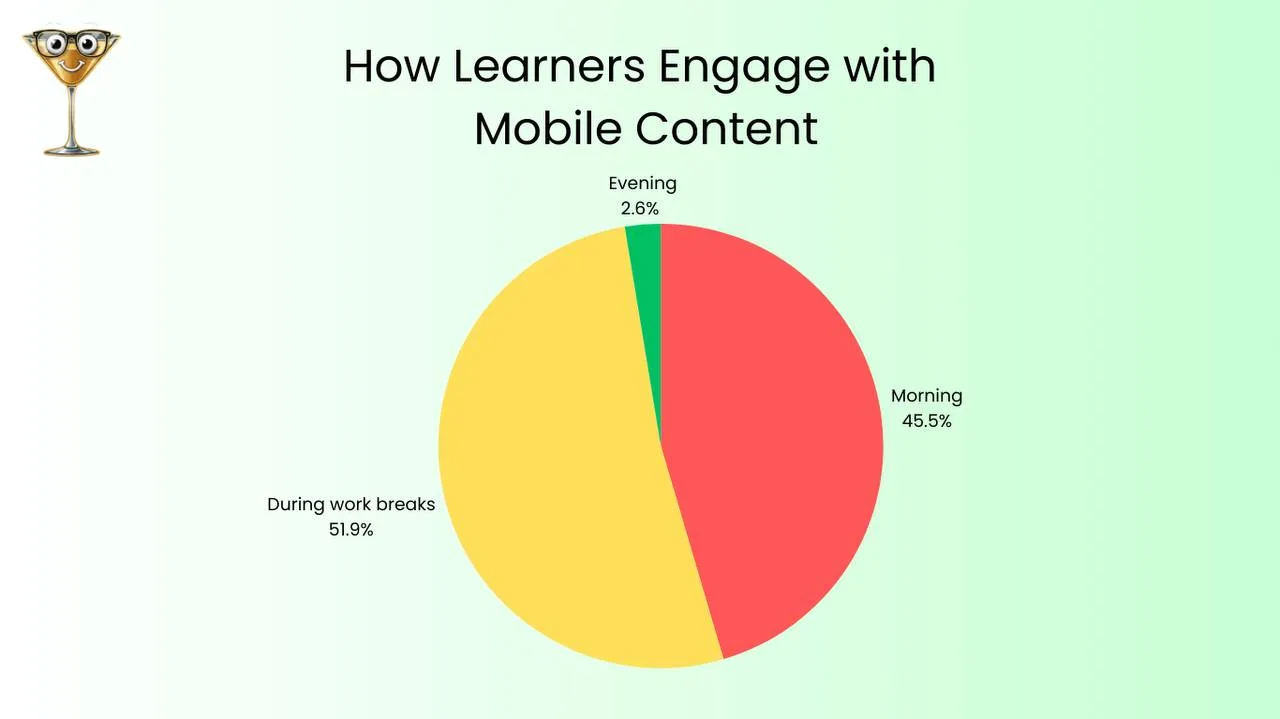
Nowadays, a smartphone is more than a simple calling device; it is a kind of cognitive aid. Mobile technology in conjunction with micro-content gives rise to "just-in-time" learning, which means the acquisition of a new skill only at the moment when it is required for the task.
Learning in the Flow of Work
Most traditional LMS (Learning Management Systems) are generally designed for compliance purposes and are detached from the daily work routine. If a user wants to find some information, he has to open a portal, look through a directory and take a generic course. On the other hand, smartphone education is always available for the learner wherever he may be.
- Morning and Night Habits: It has been found that over half of the learners choose to engage with mobile content either immediately after waking up or right before going to bed.
- The "YouTube" Effect: When facing a technical challenge, today's workers quickly look for short videos that can assist them. A corporate microlearning app helps in this manner by providing "manager-approved" short videos.
Engagement and Push Notifications
Push notification is one of the most valuable weapons in the mobile arsenal. Although considered as a source of distraction, these notifications when used properly can increase learner engagement by up to 88%. By sending a one-minute video reminder during a user's usual activity time, companies have seen monthly engagement rates achieving 92%.
Performance Metrics: Turning Knowledge into Productivity
Switching to mobile learning is not only about ease; it is a game for being radically efficient. The corporate bottom line impact is measurable:
- Productivity Gains: There has been a 130% productivity increase in organizations that have embraced micro-lessons.
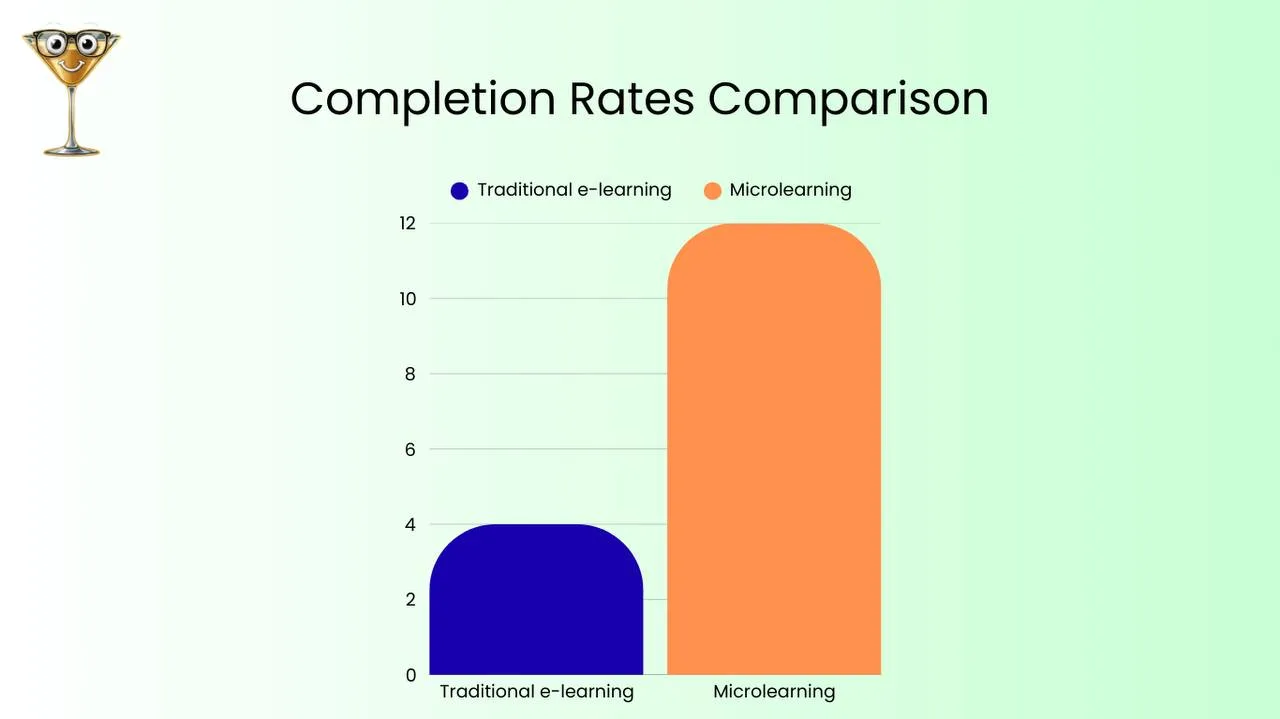
- Completion Rates: Microlearning modules can always boast completion rates of 80% to 90%, compared to 20% for traditional e-learning.
- Knowledge Recall: Users of advanced micro-apps admit they can recall 96% of the concepts even after 30 days.
Case Studies: Real-World Implementation
Walmart: Scaling Excellence
Walmart offered short and video-based training on topics like safety and customer service. The outcomes: Test scores increased by 15%, and time spent off the sales floor was cut down by 40%.
Unilever: Global Standardization
Unilever resorted to mobile micro-modules to maintain the global standard of compliance, achieving a 90% completion rate across 190 countries.
Google: The G2G Model
Google's "Googler-to-Googler" program focuses on social and peer-to-peer learning, achieving a participation rate of 80% in six months.
Ricco: Gamified Financial Literacy
While corporate training dominates the microlearning space, personal development apps are proving equally powerful. Ricco demonstrates how gamification and simulation-based learning can teach complex financial concepts through bite-sized, risk-free experiences. By letting users choose careers, manage budgets, and build wealth in a realistic simulation, Ricco turns abstract financial education into hands-on practice—proving that microlearning works just as well for life skills as it does for professional development.
Strategic Implementation: How to Begin
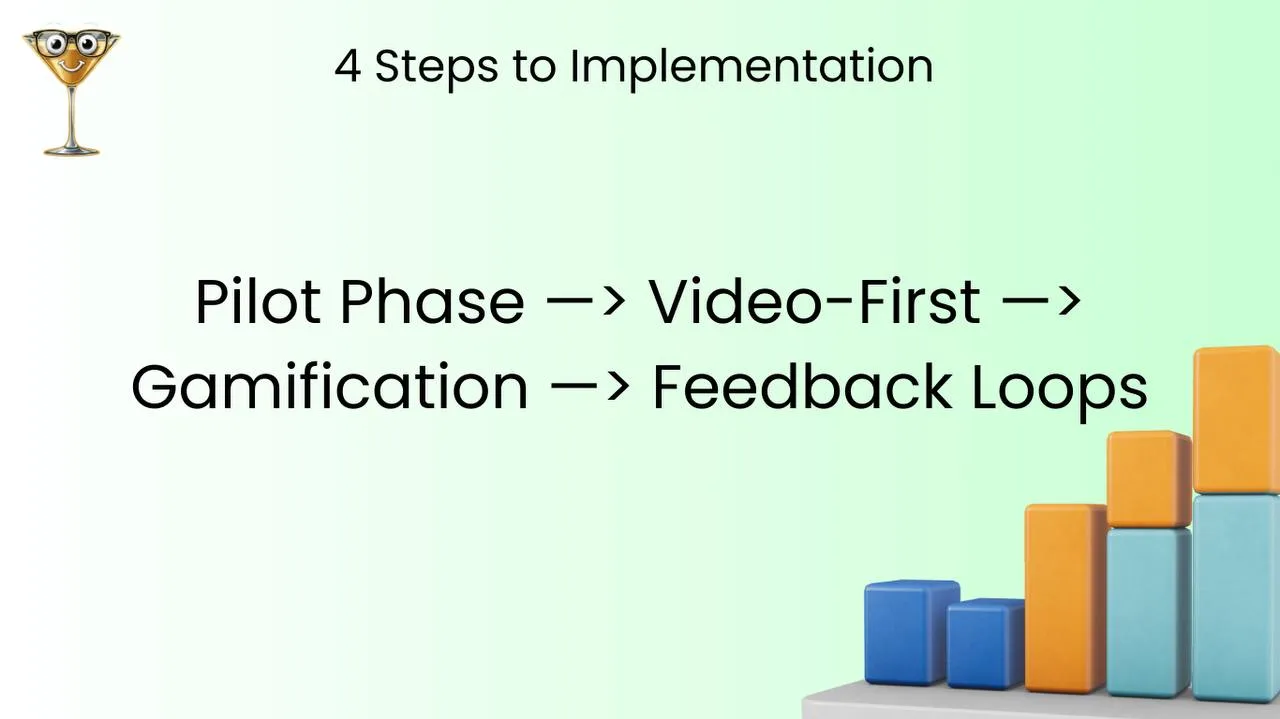
- The Pilot Phase: Singling out a high-risk or high-impact area, like workplace safety or new hire onboarding.
- Video-First Content: "User-generated" content can be a great source where top-performing employees share "pro-tips".
- Gamification and Rewards: Introduction of leaderboards, streaks, and digital badges to make training a daily routine.
- Immediate Feedback Loops: A 1-2 question quiz should follow every module to prompt active learning.
The Social Learning Catalyst: Beyond Individual Progress
Individual mastery may be the foundation of professional growth, but a microlearning app's real potential is achieved when it gets support from communal knowledge. This is called social learning and it is based on the idea that people learn the best by watching and copying their peers.
The Traditional LMS Autopsy: Why It Stalls in a Mobile World
Most existing schemes are heavy on compliance and are built for the desktop era. They work on a "just-in-case" basis. On the other hand, a contemporary microlearning app follows a "just-in-time" principle, offering point-of-need accessibility and momentum retention.
Conclusion: Embracing the 2025 Learning Paradigm
The companies that will be successful are the ones that treat learning not as a rare event, but as a continuous, everyday habit. By embedding mobile learning into the workday, organizations can develop a team that is more flexible, more motivated, and, by far, more efficient. For a comprehensive comparison of the best microlearning platforms available, check out our guide to the best microlearning apps in 2026.
Every NerdSip course clears a four-layer fact-checking pipeline before it reaches the app: grounded in live sources, scored nightly, gated on failure, and reviewable by a person at one tap. Articles on this blog are drafted with AI assistance, then researched, verified, and edited by our team.
Editorial responsibility: ai51 UG (haftungsbeschränkt). Responsible editor named in the imprint.
📚 Keep Learning
Explore the NerdSip learning hubs
The blog is our editorial layer. When you want to move from reading into doing, these hubs organize the rest of NerdSip by format, including the app itself and the press that has written about it.
Ready to Level Up?
Turn your screen time into knowledge. Download NerdSip and start learning in just 5 minutes a day.
4.7 stars from 510 reviews · 10,000+ learners