You're about to level up. Everything is aligned. The opportunity is there. You're ready. Then you self-destruct.
You're one day away from launching your business and you pick a fight with the person supporting you. You're finally in a good relationship and you create drama for no reason. You're about to get promoted and you miss the critical meeting. You're on a diet and you binge right before the weigh-in.
It's like you have a self-destruct button and you can't help but press it right before the finish line.
Here's what you don't realize: this isn't random. This isn't weakness. This isn't bad luck. This is self-sabotage. And it's a protection mechanism your brain has been using since childhood.
It's kept you safe from disappointment. It's kept you invisible. It's kept you in control.
The problem is, it's also kept you stuck.
In 2026, understanding why you sabotage yourself is the difference between staying trapped and finally breaking through. Because self-sabotage isn't something you overcome with willpower. It's something you understand, then interrupt.
This article teaches you exactly how.
The Mismatch: Why Your Brain Sabotages You
The conscious mind wants success. Wants the relationship. Wants the promotion. Wants the health.
The subconscious mind is scared of it.
Self-sabotage is a result of a mismatch between your values and your behavior. When you force yourself to do something that goes against your beliefs or values, you experience a sense of imbalance. Deep down, you often try to restore this balance by changing your behavior in secret ways that give you an excuse.
This is called cognitive dissonance. And your brain will do everything possible to get rid of it.
The dopamine you get from goal-setting is genuine. However, when it is time to complete the goals, the fear of failure leads to avoidance behavior. In a subconscious way, you start to distance yourself from your goals. This is called the approach-avoidance conflict.
So, you get the dopamine hit from planning. But when it is time to execute, fear takes over. And your brain finds a way to sabotage you before failure can happen on its own.
Because here is the truth: if you sabotage yourself, you are not a failure. You are someone who couldn't handle the challenge. That's different. That's safer for your self-image.
Your brain would prefer that you fail on your own terms rather than succeed and have to deal with what comes next.
The Five Sabotage Patterns
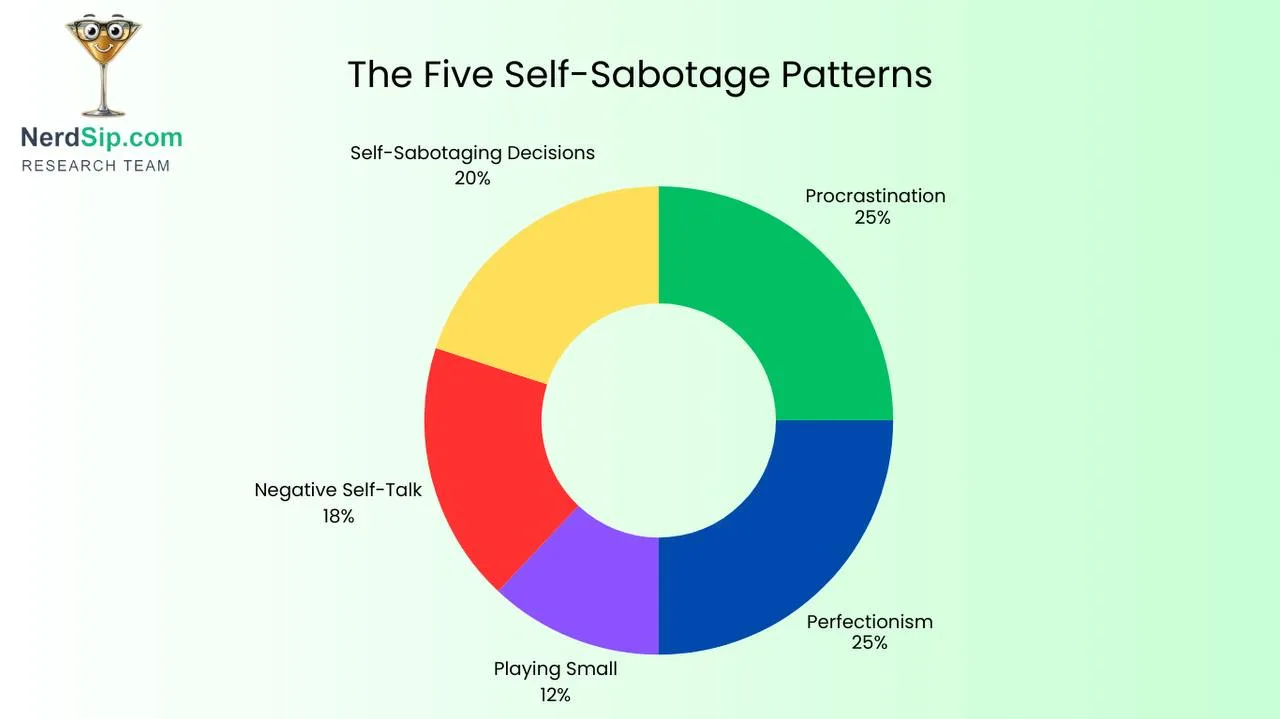
Self-sabotage can manifest differently. Procrastinating while being fully aware of the deadline. Engaging in negative self-talk that destroys motivation. Giving up on projects halfway. Creating problems in relationships when everything is going well.
These patterns trap you in the familiar, even if the familiar is not good for you.
Which pattern grips you is not random. A Big Five personality test shows the traits behind it, since perfectionism and playing small come from different places.
Pattern 1: Perfectionism
You create unrealistically high expectations. Not because you aim for excellence. But because impossible standards ensure failure. So that you can say "I could have done it if it were easier," instead of "I'm not capable."
Pattern 2: Procrastination
You leave everything for the last minute. Not because you can do better under pressure. But because working at the last minute gives you an excuse if it fails. "I only had one day to do this."
Pattern 3: Self-Sabotaging Decisions
You do strange things leading up to your big moment. Going to bed late the night before your presentation. Saying something offensive before the interview. Creating conflict before a relationship getting too serious.
It is not by chance. It is strategic. It is sabotage.
Pattern 4: Negative Self-Talk
You convince yourself that you are not good enough. Not ready. Going to fail anyway. Your inner critic enjoys using words like "never," "always," and "can't," but now is the time to challenge it.
Pattern 5: Playing Small
You don't even make the effort. You put yourself down before even starting. You remain invisible. Not applying for the job. Not asking for the date. Not starting the business.
Playing small is the most secure sabotage. If you never try, you will never fail.
The Root: What Are You Really Afraid Of?
The real question is: What are you really afraid of?
It is not failure. Fear of success is often twice as big as fear of failure.
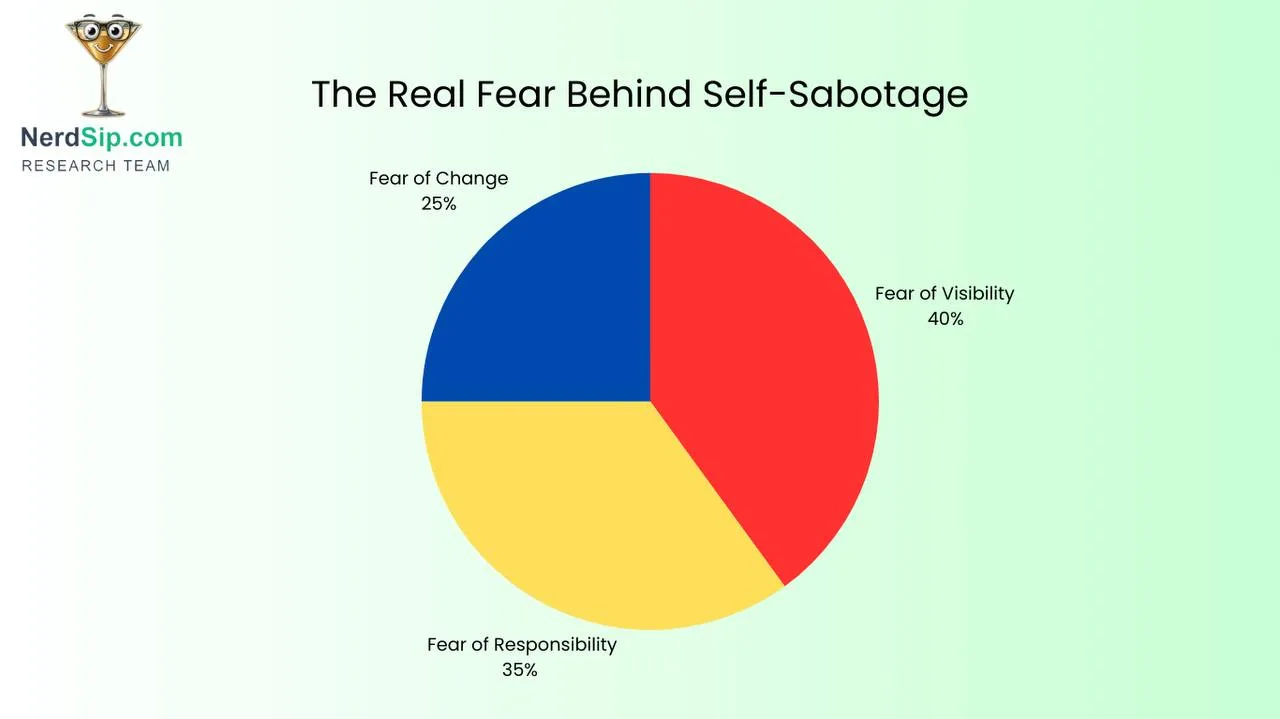
Success means change, responsibility, and being seen. If your mind thinks that "being safe means being invisible," you will, without realizing it, sabotage your chances of being noticed.
Success means:
- More people will expect things from you
- You will have to keep the new level
- You will be seen and vulnerable
- Things will change and you will lose what's familiar
- You may let down people who believe in you
So your brain sabotages. It is better to be invisible and safe than to be visible and expected to keep the level.
This is the root. Not laziness. Not weakness. Fear of the responsibility that comes with success.
The Interrupt: How to Stop the Self-Destruct Button
You can't stop what you don't see. So the first step is being aware of it. Self-sabotaging is sabotage that happens on autopilot. You have to interrupt the pattern.
When you feel the urge to procrastinate or to take your anger out on someone, stop. Ask yourself: Is this action helping my higher self, or is it feeding my fear?
That one question disables the autopilot. It makes you realize that you are doing something.
Then comes the reframe. Your inner critic loves to use words like "never," "always," and "can't." Instead of "I'll never be good enough," say "I'm a work in progress—just like literally everyone else."
Notice that you are being overly dramatic in your head and laugh it off. Humor helps. It makes self-criticism less harsh.
Then comes micro-action. Don't try to transform everything. Break big goals into bite-sized actions. Celebrate progress—however small.
Specific, Measurable, Achievable, Relevant, Time-bound goals reduce overwhelm and sabotage.
When the goal is smaller and you see progress daily, your brain stops fearing it. It becomes manageable. It becomes real.
The Micro-Learning Advantage
Here's what's interesting: you can interrupt self-sabotage patterns through daily awareness exercises with micro-lessons.
Instead of trying to fix everything at once, you work on one pattern per week.
- Week one: identify your sabotage pattern
- Week two: notice when it appears
- Week three: interrupt it
- Week four: reframe it
Daily 5-minute lessons on recognizing sabotage, understanding your fears, and building awareness help build real capability. You're not just learning theory. You're building the muscle of catching yourself before you self-destruct.
And because you're doing it daily in small doses, you actually interrupt the pattern. You see it coming. You pause. You choose differently.
By day 30, you're not sabotaging as much. By day 60, you've broken the pattern. By day 90, you've built new neural pathways.
The 30-Day Self-Sabotage Interruption Protocol
Week 1: Identify Your Pattern
Which of the five patterns is yours? Perfectionism? Procrastination? Negative talk? Playing small? Creating drama?
Write it down. Be specific about how it shows up.
Week 2: Catch Yourself
This week, just notice. Every time you sabotage, notice it. Don't judge. Just observe.
You'll be shocked how often it happens. Three times a day? Five? More?
Week 3: Ask the Question
Whenever the urge to self-sabotage arises, take a moment to stop and ask yourself: "Is this serving my highest self or just feeding my fear?"
Simply posing the question changes everything. You are no longer on autopilot—you make a conscious choice.
Week 4: Reframe and Act Small
Exchange the old habit for a new one. Instead of perfectionism, simply aim for finished. Instead of procrastination, start just a little. Instead of negative self-talk, turn it around and say, "I'm a work in progress."
Then do the small thing. One small action that breaks the pattern.
By the time you reach day 30, you have broken the pattern that you have been following for your whole life. You can anticipate it. You're choosing differently.
The Real Payoff
When you stop sabotaging yourself, everything changes.
You really achieve your goals. Not because you are more intelligent or diligent. But because you are no longer stopping yourself.
People do not hide their admiration. They see you taking action. They see you growing. They start trusting you.
More than anything, you start trusting yourself. You show yourself that you are capable of success. That being visible does not scare you. That taking responsibility does not weigh on your shoulders.
You understand that success is not the problem. The real problem was that you were stuck all along.
Stop Pressing the Button
You have pressed that self-destruct button so many times that it now seems normal. As if you were just unlucky. Or not meant for success. Which you are.
It is just that you have a quite strong protection mechanism.
This week, catch it. Identify a moment when you are about to sabotage yourself. Ask the question. Make a different choice.
That is all. One moment. One different decision.
Do that every day for 30 days and the pattern breaks. Not because you're stronger. But because you're finally aware.
And awareness is the real superpower.
Stop sabotaging. Start succeeding.
Every NerdSip course clears a four-layer fact-checking pipeline before it reaches the app: grounded in live sources, scored nightly, gated on failure, and reviewable by a person at one tap. Articles on this blog are drafted with AI assistance, then researched, verified, and edited by our team.
Editorial responsibility: ai51 UG (haftungsbeschränkt). Responsible editor named in the imprint.
📚 Keep Learning
- The Self-Awareness Gap: Why You're Not as Self-Aware as You Think
- How to Build Unbreakable Self-Discipline in 60 Seconds a Day
- The Nervous System Reset: How to Calm Your Mind in 60 Seconds
Explore the NerdSip learning hubs
The blog is our editorial layer. When you want to move from reading into doing, these hubs organize the rest of NerdSip by format, including the app itself and the press that has written about it.
Ready to Level Up?
Turn your screen time into knowledge. Download NerdSip and start learning in just 5 minutes a day.
4.7 stars from 510 reviews · 10,000+ learners