
You want to change. You know what you should be doing. You keep telling yourself that tomorrow everything will be different. Tomorrow you'll work out every day. Tomorrow you'll stop procrastinating. Tomorrow you'll learn that skill. Tomorrow you'll be the person you want to be.
Tomorrow arrives. You are motivated for two days. Then life happens. You miss a workout. You procrastinate on something important. You don't open that course. By week two, you're back to normal. That initial motivation is gone.
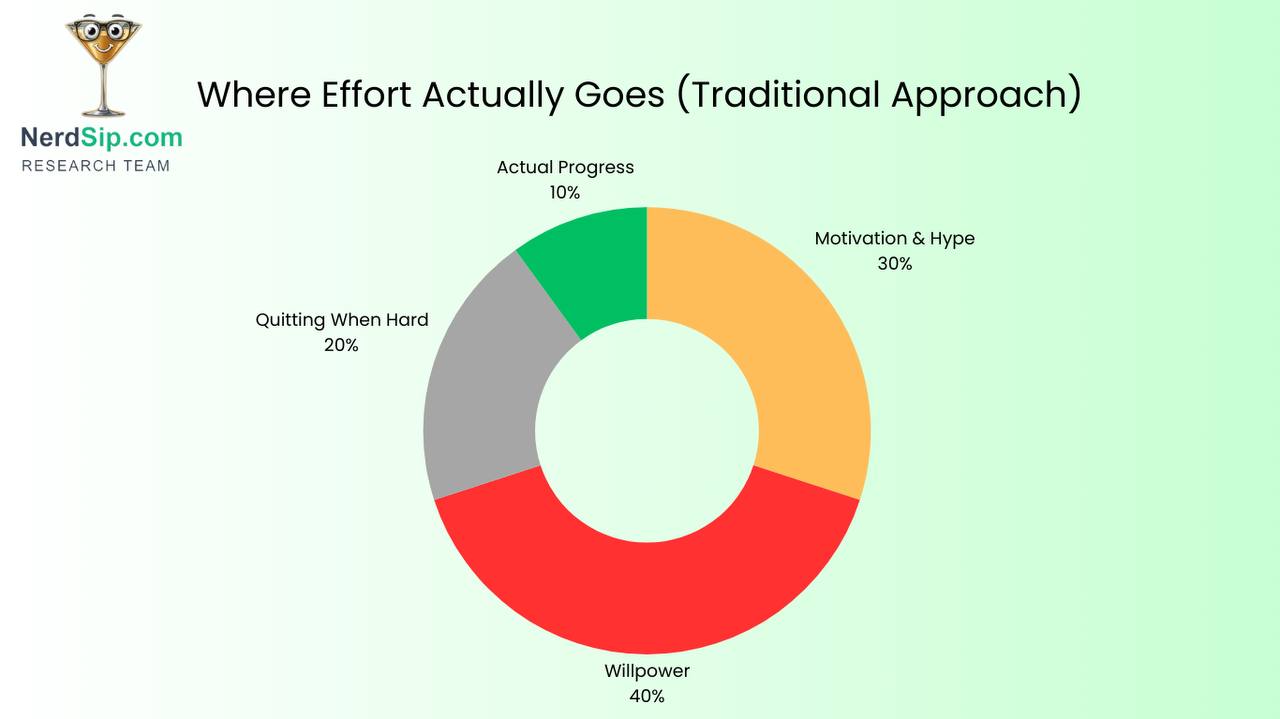
This is the reason why most people fail to change. They try to change too much at once. They go from zero to one hundred. They expect themselves to become a different person overnight.
It doesn't work. Not because they lack willpower. Not because they're lazy. It's because a massive change requires willpower. And willpower is a limited resource that gets depleted.
But small change? Tiny change? That doesn't require willpower. It requires a different approach altogether.
The Math That Changes Everything
Here's a simple mathematical principle that most people miss: tiny improvements compound.
If you improve by just 1% every single day, that doesn't sound like much. One percent. Barely noticeable. Who cares about 1%?
Mathematics does.
If you are at 100 and you improve by 1% every day, then after one week you are at 107. After one month you are at 137. After six months you are at 181. After one year you are at 3,778.
One year. One percent per day. You have become 37x better. It's not motivational speak. It's exponential mathematics.
The inverse holds as well. A daily degradation of 1% would leave you almost without value after a year. Nevertheless, this is the manner in which the majority of people treat change. They miss a day. They consider themselves to have failed. Hence, they return to the starting point. The day after, they are even worse than the baseline because they have lost their momentum.
The secret is to be consistent. Not a certain intensity. Not abrupt and massive changes. Consistency in minute increments.
Most of the self-help literature is missing this point. It markets to you the 30-day transformation. The complete life overhaul. The extreme diet. The wake-up-at-5am protocol. These are things that require a huge amount of willpower. Most people are not able to sustain them.
But 1% better every day? That's doable. Your brain is capable of handling it. It doesn't feel difficult because it isn't. It's just a little bit different from what you're doing now.
And that little bit, done every day, becomes magnificent after a long period of time.
Small Habits Change Your Brain Structure
There is a reason why small habits are effective. It is neuroscience, not just a philosophy.
When you do the same thing regularly, your brain decides to do it automatically. Neural pathways get stronger. What used to be done with a conscious effort becomes automatic. You are in fact changing the structure of your brain by doing the same thing over and over again.
But this is the crucial point: the brain only goes through the process of automation for things that are small enough for it to sustain. If something is too big, you won't keep doing it. You'll give up. The neural pathways never get stronger.
Suppose it is your intention to "exercise more." That statement is too vague. Your brain has no clue what to do with it. You need something that is smaller: "Do 10 push-ups every morning." Ten push-ups is so small that it almost seems like it has no point. But it actually does. Because this is what you will really do. Every day. No exceptions.
You do not have to struggle with motivation to brush your teeth every day. You just do it. After doing 10 push-ups every morning for two weeks, something changes. Your brain no longer sees it as a conscious choice. It is automatic. You don't think about it. You just do it.
Since the habit has become automated, you are now able to expand it. It is very easy to add 5 more push-ups when you are already doing 10. You are not going to zero. You are going to momentum. This is the way change really works. Start ridiculously small. Automate it. Then build on it.
The Identity Shift: Becoming, Not Trying
Here is something even deeper than just repeating actions: these actions change your identity. You don't "try to work out." You are "someone who works out." This is totally different. The former one requires motivation every day. The latter is just who you are.
When you consistently perform your tiny habit, you are not merely changing your behavior. You are changing your identity. After only two weeks of doing 10 push-ups every morning, you begin to see yourself as "someone who exercises." That shift in identity is more powerful than willpower because it is not motivational. It is self-concept.
Then the interesting thing happens: once you see yourself as that person, you start making other decisions that are in line with that identity. Someone who exercises would also eat better, wouldn't he? Someone who exercises would sleep more. Someone who exercises would probably learn more about fitness. You are not forcing yourself. You are just being consistent with how you see yourself.
This is the reason why 1% better every day works. You are not trying to become a completely different person. You are just being 1% more like the person you want to become. That is easy. That is sustainable. And it triggers an identity shift that makes everything else easier.
The Micro-Learning Connection
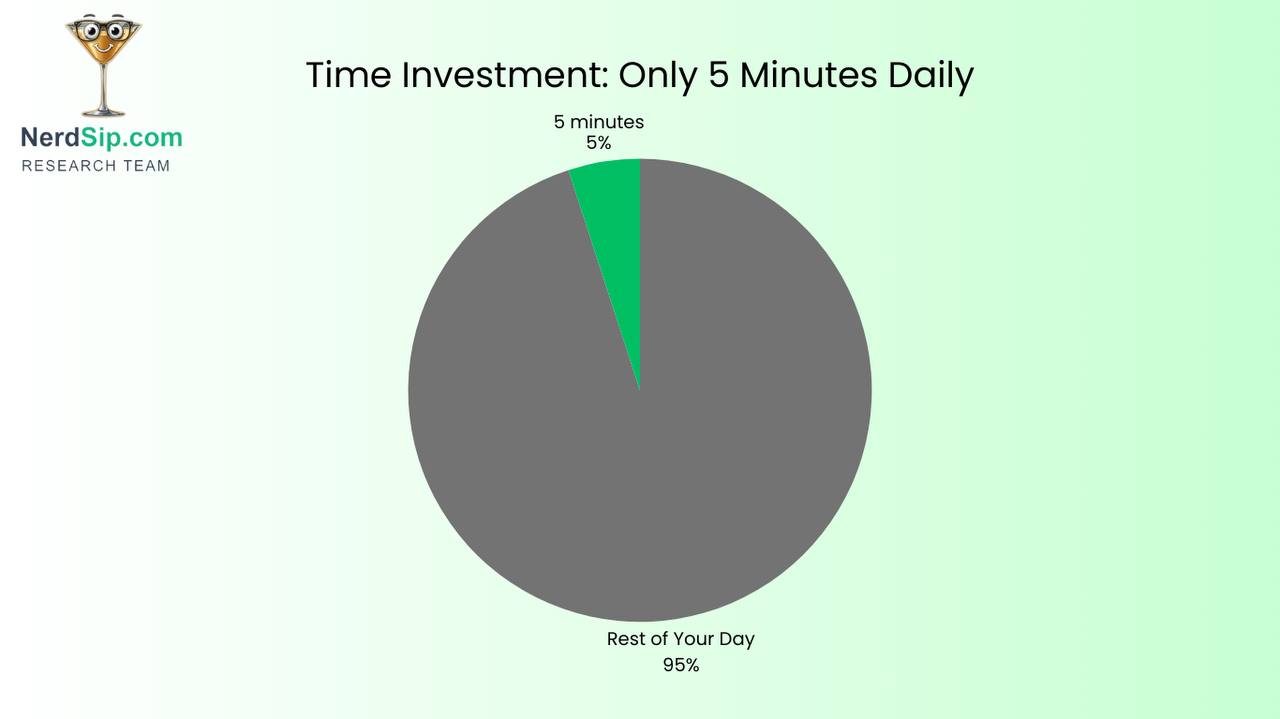
Here is where this becomes interesting for learning: micro-learning is the ideal implementation of the 1% formula. Rather than committing to a two-hour course that requires a lot of willpower to stay through, you commit to five minutes.
Five minutes of learning is so small that it does not trigger resistance. You can do it while brushing your teeth. You can do it on your commute. You can do it between meetings.
But the compounding effect is what makes it really interesting: five minutes a day adds up to 1,825 minutes in a year. That is more than 30 hours of laser-focused learning. Thirty hours. The vast majority of people never even complete one single 30-hour course. However, if you divide it into 5-minute pieces and do it every day, 30 hours suddenly becomes doable.
Platforms like NerdSip are based on this very principle. A 5-minute micro-lesson does not feel like "learning." It feels like a quick bit of knowledge. Your brain doesn't resist it. You actually complete it. And the spaced review intervals mean the information actually stays in your long-term memory instead of being forgotten by tomorrow.
The combination of the 1% formula with micro-learning causes the compounding to be almost unbelievable. Five minutes daily amounts to more than 30 hours of learning in a year. That's the equivalent of several certifications. But you never felt like you were "learning."
The Streak: Your Psychological Leverage
One of the most overlooked power plays of the 1% formula is the streak counter. Committing to something 50 days in a row generates a psychological "weight". People don't want to be the one that breaks that streak.
This is not shallow gamification, but rather behavioral psychology. When you have a streak going, breaking it is often equated to failure. On the other hand, continuing it is regarded as success. According to your brain wiring, consistency is what it seeks, thus a visible streak becomes very motivating and doesn't require any willpower.
This is the reason why leaderboards and progress tracking are important. If you have done a 5-minute learning lesson for 47 days straight, you will not skip the 48th day. You are invested. The streak has gotten off the ground.
The 30-Day Reality Check
Applying 1% better each day for 30 days results in the following reality:
- Day 1-7: You feel awkward. The new habit doesn't quite fit yet. You have to think of it, but you're doing it daily.
- Day 8-14: It becomes easier. You don't think about it so much. You are starting to see tiny results. Nothing big, but something.
- Day 15-21: It is happening almost automatically. You don't have to remind yourself. You simply do it. And the results are becoming visible.
- Day 22-30: Now, it's automatic. You are not doing it because you are motivated. You are doing it because that's who you are.
By day 30, you are not just 30% better. You are exponentially better. And since at that point it is automatic, it doesn't require willpower to keep it up. You simply do it. Then, you add another 1% habit. And another.
Start Now, Really Small
The thing is: you already know the concept. The question is whether you will apply it or not. Most people won't. They will read this, feel inspired, and then try to change too much. They will start a big habit, run out of willpower by week two, and feel like they have failed.
Don't do that. Start smaller than you think. If you want to exercise, don't start with "work out 5 days a week." Start with "do 5 push-ups after I brush my teeth." That's it. Five. You can do five push-ups.
If you want to learn something, don't commit to two-hour study sessions. Commit to five minutes. Just five minutes. Open a 5-minute lesson, learn something, and you're done. If you want to be more confident, don't try to change your entire mindset. Do one 5-minute lesson on confidence daily. Show up. Build the streak. Let the tiny lessons compound.
The 1% formula works because it is sustainable. Start so small that you can't fail. Do it daily. Build the streak. Watch it compound.
Ready to Start Your 1% Journey?
Join thousands of learners who are building their skills in just 5 minutes a day with NerdSip. Start small, stay consistent, and watch the results compound.
Join the Waitlist →