Designing a microlearning lesson is not the same as shortening a normal lesson.
If you take a 60-minute lecture, cut it into twelve five-minute clips, and call it microlearning, you may have made shorter content. You have not necessarily made better learning.
A good microlearning lesson is atomic. It has one outcome, one core idea, one example, one recall prompt, and one tiny action. That structure gives the learner a complete rep instead of a content fragment.
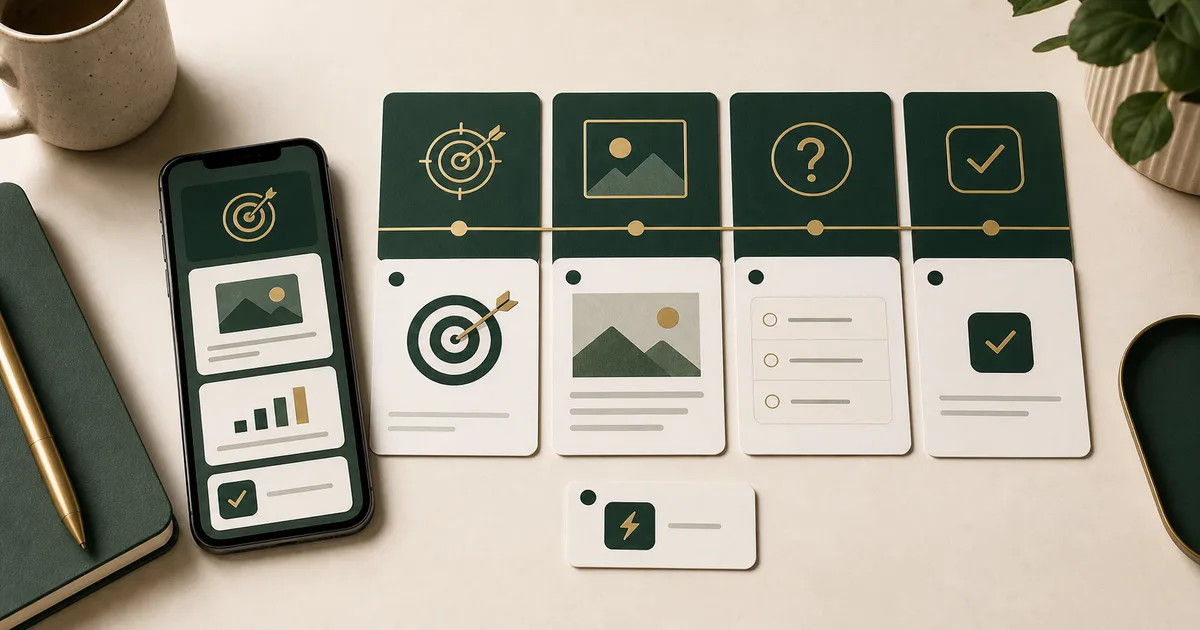
The Atomic Lesson Template
Use this template whenever you design a microlearning lesson:
- Outcome: After this lesson, the learner can do what?
- Concept: What one idea do they need?
- Example: What concrete situation shows the idea?
- Recall: What question forces them to retrieve it?
- Action: What tiny real-world step can they take?
- Review: When should they see it again?
This structure works for workplace training, personal learning, app lessons, onboarding, compliance, communication skills, and general knowledge.
Step 1: Write the Outcome First
A topic is not an outcome. Negotiation is a topic. Ask one constraint-finding question in a negotiation is an outcome.
Excel is a topic. Use SUMIF to total values that match one condition is an outcome. Public speaking is a topic. Open a talk with a problem statement instead of an apology is an outcome.
The narrower the outcome, the easier the lesson becomes. If you cannot write the outcome in one sentence, the lesson is probably too large.
Step 2: Remove Everything That Does Not Serve the Outcome
Microlearning requires editorial discipline. Most lessons become bloated because the creator wants to include context, history, edge cases, terminology, and related advice.
Some of that may be useful later. It does not all belong in this lesson.
Ask: does this sentence help the learner perform the outcome? If not, move it to another lesson or remove it.
Step 3: Teach One Concept Clearly
The concept is the mental model behind the action. If the learner only copies a step, they may not know when to use it. If they understand the concept, they can adapt.
For example, in a lesson about active listening, the concept might be: people feel heard when you reflect meaning before adding your own opinion. That concept supports many actions: summarizing, asking follow-ups, naming emotion, and pausing before advice.
Step 4: Give One Strong Example
Examples are where microlearning becomes concrete. A short lesson cannot afford vague inspiration.
Weak example: communicate better in meetings. Strong example: when someone says the deadline is unrealistic, reply with: What constraint is creating the biggest risk?
The learner should see exactly what the idea looks like in the real world.
Step 5: Add a Recall Prompt
A recall prompt turns content into memory work. It should be answerable without looking back.
Good prompts include: What is the rule? What is one example? What is the difference between these two options? When would you use this? What mistake does this prevent?
Do not make every prompt a trivia question. The best prompts connect directly to use.
Step 6: Add One Tiny Action
The action is the bridge between lesson and skill. It should be small enough to do today.
For a writing lesson: rewrite one sentence. For a finance lesson: calculate one number. For a social skill lesson: ask one follow-up. For a coding lesson: write one function. For a health lesson: identify one meal pattern.
If the action is too big, the learner will postpone it. If it is tiny, they can complete the rep immediately.
Step 7: Schedule Review
One exposure is not enough. Add a review prompt after a delay.
The review does not need to repeat the whole lesson. It can ask: what was the idea, and where did you use it? This brings active recall and application back into the loop.
Before and After Example
Bad micro lesson: Here are seven tips for better meetings. It lists agendas, timeboxing, action items, facilitation, note-taking, decision logs, and follow-ups.
Atomic version: After this lesson, the learner can end a meeting with one clear owner and deadline. Concept: decisions vanish when ownership is vague. Example: replace we should follow up with Alex owns the draft by Friday. Recall prompt: what two details must every action item include? Tiny action: rewrite one current task with owner and deadline.
The atomic version is smaller, but it is more usable.
A Template You Can Copy
Title: Use an action phrase.
Outcome: After this lesson, you can...
Why it matters: One sentence.
Concept: One mental model.
Example: One realistic scenario.
Try it: One tiny action.
Recall: One question.
Review: One delayed prompt.
Quality Checklist
- Can the learner finish in under 10 minutes?
- Is there only one outcome?
- Is the example concrete?
- Does the learner retrieve something?
- Is there an action outside the lesson?
- Is there a review later?
- Would this still make sense on a phone?
Design for One Reader Moment
A microlearning lesson should be designed around the moment in which it will be used. A lesson someone takes before a sales call needs a different shape from a lesson someone takes while studying for an exam. A lesson inside onboarding needs a different shape from a curiosity lesson about black holes.
Ask: where is the learner, what are they trying to do, and what friction are they facing? If the learner is anxious before a meeting, the lesson should be direct and actionable. If the learner is exploring a new topic, the lesson can start with curiosity and orientation. If the learner is reviewing for a test, the lesson should prioritize recall and error correction.
The Five Bad Microlearning Patterns
1. The chopped webinar
This is a long lecture cut into shorter clips. It is shorter, but not redesigned. The learner still has no clear outcome, no recall prompt, and no action.
2. The inspirational tip
This feels good but teaches little. "Communicate clearly" is not a lesson. "Put the decision request in the first three lines" is a lesson.
3. The overloaded card
This tries to teach seven related ideas at once. It looks efficient, but the learner leaves with a blur.
4. The trivia trap
Facts can be useful, but a lesson should make clear why the fact matters and what the learner can do with it.
5. The quiz-only lesson
A quiz can reinforce learning, but if it appears without explanation, examples, or feedback, it becomes guessing.
The Atomic Lesson Template in Detail
Outcome: Write a sentence that starts with a verb. "Identify confirmation bias in a decision" is stronger than "understand confirmation bias." Verbs keep the lesson honest.
Concept: Teach the smallest mental model that supports the outcome. Do not dump background. The learner needs enough to act, not enough to pass as an expert.
Example: Use a realistic scenario. The example is where the lesson becomes memorable. If the lesson is about feedback, show the sentence. If it is about code, show the pattern. If it is about finance, show the calculation.
Recall: Ask for retrieval, not recognition. "Which option is correct?" can work, but "explain the rule in your own words" is often stronger.
Action: Give one tiny next step. Make it small enough that the learner can do it before motivation fades.
Review: Bring the idea back later with a variation, not just a repeat. Variation teaches transfer.
Example: Designing a Lesson on Active Listening
Weak version: "Active listening is important. Maintain eye contact, nod, and ask questions." This is familiar and forgettable.
Atomic version: Outcome: reflect meaning before giving advice. Concept: people feel heard when you show you understood the point, not just the words. Example: if someone says, "I am tired of this project changing every week," reply, "It sounds like the constant changes are making it hard to feel progress." Recall: what should you reflect before advice? Action: use one reflection sentence today.
The atomic version is not longer. It is sharper.
Example: Designing a Lesson on AI Prompts
Weak version: "Write better prompts by being specific." True, but too vague.
Atomic version: Outcome: improve a weak prompt by adding role, context, task, and constraints. Concept: AI output improves when the model knows who it should act as, what situation it is in, what it must produce, and what limits matter. Example: turn "write an email" into "Act as a customer support lead. Write a calm 120-word email to a frustrated user whose refund is delayed. Acknowledge the issue, give the next step, and avoid blaming them." Recall: name the four prompt parts. Action: rewrite one prompt you actually use.
Quality Signals of a Good Lesson
A good microlearning lesson creates a small behavior change. The learner can explain the idea. The learner can recognize where it applies. The learner has one safe way to try it. The learner gets a check on whether they understood. The lesson points to the next lesson without pretending to be complete expertise.
How NerdSip Uses This Design Logic
NerdSip works best when a user asks for a topic that can be turned into atomic lessons. Instead of giving a giant explanation of negotiation, the app can break the topic into questions, framing, anchoring, listening, trade-offs, and practice checks. Instead of giving one long AI literacy article, it can build short lessons around prompts, hallucinations, model limits, verification, and use cases.
That is the point of microlearning design: not less content, but better sequencing.
Designing a Sequence, Not Just One Lesson
One atomic lesson is useful. A sequence of atomic lessons is where microlearning becomes a curriculum. The sequence should move from recognition to recall to application to variation.
For example, a course on negotiation might start with identifying positions versus interests. The next lesson teaches one question for uncovering constraints. The next gives a scenario. The next asks the learner to rewrite a weak response. The next reviews the concept in a different context. Each lesson is small, but the path is not random.
This is the difference between a pile of tips and a learning experience. Tips are interchangeable. A sequence builds capability.
Microlearning Design Checklist for Review
- Does the lesson title promise an action, not just a topic?
- Can the learner finish it on a phone without losing the thread?
- Is there exactly one main concept?
- Does the example look like a situation the learner might actually face?
- Does the recall prompt require memory, not guessing?
- Is the action small enough to do today?
- Does the next lesson build on this one?
If a lesson fails two or more of these checks, it probably needs redesign, not just editing.
How to Test a Lesson Before Publishing
Give the lesson to one person from the intended audience and watch where they hesitate. Do they understand the outcome? Can they explain the concept after one pass? Do they know what action to take? Does the example feel realistic? If they say "that makes sense" but cannot perform the recall prompt, the lesson is not done.
A quick user test is more useful than polishing language in isolation. Microlearning lives or dies in the moment of use. The learner either gets a small clear rep, or they get another nice-looking card that disappears from memory.
Design for Transfer
Transfer means the learner can use the idea in a new situation, not only repeat the original example. Add at least one variation when possible. If the lesson teaches a feedback sentence for managers, show one workplace example and one personal example. If it teaches a spreadsheet formula, show one sales table and one budget table. Variation helps the learner understand the pattern behind the example.
Final Design Rule
If the learner cannot say what they learned, answer one check, and take one tiny action, the lesson is not finished. It may be short, polished, and attractive, but it is not yet strong microlearning.
The Bottom Line
A microlearning lesson should feel small, but complete. It should give the learner one useful idea and one way to use it.
That is the atomic lesson: outcome, concept, example, recall, action, review. Use it and your short lessons become more than short content. They become repeatable learning reps.
Frequently Asked Questions
What is an atomic lesson?
An atomic lesson is a small lesson built around one clear learning outcome, one concept, one example, one recall prompt, and one action.
How long should a microlearning lesson be?
A microlearning lesson should usually take 3 to 10 minutes, but the real constraint is one clear objective per lesson.
What is the biggest microlearning design mistake?
The biggest mistake is cutting long content into short chunks without redesigning it around recall, application, and review.
Every NerdSip course clears a four-layer fact-checking pipeline before it reaches the app: grounded in live sources, scored nightly, gated on failure, and reviewable by a person at one tap. Articles on this blog are drafted with AI assistance, then researched, verified, and edited by our team.
Editorial responsibility: ai51 UG (haftungsbeschränkt). Responsible editor named in the imprint.
📚 Keep Learning
Explore the NerdSip learning hubs
The blog is our editorial layer. When you want to move from reading into doing, these hubs organize the rest of NerdSip by format, including the app itself and the press that has written about it.
Create short lessons people can actually use
NerdSip generates focused micro-courses on any topic and turns them into repeatable learning reps.
4.7 stars from 510 reviews · 10,000+ learners