If you have ADHD, you have probably been told to just focus, use a planner, and study harder. That advice fails because it treats an ADHD brain like a neurotypical brain with the volume turned down. It is not. It is a different attention system with different rules. Learn the rules and learning gets dramatically easier. This guide covers why traditional studying fights your wiring, the strategies with real evidence behind them, and the tools that help, with links to deeper guides on each piece.
Why learning feels harder with ADHD
ADHD is not a knowledge problem or an intelligence problem. It is an executive function problem. Executive functions are the brain's management layer: starting tasks, holding information in working memory, resisting distraction, and switching gears on purpose. Learning leans on all four at once, which is why a lecture or a textbook chapter can feel like running uphill in sand.
Underneath sits dopamine. ADHD brains regulate it differently, which changes what feels doable. A boring-but-important task offers no dopamine now, so the brain refuses to engage, no matter how loudly you tell yourself it matters. This is also why you can forget a lecture within minutes yet recall every detail of a topic you love. The memory hardware works fine. The gatekeeper is picky.
The interest-based nervous system
Dr. William Dodson coined a phrase that explains most ADHD learning struggles: the interest-based nervous system. Neurotypical brains engage with tasks based on importance and rewards. ADHD brains engage based on four different triggers:
- Interest. The topic is genuinely fascinating right now.
- Novelty. It is new, surprising, or different from yesterday.
- Challenge. It has a game-like difficulty that provokes you.
- Urgency. The deadline is tonight.
Every effective ADHD learning strategy is a way of smuggling one of these four triggers into material that lacks them. Once you see that pattern, you can stop copying study systems built for other brains and start engineering your own. Our deep dive on how to learn with ADHD when you can't focus walks through this in detail.
The strategies that actually work
These are the tactics that come up again and again in both research and the ADHD community, because they align with the wiring instead of fighting it.
1. Shrink the unit of work
The hardest moment is starting. So make the thing you are starting tiny: one page, one flashcard deck, one five-minute lesson. Momentum is easier to keep than to create, and a small unit finished beats a large unit avoided. This is the core reason microlearning works so well for ADHD brains: every session is short enough to start and delivers a completed-it dopamine hit at the end.
2. Sprint, then move
Forget the two-hour study block. Set a timer for 10 to 25 minutes, work with full permission to stop when it rings, then take a real break that involves moving your body. Movement is not a reward; it is part of the method. Exercise measurably improves attention in ADHD, and a walk between sprints buys back focus for the next one.
3. Test yourself instead of rereading
Rereading and highlighting feel like studying but produce almost nothing, for any brain. For ADHD brains they are doubly bad, because passive input invites drift. Active recall, closing the material and retrieving the answer from memory, forces engagement and doubles as a game. Quizzes, flashcards, and explaining a concept out loud all count. Our guide to the best study methods for students with ADHD ranks these techniques and shows how to combine them.
4. Borrow another person's presence
Body doubling, working quietly alongside someone else in person or on a video call, is one of the strangest and most reliable ADHD tricks. The other person does nothing, and somehow starting becomes possible. Study groups, libraries, and cafes work for the same reason.
5. Externalize everything
Working memory is exactly what ADHD taxes most, so stop using it as storage. Notes, capture apps, visible checklists, and phone reminders are not crutches. They are the correct architecture. The rule: if it matters, it goes somewhere outside your head within ten seconds.
The phone: your biggest rival and your best tool
The device in your pocket is engineered to win exactly the dopamine auction your textbook keeps losing. ADHD brains are especially vulnerable to infinite feeds, which is why doomscrolling hits so much harder with ADHD; we unpack the mechanism in ADHD and doomscrolling.
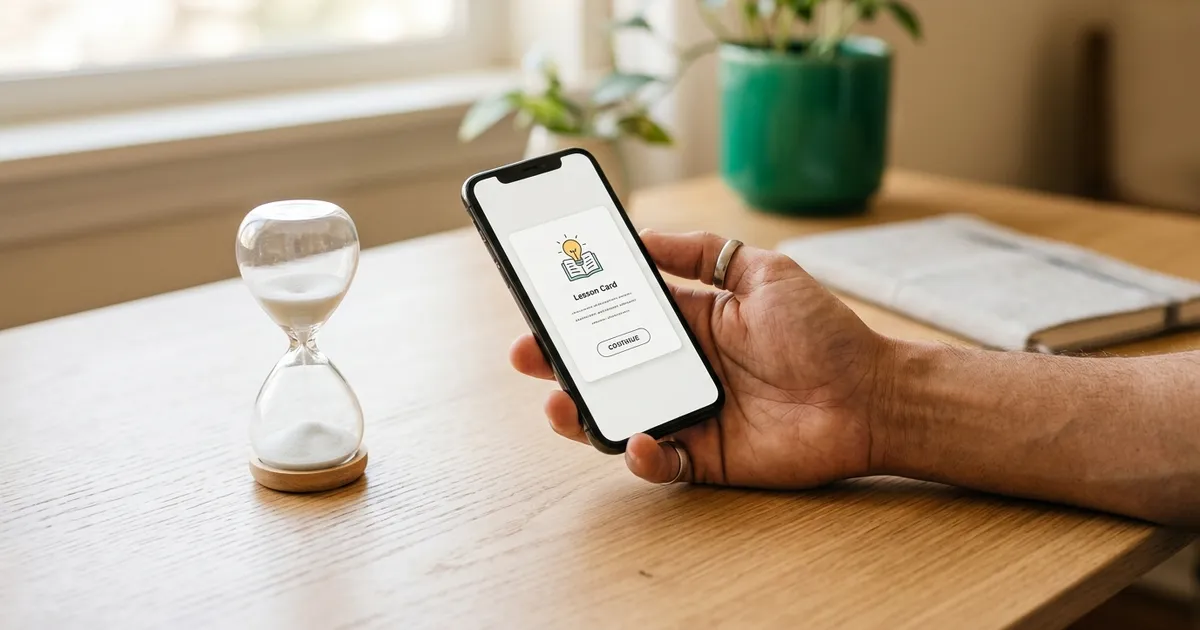
But the same properties that make the phone dangerous make it the best delivery system for learning an ADHD brain has ever had: novelty on tap, instant feedback, and zero setup cost. The move is not less phone; it is a rigged phone. Put the learning apps where the social apps used to be, and let the path of least resistance point somewhere useful. Our roundup of the best learning apps for adults with ADHD compares the options honestly, including where each one falls short.
NerdSip was built almost embarrassingly close to this spec: pick anything you are curious about, get a five-minute gamified lesson, answer quiz questions with instant feedback, keep a streak if streaks motivate you. Novelty, challenge, and quick wins, which is three of the four interest-based triggers in one loop. A good starting point is the course on learning faster.
Hyperfocus: the superpower with a bill attached
ADHD attention is not weak; it is unregulated. When a topic locks in, you can learn for six hours straight and love every minute. Use those windows when they open. But hyperfocus is weather, not climate. It arrives on its own schedule and often leaves just as fast. Build your baseline on small daily sessions that work in any weather, and treat hyperfocus as a windfall rather than a plan.
If you are not sure it is ADHD
Plenty of focus problems are not ADHD: chronic short sleep, phone habits, stress, and untrained attention produce similar symptoms. If that might be you, start with our guide to why you can't focus when studying, which covers the full list of causes and fixes. And whether or not ADHD is in the picture, a short attention span is workable; our guide on how to improve attention span has a 30-day training plan and a section on learning with a short attention span.
If focus struggles are seriously disrupting your work or studies, talk to a clinician. Strategies help enormously, but they are not a substitute for a proper evaluation and treatment plan.
Quick reference: what is actually going wrong
Most ADHD study advice fails because it treats the symptom. Find your problem in the left column and fix the real thing instead.
| What it feels like | What is actually happening | What to do instead |
|---|---|---|
| "I cannot make myself start" | The task offers no dopamine now, so the brain will not engage | Shrink it until starting is trivial. Two minutes, one card, one page |
| "I read the page four times and got nothing" | Passive input, no retrieval, attention drifted after line two | Close the book and say the answer out loud before checking |
| "I keep losing my place" | Working memory is overloaded and using itself as storage | Write it down within ten seconds. Every time, no exceptions |
| "I studied for four hours and remember nothing" | Long blocks past the attention window are mostly performance | Sprint, break, move. Three good sprints beat four hollow hours |
| "I only work the night before" | Urgency is the one trigger the deadline supplies for free | Manufacture urgency earlier with short timers and hard stops |
| "I did great for a week and then stopped" | Novelty ran out, which was the thing carrying the habit | Rotate topics and formats on purpose before boredom arrives |
Engineer the environment, not the willpower
Willpower is the least reliable tool in an ADHD toolkit, and it is the one most advice tells you to use. Environment is more reliable, because it works even on the days you do not.
The principle is friction. Whatever you want to happen should be close to zero effort to start, and whatever you want to avoid should cost several deliberate steps. That means the book already open on the desk, the app already on the home screen, the tab already loaded. It also means the phone in another room, the notifications off at the system level rather than the app level, and the browser signed out of whatever eats your afternoon.
Do this once, properly, and it keeps paying. Rely on deciding correctly in the moment and you will lose most of those moments, because the moment is exactly when an ADHD brain is least equipped to decide. Give yourself one great decision made in advance instead of forty small ones made under pressure.
One caveat worth naming: an environment that never changes stops working. Novelty is one of the four triggers, so a workspace that felt perfect in March can go flat by May. Move rooms, change the desk, work from a library for a week. Rotating the setting is not procrastination. It is maintenance.
A study session that survives an ADHD brain
Here is a session template that assumes you will get distracted rather than pretending you will not. Forty-five minutes, start to finish.
- Two minutes: decide and write it down. One sentence naming exactly what "done" looks like. Not "study biology". Rather "be able to explain the Krebs cycle without notes". Vague goals are unstartable.
- One minute: strip the desk. Everything off it except what this session needs. Phone out of the room, not face down.
- Fifteen minutes: first sprint. Timer visible. Full permission to stop when it rings, which is what makes starting possible.
- Five minutes: move. Stand, walk, stairs, anything with your body in it. Not your phone. The break exists to reset attention, and a feed does the opposite.
- Fifteen minutes: second sprint, retrieval only. No new input. Close everything and pull back what you just covered. This is the part that makes it stick, and it is the part everyone skips.
- Five minutes: capture the loose ends. Write down what you did not finish and what confused you. Future you starts from that note instead of from nothing, which removes tomorrow's hardest moment.
Two hours of this beats a whole day of the other thing. If forty-five minutes is too much today, run one sprint and stop. A short session completed is infinitely better than a long session abandoned, and it keeps the streak of evidence that you are someone who does this.
When you have already lost the day
This deserves its own section because it is where most ADHD study plans actually die. Not in the strategy. In the aftermath of a bad day.
The pattern is familiar. You plan a solid morning, lose it to something, and then the guilt arrives. The guilt does not produce work. It produces avoidance, which produces more guilt, and by evening the day is unsalvageable and tomorrow already feels contaminated. That spiral has cost people entire semesters.
The way out is unglamorous: make the re-entry point absurdly small. Not "catch up on the three sessions I missed". One card. One paragraph. Two minutes with a timer. The goal is not progress, it is breaking the story that you have failed and therefore cannot start. Once you have done two minutes, you are no longer someone who did nothing today, and that shift does more work than any amount of self-criticism.
It also helps to plan for this in advance, on a good day, when you are able to be generous with yourself. Decide now what your minimum looks like when everything goes wrong. Write it down. Then on the bad day you are following an instruction rather than making a decision, which is exactly the trade you want.
When everything is interesting and nothing gets finished
The opposite problem gets far less attention than it deserves. Some ADHD learners have no trouble starting at all. They start constantly. Six courses, four languages, a guitar, an unfinished novel about Byzantine history. Every one of them fascinating for eleven days.
Having many interests is not a symptom on its own. Plenty of people without ADHD live this way, and some call themselves multipotentialites. What matters clinically is impairment: whether the constant switching is costing you work, money or relationships.
Novelty is doing this. It is the same trigger that makes learning possible, running without a brake. The instinct is to respond with discipline, pick one thing and grind, which almost never survives the month.
A better move is to give the novelty somewhere legitimate to go. Keep one main thread you return to daily, however small the session, and one deliberately rotating slot where anything is allowed. The rotating slot absorbs the impulse instead of letting it hijack the main thread. You still get the thrill of a new rabbit hole every week. You just stop paying for it with the thing you actually wanted to finish.
Keep a list of everything you abandoned, too. Not as a monument to failure. Half of those topics come back around, and starting again from a note you already wrote is much cheaper than starting from zero.
Medication is not a study skill
If you are medicated, you have probably noticed something frustrating: the medication makes it possible to sit down, and then you sit down and still do not know how to study. That is not a failure of the medication. Treatment can open the window. It does not supply the method.
The strategies in this guide are the method, and they are worth building whether or not medication is part of your picture. People who have both tend to do best, because the skills keep working on the days the schedule slips, the prescription runs late, or the dose is being adjusted. Skills are portable in a way that nothing else here is.
Decisions about diagnosis and treatment belong with a clinician who knows your situation. This guide is about what you do with your attention once you have it.
The bottom line
Learning with ADHD stops being a fight when you stop using systems designed for a different brain. Shrink the units. Sprint and move. Retrieve instead of rereading. Borrow presence when starting is hard, write everything down, and rig your phone so novelty works for you instead of against you. Your brain runs on interest, novelty, challenge, and urgency. Feed it those, and it learns astonishingly well. If you want a tool that does the feeding automatically, NerdSip turns any topic into the exact format this guide describes.
Sources and Further Reading
- National Institute of Mental Health: ADHD Overview
- CHADD: ADHD in Adults
- ADDitude: Secrets of the ADHD Brain (Dr. William Dodson)
- CDC: Attention-Deficit / Hyperactivity Disorder
Everything in this guide
This page is the map. Each article below goes deeper into one part of it.
How to Learn with ADHD When You Can't Focus
Practical, science-backed ways to learn with ADHD when you can't focus: micro-sessions, gamification…
Why Microlearning Works So Well for ADHD Brains
Why microlearning works for ADHD brains: it fits working memory limits, delivers fast dopamine, lowers…
Best Study Methods for Students with ADHD (That Work)
The best study methods for ADHD students work with the brain, not against it: short Pomodoro sprints, active…
Best Learning Apps for Adults with ADHD in 2026
The best learning apps for adults with ADHD in 2026, ranked by how well they fit the ADHD brain. Short…
ADHD and Doomscrolling: Why You Can't Put Your Phone Down
The ADHD brain runs low on dopamine, and infinite-scroll feeds hand it out on a slot-machine schedule. Here…
Frequently Asked Questions
Why is learning so hard with ADHD?
ADHD affects executive functions: working memory, task initiation, and sustained attention. Traditional learning formats assume you can start on command and focus for an hour, which is exactly what ADHD makes difficult. The problem is the format, not your intelligence. Short sessions, active recall, and genuine interest change the equation.
What is the best study method for ADHD?
Short timed sprints with active recall beat long passive sessions. Work for 10 to 25 minutes, quiz yourself instead of rereading, take a real movement break, and repeat. Body doubling, working alongside another person, helps with starting. The best method is whichever one you can begin within two minutes of deciding to study.
Can adults with ADHD still learn new skills?
Absolutely. ADHD adults often learn faster than average when the topic hooks them, a pattern tied to the interest-based nervous system. The skill is engineering that hook: pick formats with novelty and fast feedback, break material into small units, and let curiosity choose the entry point rather than forcing a rigid curriculum.
Is hyperfocus good or bad for learning?
Both. Hyperfocus can produce hours of deep, joyful learning when a topic locks in. The risks are neglecting everything else and burning out on a subject overnight. Use it when it arrives, but do not build your whole system on it. Consistent small sessions are the reliable engine; hyperfocus is a bonus.
Every NerdSip course clears a four-layer fact-checking pipeline before it reaches the app: grounded in live sources, scored nightly, gated on failure, and reviewable by a person at one tap. Articles on this blog are drafted with AI assistance, then researched, verified, and edited by our team.
Editorial responsibility: ai51 UG (haftungsbeschränkt). Responsible editor named in the imprint.
📚 Keep Learning
Explore the NerdSip learning hubs
The blog is our editorial layer. When you want to move from reading into doing, these hubs organize the rest of NerdSip by format, including the app itself and the press that has written about it.
Learning that works the way your brain does
NerdSip serves five-minute gamified lessons with instant quiz feedback: novelty, quick wins, and dopamine on a schedule that fits an ADHD brain. Free to start.
4.7 stars from 380 reviews · 10,000+ learners