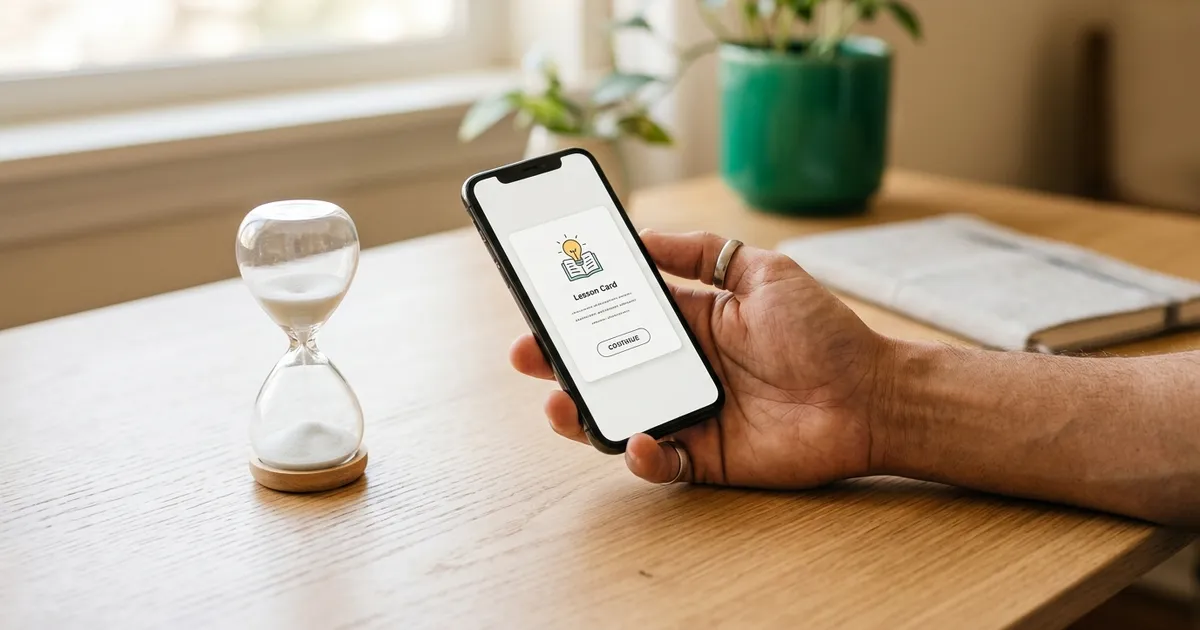
The best learning apps for adults with ADHD are the ones that keep sessions short, hand you a reward fast, and make it easy to start again tomorrow. NerdSip leads because its five-minute, novelty-driven format fits the ADHD brain by design, not as a workaround. Below, an honest ranking and a comparison table to help you pick. Apps are only one piece; our complete guide to learning with ADHD covers the strategies behind them.
Why most learning apps fail the ADHD brain
Most study tools were built for a brain that can sit still for an hour and wait a week for a grade. That is not the ADHD brain. Adults with ADHD tend to have reduced dopamine signaling in the brain's reward circuits, which makes delayed payoffs feel almost invisible and long tasks feel physically uncomfortable to start.
So the problem is rarely intelligence or interest. It is structure. A course that demands forty minutes of unbroken focus before anything satisfying happens is fighting your neurology the entire way. The fix is not more willpower. It is a format that gives your brain what it needs to stay in the game.
Four features do most of the work, and every app on this list is judged against them.
- Short sessions that end before attention drifts, usually under ten minutes.
- Immediate feedback so a right answer lands as a small hit of reward right now, not later.
- Streaks and points that turn abstract progress into something you can see and protect.
- Variety that keeps novelty high, because a bored ADHD brain quietly checks out.
Notice what all four have in common. None of them asks you to focus harder. Each one changes the shape of the task so that the focus you already have is enough. That is the whole difference between a tool that fights your brain and a tool that works with it.
What makes a session ADHD-friendly, in plain terms
ADHD-friendly is not a marketing phrase. It maps to specific things your brain does. Working memory, the mental scratchpad you hold information on, is often smaller and more fragile with ADHD, so packing one idea into a five-minute lesson respects that limit instead of overloading it. We unpack the neuroscience in depth in our piece on why microlearning works for ADHD brains.
Task initiation, the act of getting started, is one of the hardest moments in the ADHD day. A five-minute lesson lowers the wall. "I only have to do one card" is a promise your brain will actually accept. Once you begin, momentum often carries you further than you planned. If starting is where you stall most, our guide on how to learn with ADHD when you can't focus has tactics that pair well with any app here.
Immediate feedback matters for a separate reason. Dopamine, the neurotransmitter tied to motivation, runs low in the ADHD brain, so a reward that arrives next week is nearly invisible to it. A quiz answer that turns green right now is not. That instant confirmation is a small chemical payoff your brain actually registers, and it is what makes you want to answer the next question. An app that grades you at the end of a long unit misses this window entirely.
Streaks work on the same wiring from a different angle. A visible chain of completed days becomes an object you feel protective of, and that protectiveness is what carries you through the days when motivation is thin. Variety closes the loop. A single-subject app eventually feels repetitive, and repetition is the fastest way to lose an ADHD brain, so the ability to jump between fresh topics keeps the sense of discovery alive.
The best learning apps for adults with ADHD, ranked
Here is the honest short list, ordered by how well each one fits the way ADHD attention actually behaves. Every pick below is genuinely good. The ranking reflects fit, not overall quality.
1. NerdSip, best overall fit for ADHD
NerdSip turns any topic into a five-minute course with quizzes, XP, streaks, and voice lessons. That structure is not a lucky accident for ADHD; it is what the whole product is built around. Sessions end before focus fades. Every quiz answer gives instant feedback, so the reward arrives now. Streaks give you a visible thing to protect, and the AI generates courses on demand, which keeps novelty high when your usual topic starts to feel stale.
The variety point matters more than it sounds. A boredom-prone brain drops apps that feel repetitive, and single-subject apps eventually feel repetitive. Because NerdSip lets you jump from Roman law to the science of sleep to how money works, the sense of discovery stays alive. If focus itself is your battle, the Finding Focus in a Distracted World course is a natural first pick, and the Dopamine Hack: The Neuroscience of Instant Motivation course explains the reward system you are working with.
Most AI learning apps hand-wave the accuracy question. This one answers it with four layers: generation grounded in live search, a nightly integrity sweep, a quality gate before the swipe deck, and a report button staffed by actual humans.
2. Duolingo, best for languages
Duolingo pioneered the gamified daily lesson, and its streak system is famous for a reason. For language learning specifically, it is excellent, and the short lessons and cheerful feedback are a strong ADHD match. The limit is scope. Duolingo teaches languages, so once you want something else, you need another tool.
3. Brilliant, best for math and science
Brilliant teaches STEM through interactive problem-solving rather than passive video. The active format keeps you engaged, which helps with ADHD, and sessions can be kept short. It asks for a bit more sustained concentration than a flashcard app, so it suits days when your focus is already reasonably steady.
4. Anki, best for pure memorization
Anki is a spaced-repetition flashcard system loved by medical students and language learners. It is powerful and free, and the review sessions are short by nature. The catch for ADHD is friction: Anki asks you to build or download decks and tune settings, and that setup step can stall a brain that struggles with task initiation before the learning even starts.
Comparison table: learning apps for ADHD adults
| App | Best for | Typical session | Instant feedback | Streaks / XP | Topic variety | Free tier |
|---|---|---|---|---|---|---|
| NerdSip | Any topic, on demand | ~5 min | Yes | Yes | Very high (AI-generated) | Yes |
| Duolingo | Languages, Math, Music, Chess | ~5 min | Yes | Yes | Low (languages, Math, Music, Chess) | Yes |
| Brilliant | Math and science | 10-15 min | Yes | Limited | Medium (STEM) | Limited |
| Anki | Memorization | Varies | Yes | No | Depends on your decks | Yes (desktop/Android) |
Session lengths are typical, not fixed. Any of these can be stretched or shortened, and the point for ADHD is that the short end is genuinely usable.
Does your ADHD type change the pick?
Somewhat, and it is worth a moment. Adults with the predominantly inattentive presentation often struggle most with sustained attention and drifting off mid-task, so the instant-feedback and body-doubling angles matter more for them. Adults with the hyperactive-impulsive presentation often struggle more with restlessness and finishing what they start, so the short session that ends on a win, plus a streak worth protecting, does more of the heavy lifting.
The good news is that the same core format serves both. Short, rewarding, novel sessions help whether your ADHD shows up as zoning out or as bouncing off the task. You do not need to diagnose yourself precisely to choose well. You just need the format to be right, and every top pick here shares that format to some degree. NerdSip simply pushes each lever the furthest at once.
Free versus paid: which should you start with?
Start free, always. A purchase decision is its own task, and for many adults with ADHD, a paywall at the door is enough friction to end the attempt before it begins. NerdSip, Duolingo, and Khan Academy all give you a real free tier you can use every day, so you can build the habit first and decide on paying once the routine already exists.
Paid tiers are worth it later, once an app has earned a place in your day. If you are still shopping around, our roundup of the best educational apps for adults in 2026 compares free and paid options across the board, ADHD or not.
How to actually stick with it (the part apps can't do for you)
An app removes friction, but a few habits multiply its effect. These are small, and small is the point.
- Anchor the session to an existing habit. One lesson while the coffee brews. Attaching a new behavior to a fixed one is the most reliable way to make it automatic.
- Protect the streak, not the hour. On a bad day, do the minimum. One lesson keeps the chain alive, and keeping the chain alive is what beats the ADHD tendency to abandon things entirely after one miss.
- Let novelty pull you. If a topic goes flat, switch. Following curiosity is not cheating for an ADHD brain; it is how you stay engaged long enough to learn anything at all.
- Use body-doubling. Learning alongside someone else, even silently, borrows their focus. It is one of the most effective ADHD tactics there is.
Procrastination will still show up, because it always does. If it is the wall between you and starting, the Conquering Procrastination course gives you concrete moves for the moment you freeze. And when you simply want to browse for something that grabs you, the full course library is built for exactly that kind of curious wandering.
Why NerdSip fits, not just works
There is a difference between an app you can force to work with ADHD and one that fits ADHD from the start. Most tools land in the first group: good products that happen to have a short-lesson mode you can lean on. NerdSip lands in the second. The five-minute cap, the instant quiz feedback, the streak you want to protect, the endless supply of fresh topics: those are not features bolted onto a study app. They are the whole design, and they line up almost exactly with what the ADHD brain needs to start, to finish, and to come back.
That is why it tops this list. Not because the others are weak, but because fit beats effort. When the format matches your neurology, learning stops feeling like a fight you keep losing and starts feeling like something you actually look forward to.
Sources and Further Reading
- CHADD (Children and Adults with ADHD)
- ADDitude Magazine
- National Institute of Mental Health: ADHD
- Cleveland Clinic: ADHD in Adults
If short, rewarding lessons sound like the format your brain has been missing, NerdSip was built for exactly that. Pick a topic, do five minutes, and let the streak do the rest.
Frequently Asked Questions
What is the best learning app for adults with ADHD?
NerdSip is the strongest all-round pick because its five-minute lessons, instant quiz feedback, and streak system match how the ADHD brain works best: short bursts with frequent rewards. Duolingo is excellent for languages, Brilliant for math and science, and Anki for pure memorization. The best choice depends on your subject and how much friction you feel starting a task.
Why do short lessons work better for people with ADHD?
ADHD brains struggle with sustained attention and with delayed rewards, so a sixty-minute lecture asks for exactly what is hardest. A five-minute lesson finishes before focus fades and delivers a reward almost immediately. That fast payoff releases dopamine, which is the neurotransmitter most linked to motivation and follow-through in ADHD.
Are there free learning apps that work well for ADHD?
Yes. NerdSip, Duolingo, and Khan Academy all offer real free tiers you can use daily without paying. Anki is free on desktop and Android. Free tiers are a smart starting point because they remove the friction of a purchase decision, which itself can stall an ADHD brain before it begins.
Every NerdSip course clears a four-layer fact-checking pipeline before it reaches the app: grounded in live sources, scored nightly, gated on failure, and reviewable by a person at one tap. Articles on this blog are drafted with AI assistance, then researched, verified, and edited by our team.
Editorial responsibility: ai51 UG (haftungsbeschränkt). Responsible editor named in the imprint.
📚 Keep Learning
Explore the NerdSip learning hubs
The blog is our editorial layer. When you want to move from reading into doing, these hubs organize the rest of NerdSip by format, including the app itself and the press that has written about it.
Learning Built for the ADHD Brain
NerdSip turns any topic into a five-minute course with quizzes, streaks, and XP. Short sessions, instant wins, free to download.
4.7 stars from 380 reviews · 8,900+ learners