The Human Brain
Most of what people know about the brain is wrong, including the famous bits. Here is what each part actually does, which claims survive contact with the evidence, and what any of it means for how you learn.
Published , last updated , reviewed by the NerdSip Research Team
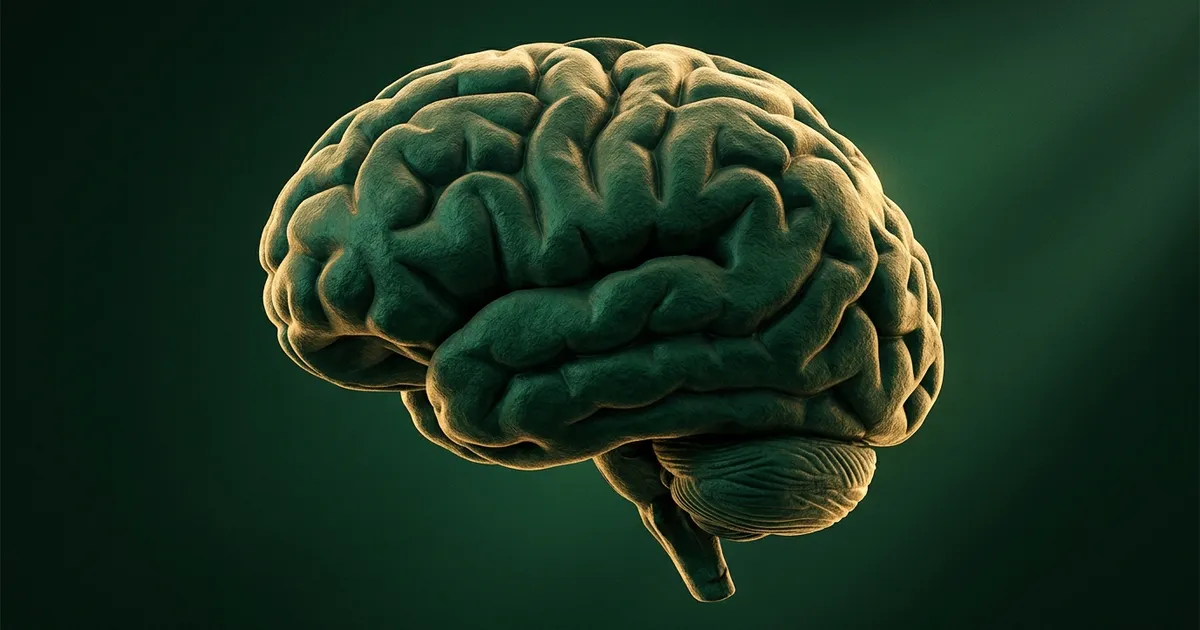
Click any region on the interactive map and it tells you what that piece actually does. Then the four claims worth unlearning, each with the study it came from. Where researchers still disagree, this page says so instead of picking the tidier story.
The human brain is a roughly 1.3 kilogram organ containing about 86 billion neurons and a similar number of non-neuronal glial cells, around 170 billion cells in total. Its primary function is to keep the body alive and to predict what happens next, using sensory input, stored memory and control of movement. It is organised into two hemispheres, four lobes per hemisphere, a cerebellum and a brainstem, with the hippocampus, amygdala and thalamus buried underneath. It consumes about 20 percent of the body's energy while making up about 2 percent of its weight, roughly 20 watts. Around 69 of its 86 billion neurons sit in the cerebellum rather than the thinking cortex, which holds about 16 billion. Three of the most repeated claims about it, the ten percent myth, the left-brain personality, and full maturity at 25, are not supported by evidence.
Almost everything most people know about the brain arrived through a game of telephone. That you use ten percent of it. That you are left-brained or right-brained. That it is finished at twenty-five. None of those are true, and the real answers are stranger than the myths they replaced.
This page is the plain-English version. Start with the map below: click any region and it tells you what that piece actually does. Then the four claims worth unlearning, then a direct answer to each question people actually ask, with the study it came from. Where the science is still arguing with itself, we say so instead of picking the tidier story.
Click any region
A side view of the left hemisphere. Tap a lobe to see what it does, then switch to the inside view for the structures buried under the surface.
Tap a region, or use the arrow keys
Quick answers
What is the primary function of the human brain?
To keep the body alive and to predict what is about to happen. Everything else, including thought and language, is built on those two jobs.
Read the full answerHow many brain cells does a human have?
About 170 billion in total: roughly 86 billion neurons and roughly 85 billion glial cells. The famous 86 billion figure counts only the neurons.
See how it was countedWhat are the main regions of the human brain?
Four lobes per hemisphere, frontal, parietal, temporal and occipital, plus the cerebellum and the brainstem, with the hippocampus, amygdala and thalamus buried inside.
Tour every regionWhen does the human brain fully develop?
There is no finish line at 25. Cortical volume peaks around age six, white matter around age 29, and change continues for the rest of your life.
See the real timelineHow does the human brain process information?
It does not wait and react. It predicts what the senses should report, then spends its energy on the difference between the guess and the signal.
How prediction worksWhat does a real human brain look like?
Soft, pinkish grey and closer to firm jelly than to the rubbery models in classrooms. Out of the skull, an unpreserved brain slumps under its own weight.
The honest descriptionThe human brain in numbers
Every figure below is traceable to the source named beside it. Where a number is an extrapolation rather than a measurement, the table says so.
| Measure | Value | Source |
|---|---|---|
| Weight (adult) | 1,300 to 1,400 g (about 3 lb) | Dekaban & Sadowsky, 1978 |
| Neurons | ~86.1 billion | Azevedo et al., 2009 |
| Non-neuronal (glial) cells | ~84.6 billion | Azevedo et al., 2009 |
| Neurons in the cerebellum | ~69 billion (about 80%) | Azevedo et al., 2009 |
| Neurons in the cerebral cortex | ~16 billion | Azevedo et al., 2009 |
| Synapses | ~100 trillion (estimate) | Extrapolated from samples |
| Energy use | ~20 W, about 20% of the body's budget | Attwell & Laughlin, 2001 |
| Share of body weight | ~2% | Standard anatomy |
| Water content | 73 to 75% | Chang, Ke & Chen, 2009 |
| Cortex surface area, unfolded | ~2,500 cm² | Toro et al., 2008 |
| Cortex thickness | 2 to 4 mm | Standard anatomy |
| Fastest signal speed | ~120 m/s (~430 km/h) | Kandel, Principles of Neural Science |
| Cortical grey matter peaks | ~5.9 years of age | Bethlehem et al., 2022 |
| White matter volume peaks | ~28.7 years of age | Bethlehem et al., 2022 |
Four things about the brain that are not true
We only use 10 percent of our brains.
There is no dormant 90 percent. Imaging shows activity throughout the organ, and damage to any part of it costs you something. The claim has no traceable source, only a long history of repetition.
You are either left-brained or right-brained.
Certain tasks lean one way, language usually left, spatial attention usually right. But a scan of 1,011 brains found no evidence that individual people run on one side. Both halves are busy, constantly, in everyone.
The brain is fully developed at 25.
Nothing switches off at 25. Different measures peak at wildly different ages, cortical volume around six, white matter volume around 29, and refinement continues for decades after.
Brain cells never come back once they die.
Mostly true for the cortex, genuinely contested for the hippocampus, where two 2018 studies reached opposite conclusions. The stronger and better-supported story is not replacement but rewiring: surviving neurons change their connections throughout life.
What is the primary function of the human brain?
The textbook answer is that the brain processes information. That is true and almost useless, because it describes a calculator equally well. The more accurate answer has two parts.
First, the brain keeps the body alive. Breathing, heart rate, temperature, hunger, thirst, the sleep and wake cycle. These are handled by the brainstem and hypothalamus, they never pause, and they account for a large share of the organ's running costs. Nothing else the brain does matters if this fails.
Second, the brain predicts. This is the part that changed how neuroscientists talk about the organ over the last two decades. Rather than sitting passively and reacting to what the senses report, the brain constantly generates expectations about what it is about to sense, and then compares those expectations against the incoming signal. What travels up from your eyes and ears is mostly the error, the part the prediction got wrong. It is a far cheaper way to run a body, and it explains why you can be genuinely startled by a stair that is not there.
Everything else, language, planning, empathy, doing your taxes, is built on those two jobs. Thinking is not a separate department. It is prediction running far enough ahead of the present that it stops looking like perception.
What are the main regions of the human brain?
The brain divides into two hemispheres, and each hemisphere divides into four lobes. Add the cerebellum tucked underneath at the back and the brainstem descending into the spinal cord, and you have the six regions visible from the outside.
- Frontal lobe. Planning, decision-making, self-control, voluntary movement, and speech production. The largest lobe and the last to mature.
- Parietal lobe. Touch, temperature, pain, where your limbs are in space, and rough number sense.
- Temporal lobe. Hearing, understanding language, recognising faces, and forming memories. The hippocampus is buried inside it.
- Occipital lobe. Vision, almost exclusively. The smallest lobe, sitting as far from your eyes as it is possible to get.
- Cerebellum. Balance, coordination and timing. About a tenth of the volume, roughly four fifths of the neurons.
- Brainstem. Breathing, heartbeat, swallowing, the switch between sleep and waking. The part that cannot be spared.
Underneath the surface sit the structures people quote most often without being able to place: the hippocampus, which turns experience into lasting memory; the amygdala, which flags what matters before you have consciously noticed it; the thalamus, which relays nearly every sense except smell; the hypothalamus, four grams of tissue running hunger, thirst, temperature and hormones; and the corpus callosum, the 200-million-fibre bridge between the halves. The map at the top of this page has all eleven.
One warning about lobe diagrams. The borders are useful conventions, not real seams. No single lobe performs a whole function on its own, and the interesting work happens in networks that cut straight across the lines.
How many brain cells does a human have?
About 170 billion cells, of which roughly 86 billion are neurons and roughly 85 billion are glial cells.
The 86 billion figure is the one that travels, and it is usually quoted as the number of brain cells, which is wrong by about half. It counts neurons only. Glia are the other half of the organ, and they are not packing material: they insulate axons, clear waste, regulate blood flow and shape signalling directly.
The older number you may remember, 100 billion neurons, was never measured. It circulated for decades as an estimate nobody had checked. In 2009 a team led by Suzana Herculano-Houzel dissolved whole human brains into a uniform suspension and counted the cell nuclei in samples of the resulting soup, a method that does not care how unevenly cells are distributed. The answer came back at 86.1 billion neurons and 84.6 billion non-neuronal cells.
The distribution is the genuinely surprising part. The cerebellum holds about 69 billion of those neurons. The cerebral cortex, the folded outer sheet that does the reasoning and the language and the planning, holds only about 16 billion. Four out of every five of your neurons are working on movement and timing.
How does the human brain process information?
Not the way a computer does, and the difference matters more than the similarities.
A signal arrives as a change in voltage travelling down a neuron's axon, at anything from half a metre per second to 120 metres per second depending on whether that fibre is insulated in myelin. At the end it stops, because neurons do not touch. The message crosses a gap of 20 to 40 nanometres as a puff of chemical, lands on the next cell, and either nudges it closer to firing or further away. A single neuron may be listening to thousands of others at once and fires only when the sum crosses a threshold.
What makes this a brain rather than a very slow circuit board is that the connections change. Every time two neurons fire together, the link between them strengthens slightly. That is the physical basis of learning, and it is why the shape of the tissue reflects what a person has spent their life doing.
On top of all this sits the prediction loop. Your senses take in an enormous volume of raw data, and conscious awareness handles a famously tiny slice of it. Estimates for how much information reaches conscious processing per second range from around 10 to 50 bits, against millions arriving at the receptors. The gap is not a failure. It is the compression that makes acting in real time possible at all.
When does the human brain fully develop?
It does not, in the sense people mean. There is no age at which the brain is finished.
The 25 figure has a real origin. The prefrontal cortex, which handles planning and impulse control, is the last area to become fully myelinated, and that process runs into the mid-twenties. Somewhere along the way this became a hard deadline, and then a legal talking point, and then a fact everyone knows.
The largest study of human brain development to date, a 2022 analysis pooling more than 120,000 scans across the lifespan, gives a much less tidy picture. Total cortical grey matter volume peaks at about 5.9 years of age. Cortical thickness peaks even earlier, before age two. Total white matter volume, the insulated wiring, does not peak until about 28.7 years. Subcortical grey matter peaks around 14.4 years. Every measure has its own schedule, and none of them cluster at 25.
The useful version of the truth is less dramatic and more encouraging. Different systems mature at different rates, the ones handling long-range planning finish late, and structural change in response to what you do continues for the rest of your life.
What does a real human brain actually look like?
Softer than almost anyone expects. A fresh, unfixed human brain has roughly the consistency of firm jelly or a very soft cheese, and lifted out of the skull it slumps and deforms under its own weight. The rubbery, self-supporting specimens in teaching labs have been hardened in formalin for weeks. That preservation also drains the colour and stiffens the tissue considerably, so what most people picture as a real brain is a chemically altered version of one.
Living, it is pinkish grey and glossy, wrapped in membranes and threaded with fine red vessels. The grey matter of the cortex is the outer layer, only two to four millimetres thick. Slice into it and the inside is paler and creamier, and that is the white matter, whose colour comes from the fatty myelin sheathing the connecting fibres.
Size: around 1,300 to 1,400 grams in an adult, roughly the weight of a large cabbage or a small laptop. It floats in cerebrospinal fluid, which is why it weighs closer to 50 grams in situ than 1,400, and why a brain out of its fluid is so much heavier and more fragile than it looks.
One more thing that surprises people who see one. There is no visible seam between the parts you have read about. The lobes are named after the skull bones above them, not after any boundary the tissue actually has.
What all of this means for learning
This is the part we care about most, because it is the part we build for.
Three findings on this page are not trivia. They are the mechanics of how anything gets into your head and stays there.
Connections change with use, and that is all learning physically is. When two neurons fire together repeatedly the link between them strengthens. There is no separate storage compartment; the wiring that does the processing is the wiring that holds the memory. Which is why the London taxi drivers ended up with measurably more grey matter in the posterior hippocampus, and why the effect scaled with years on the job rather than appearing overnight.
Spacing beats cramming, because strengthening a connection takes time. The same total minutes spread across a week produce more durable retention than the same minutes in one sitting. This is one of the oldest and most replicated findings in the whole of psychology, and it is still the single most ignored one.
Retrieving beats rereading. Pulling a fact out of your head fires the pathway. Looking at it again mostly exercises your visual system. Testing yourself feels harder and less productive than review, and it produces substantially better retention, which is exactly the kind of result that loses to intuition.
The thing this page will not tell you
That you can train your brain, in the sense the phrase is usually sold. The largest review of the commercial brain-training literature found that practising these programs makes you better at the practised tasks, with weak evidence of transfer to related tasks and essentially none to everyday cognitive performance. You get better at the game.
The honest version is duller: there is no exercise that upgrades general cognition. There is only learning specific things, using methods that respect how the tissue actually works. If you want to know more about a subject, the route is to learn about that subject, spaced out, with recall.
That is the whole design brief for what people now call brainmaxing, and it is what we built NerdSip around: short courses, a question at the end of every lesson, and the material coming back later instead of being read once and filed.
Fascinating facts about the human brain
Every fact below is sourced. We left out the ones that circulate widely and turn out to be invented, and there were more of those than we expected.
-
01
Four out of five of your neurons are in the cerebellum
The cerebellum takes up about a tenth of the brain by volume and holds around 69 of your 86 billion neurons. The cerebral cortex, the part everyone means when they say thinking, holds about 16 billion.
Azevedo et al., 2009 -
02
The brain has no pain receptors
Cut into brain tissue and it feels nothing, which is why awake craniotomies exist. Surgeons can ask a patient to name objects or play guitar while operating, because the headache you get is coming from the membranes and blood vessels around the brain, never the brain itself.
Standard neurosurgical practice -
03
It runs on about 20 watts
Less than most desk lamps. That is roughly 20 percent of your entire energy budget going into 2 percent of your body weight, which makes the brain by far the most expensive tissue you own.
Attwell & Laughlin, 2001 -
04
Signals travel at up to 430 kilometres per hour
The fastest myelinated nerve fibres carry a signal at around 120 metres per second. The slowest, unmyelinated ones crawl at about half a metre per second, which is why a stubbed toe hurts twice, sharply and then dully.
Kandel, Principles of Neural Science -
05
Your cortex would cover a small table
Unfolded, the sheet of cortex measures roughly 2,500 square centimetres and is only two to four millimetres thick. The wrinkles exist because evolution needed to fit a tablecloth into a lunchbox.
Toro et al., 2008 -
06
About three quarters of it is water
The brain is roughly 73 to 75 percent water, and of the dry weight that remains, around 60 percent is fat. It is the fattiest organ in the body.
Chang, Ke & Chen, 2009 -
07
Smell is the only sense that skips the switchboard
Sight, sound, touch and taste all route through the thalamus before reaching the cortex. Smell goes straight to the olfactory bulb, next door to the memory and emotion structures, which is part of why a scent can reopen a memory faster than a photograph.
Shepherd, 2005 -
08
Neurons never actually touch
There is a gap of roughly 20 to 40 nanometres between one neuron and the next. Every thought you have ever had crossed that gap chemically, not electrically.
Kandel, Principles of Neural Science -
09
London taxi drivers grew a bigger hippocampus
Drivers who had memorised the 25,000 streets of central London had significantly more grey matter in the posterior hippocampus than matched controls, and the effect scaled with years on the job. Structure follows use.
Maguire et al., 2000 -
10
Sleep flushes the brain out
During sleep the space between brain cells expands by around 60 percent, and fluid washes through and clears out metabolic waste. The clearance runs roughly twice as fast asleep as awake.
Xie et al., 2013 -
11
Remembering something changes it
A memory does not sit in storage like a file. Recalling it makes it briefly unstable and it has to be written back, which means every recollection is slightly rewritten by the act of recalling it.
Nader, Schafe & LeDoux, 2000 -
12
You are blind in two spots and never notice
Each eye has a hole in its retina where the optic nerve leaves. Your brain fills the gap by inventing whatever it expects should be there, and it is so convincing that most people go a lifetime without spotting it.
Ramachandran, 1992 -
13
There is no left-brain or right-brain personality
A study scanning 1,011 brains found that people do not have a stronger left or right network overall. The hemispheres do specialise for certain tasks, language leaning left, spatial attention leaning right, but nobody is a right-brained person.
Nielsen et al., 2013 -
14
The ten percent claim was never based on anything
No study ever supported it. Brain imaging shows activity across effectively the whole organ over the course of a day, and there is no region you can damage without losing something.
Beyerstein, 1999 -
15
A newborn brain doubles in its first year
Brain volume grows by about 101 percent in the first twelve months, then by around 15 percent in the second. By age two it is already close to 83 percent of adult volume.
Knickmeyer et al., 2008 -
16
The two halves are joined by 200 million fibres
The corpus callosum is a dense cable of roughly 200 million axons. It is the physical reason the hemispheres cannot work in isolation, and cutting it produces some of the strangest results in all of neuroscience.
Tomasch, 1954 -
17
Your body map is wildly out of scale
The strip of cortex handling touch gives your lips, tongue and fingertips enormous territory and your torso almost none. Drawn to that scale, a human is mostly hands and mouth.
Penfield & Boldrey, 1937 -
18
Whether adults grow new neurons is still an open fight
Two major papers published months apart in 2018 reached opposite conclusions about whether the adult human hippocampus makes new neurons. It remains unresolved, which is worth knowing whenever you see a confident headline about it.
Sorrells et al., 2018; Boldrini et al., 2018
When the human brain actually develops
The single most repeated claim about brain development, that it finishes at 25, comes from a rounding of one slow curve. Here is what the lifespan data actually shows.
-
Birth
About a quarter of adult size
All the neurons are essentially there. What is missing is the wiring and the insulation.
-
1 year
Volume roughly doubles
The fastest growth of your life. By the first birthday the brain is around 72 percent of adult volume.
-
~6 years
Cortical grey matter peaks
Total cortical volume reaches its maximum at about 5.9 years, then begins a long, normal decline as unused connections are pruned away.
-
Teens
Pruning and myelination accelerate
The brain gets faster and more efficient by cutting connections it does not use and insulating the ones it keeps. Reward sensitivity runs ahead of impulse control.
-
~29 years
White matter peaks
Total white matter volume, the insulated wiring, reaches its maximum at about 28.7 years. This is the curve that got rounded down to 25.
-
After 30
Change never stops
Volumes decline slowly, but structure keeps responding to what you do. Learning a demanding skill measurably alters the tissue at any age.
Frequently asked questions
How much does a human brain weigh?
An adult human brain weighs roughly 1,300 to 1,400 grams, about three pounds. Averages are approximately 1,336 grams for adult men and 1,198 grams for adult women, a difference that tracks overall body size and does not predict anything about ability.
How many neurons are in the human brain?
About 86 billion neurons, alongside roughly 85 billion non-neuronal cells. Around 69 billion of the neurons are in the cerebellum and about 16 billion in the cerebral cortex.
What are the four lobes of the brain?
Frontal, parietal, temporal and occipital, in each hemisphere. Frontal handles planning, self-control and movement. Parietal handles touch and spatial sense. Temporal handles hearing, language and memory. Occipital handles vision.
Do we really only use 10 percent of our brains?
No. The claim has no scientific basis and no traceable origin. Brain imaging shows activity across effectively the entire organ over the course of a day, and there is no area you can lose without losing a capability with it.
What is the difference between grey matter and white matter?
Grey matter is mostly neuron cell bodies and the connections between them, and it forms the outer two to four millimetres of the cortex. White matter is the insulated cabling underneath, and it looks white because of the fatty myelin wrapped around the fibres.
How fast do signals travel in the brain?
Up to about 120 metres per second, roughly 430 kilometres per hour, in the thickest myelinated fibres. Uninsulated fibres carry signals at closer to half a metre per second, which is why sharp pain arrives before dull pain.
How much energy does the brain use?
About 20 watts, which is around 20 percent of the body's resting energy budget for an organ that is about 2 percent of body weight. Over a day that works out to roughly 400 calories.
What does the frontal lobe do?
It plans, decides, holds intentions in mind, suppresses impulses, initiates voluntary movement, and produces speech. It is the largest lobe and the slowest to mature.
What does the hippocampus do?
It converts experience into memory that can be recalled later, and it maintains your mental map of space. Losing both hippocampi leaves old memories and learned skills intact but makes forming new episodic memories almost impossible.
Is the brain a muscle?
No. It is nervous tissue and it does not grow by being worked in the way a muscle does. What changes with practice is connectivity and, in some cases, local grey matter density, which is a real effect but a different mechanism from muscle growth.
Can the brain feel pain?
Brain tissue itself has no pain receptors, which is why awake brain surgery is possible. Headaches originate in the membranes, blood vessels, muscles and nerves surrounding the brain, not in the brain.
Are you left-brained or right-brained?
Neither. A study of 1,011 brains found no evidence that individuals favour a left or right network overall. Specific functions do lateralise, language typically to the left and spatial attention to the right, but that is a property of tasks, not personalities.
How many synapses does the human brain have?
Estimates run to roughly 100 trillion connections across the whole brain, with the cerebral cortex alone carrying somewhere around 150 trillion by some counts. These are extrapolations from tissue samples, so treat any single figure as an order of magnitude rather than a measurement.
Does the brain shrink with age?
Volume declines gradually from early adulthood, and the rate varies a great deal between individuals. Decline in volume is not the same as decline in capability, and structural change in response to learning continues throughout life.
Can you train your brain?
You can reliably get better at the specific things you practise, and that improvement shows up in the tissue. What the evidence does not support is that practising one narrow task produces broad gains in general intelligence or memory. Transfer to unrelated skills is weak, so learn the thing you actually want to know.
Five-minute courses on this
Free to start, fact-checked, no prior knowledge assumed.
Brain Basics: Unlocking Your Mind
The five-minute orientation tour of the organ this page describes.
The Left-Brain/Right-Brain Myth
Where the split personality story came from, and what the scans actually show.
Beyond the Myth: The Networked Brain
Why functions live in networks rather than in the neat regions on the diagram.
The Glitch in the Matrix: Why Your Brain Lies
Prediction, filled-in blind spots, and the edits you never notice.
The Gut-Brain Axis: Your Second Nervous System
The nerve highway between your stomach and your head, and what really travels on it.
Mastering the Memory Palace
The oldest memory technique on record, and the spatial system it exploits.
Learn one real thing about your brain today
NerdSip turns any topic you type into a fact-checked five-minute course, brain science included. Every lesson ends in a question, and the app brings the material back later so it sticks. Free to start.
Download NerdSip FreeSources
- Azevedo FAC et al. (2009). Equal numbers of neuronal and nonneuronal cells make the human brain an isometrically scaled-up primate brain. Journal of Comparative Neurology 513(5):532-541
- Bethlehem RAI et al. (2022). Brain charts for the human lifespan. Nature 604:525-533
- Nielsen JA et al. (2013). An evaluation of the left-brain vs. right-brain hypothesis with resting state functional connectivity MRI. PLoS ONE 8(8):e71275
- Maguire EA et al. (2000). Navigation-related structural change in the hippocampi of taxi drivers. PNAS 97(8):4398-4403
- Xie L et al. (2013). Sleep drives metabolite clearance from the adult brain. Science 342(6156):373-377
- Attwell D & Laughlin SB (2001). An energy budget for signaling in the grey matter of the brain. Journal of Cerebral Blood Flow & Metabolism 21(10):1133-1145
- Knickmeyer RC et al. (2008). A structural MRI study of human brain development from birth to 2 years. Journal of Neuroscience 28(47):12176-12182
- Nader K, Schafe GE & LeDoux JE (2000). Fear memories require protein synthesis in the amygdala for reconsolidation after retrieval. Nature 406:722-726
- Dekaban AS & Sadowsky D (1978). Changes in brain weights during the span of human life. Annals of Neurology 4(4):345-356
- Sorrells SF et al. (2018). Human hippocampal neurogenesis drops sharply in children to undetectable levels in adults. Nature 555:377-381
- Boldrini M et al. (2018). Human hippocampal neurogenesis persists throughout aging. Cell Stem Cell 22(4):589-599
- Scoville WB & Milner B (1957). Loss of recent memory after bilateral hippocampal lesions. Journal of Neurology, Neurosurgery & Psychiatry 20(1):11-21
- Beyerstein BL (1999). Whence cometh the myth that we only use 10% of our brains? In: Mind Myths, Wiley
- Simons DJ & others (2016). Do brain-training programs work? Psychological Science in the Public Interest 17(3):103-186
- Pashler H, McDaniel M, Rohrer D & Bjork R (2008). Learning styles: concepts and evidence. Psychological Science in the Public Interest 9(3):105-119
- Roediger HL & Karpicke JD (2006). Test-enhanced learning: taking memory tests improves long-term retention. Psychological Science 17(3):249-255
- Cepeda NJ, Pashler H, Vul E, Wixted JT & Rohrer D (2006). Distributed practice in verbal recall tasks: a review and quantitative synthesis. Psychological Bulletin 132(3):354-380
Written and fact-checked by the NerdSip Research Team. Every numerical claim on this page is traceable to a peer-reviewed source listed above. Where the evidence is contested, we say so rather than choosing the cleaner answer. This page is general science education and is not medical advice.