Five minutes is too short for a lecture. It is too short for a deep project. It is too short for mastery.
But five minutes is enough for one learning rep.
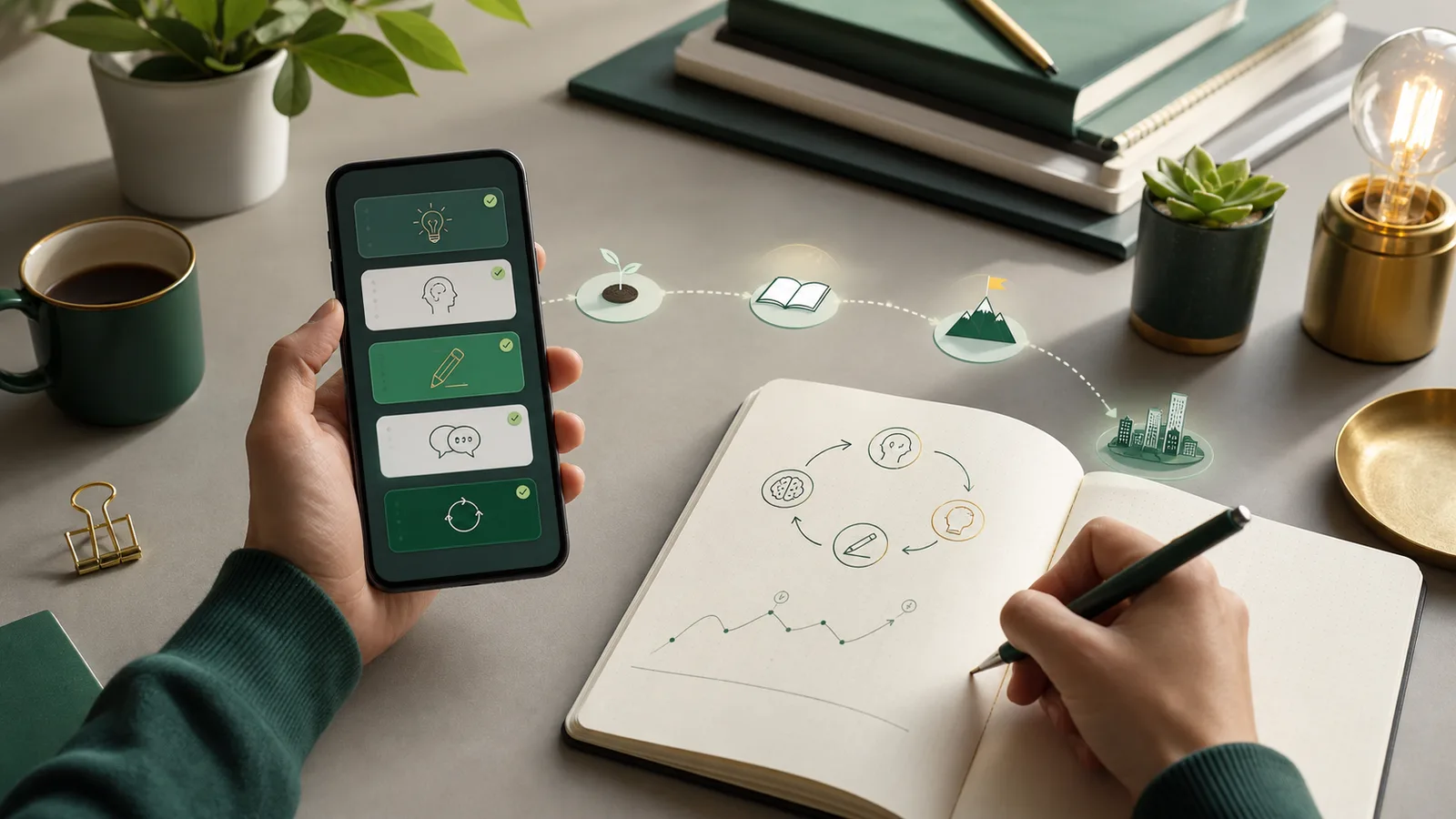
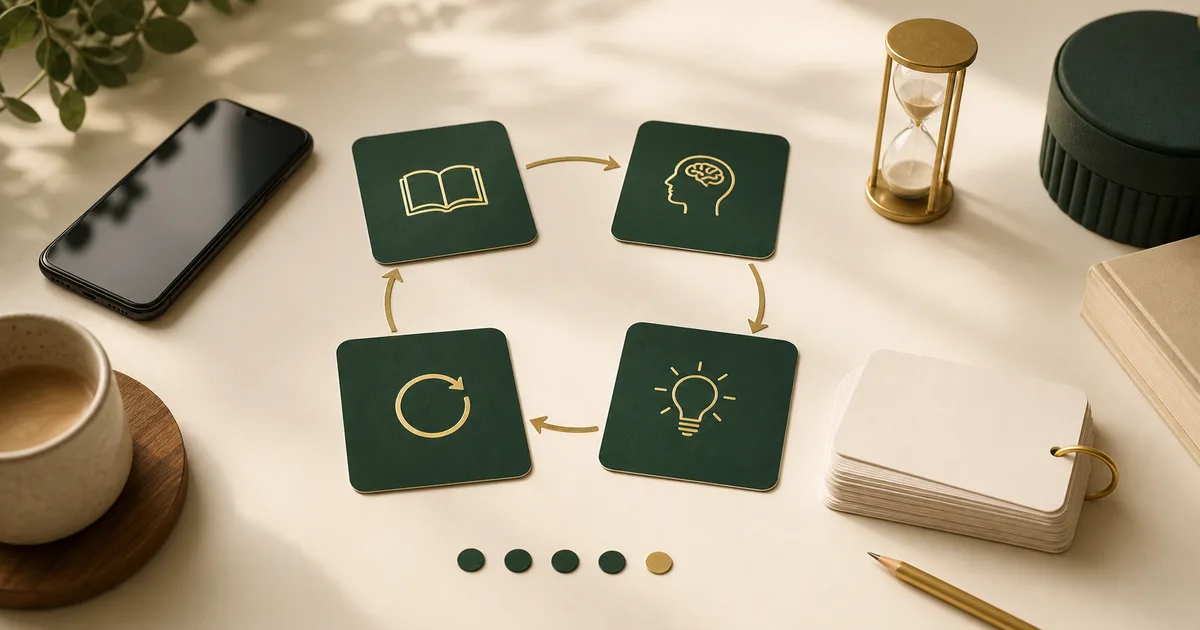
The problem is that most people use five-minute learning like content consumption. They watch, skim, nod, and move on. The 5-minute learning loop fixes that by giving each short session a job: learn, recall, apply, repeat.
The Loop in One Sentence
Learn one idea, recall it without looking, apply it once, and repeat it after a delay.
That is the whole loop. It is simple enough to remember and strong enough to build a real habit.
Minute 1-2: Learn One Idea
The first step is not learn a topic. It is learn one idea.
Do not learn productivity. Learn one way to define the next action. Do not learn negotiation. Learn one constraint question. Do not learn AI. Learn one prompt structure. Do not learn psychology. Learn one bias and one example.
The smaller the idea, the more likely you are to finish the rep.
Minute 3: Recall Without Looking
Close the lesson. Ask yourself: what was the idea? Why does it matter? What is one example?
This minute matters because it changes the learning mode. Rereading asks: do I recognize this? Recall asks: can I retrieve this?
Memory grows through retrieval. If recall feels slightly difficult, that is a good sign.
Minute 4: Apply It Once
Application can be tiny. Rewrite one sentence. Ask one better question. Solve one mini problem. Explain one concept. Use one formula. Add one example to your notes.
The goal is not to complete a project in minute four. The goal is to connect the idea to behavior.
A small action tells your brain: this information is useful.
Minute 5: Repeat or Schedule Review
Use the last minute to review an older idea or decide when today's idea will come back.
You can ask: what did I learn yesterday? What idea should I see again tomorrow? What did I use this week?
This is where the loop becomes compounding instead of isolated.
Why This Works
The loop combines four learning principles. The lesson is small enough to reduce cognitive load. Recall strengthens memory. Application creates relevance. Repetition fights forgetting.
None of those principles require a perfect schedule. They require a repeatable rep.
Examples of the 5-Minute Loop
Communication
Learn: specific follow-up questions get better answers. Recall: what makes a follow-up specific? Apply: ask one person, what part of that was hardest? Repeat: review the idea tomorrow before your next conversation.
Coding
Learn: a for loop repeats an action over a sequence. Recall: write the structure from memory. Apply: loop over three sample items. Repeat: solve a similar task in two days.
Finance
Learn: savings rate is money saved divided by income. Recall: explain the formula. Apply: calculate it once. Repeat: compare next month.
AI Literacy
Learn: better prompts include role, context, task, and constraints. Recall: name the four parts. Apply: rewrite one prompt. Repeat: use it again tomorrow.
What the Loop Is Not
It is not a promise that you can master anything with no practice. It is not a replacement for deep work. It is not a hack that removes effort.
It is a reliable starting mechanism. It helps you begin, remember, and apply. For deeper skills, you still need longer practice blocks. But the loop makes those blocks easier because you arrive with context.
How to Keep It Going
Attach the loop to an existing trigger: morning coffee, commute, lunch, closing your laptop, or the moment you usually open a feed.
Keep the bar low. One loop is enough. If you have more time, keep going, but do not make the official habit bigger than five minutes.
Track completion and application. A streak proves you showed up. An application proves learning moved into life.
If You Miss a Day
Do not catch up. Restart.
Catch-up creates punishment. Restarting creates continuity. Review one old idea and learn one new one. That is enough.
Why the Loop Works Better Than a To-Do Goal
"Learn more" is a weak goal because it does not tell you what to do next. The 5-minute learning loop is stronger because it defines the action. You do not need to decide whether to study, read, watch, review, summarize, or practice. The loop tells you: learn, recall, apply, repeat.
This removes a surprising amount of friction. Many people lose the habit before they even begin because choosing the method takes more energy than the lesson. A loop gives you a default.
The Loop as a Tiny Operating System
Think of the loop as an operating system for learning. The topic can change, but the process stays stable. Today the topic might be negotiation. Tomorrow it might be sleep science. Next week it might be AI prompts. The loop stays the same.
This is useful because curiosity is unpredictable. You can follow curiosity without losing structure. The loop gives exploration a shape.
How to Use the Loop for Different Goals
For remembering facts
Learn one fact with context, recall it without looking, explain why it matters, and review it later. A fact without context becomes trivia. A fact with context becomes a mental hook.
For learning a skill
Learn one move, recall the rule, apply it in the smallest real context, and repeat with variation. Skill learning needs output. If the loop never leaves your head, it is incomplete.
For better conversations
Learn one question pattern, recall it, use it once, and notice the response. Conversation learning works best when the practice is gentle and frequent. You do not need to reinvent your personality. You need more small reps.
For work performance
Learn one communication, judgment, or tool improvement. Recall the rule. Apply it to one email, meeting, spreadsheet, or decision. Repeat it until it becomes default behavior.
The 5-Minute Loop Versus the 60-Minute Fantasy
The 60-minute fantasy sounds like this: tonight I will sit down, finally focus, and change everything. Sometimes that happens. Often it does not. You get tired, distracted, interrupted, or discouraged. Then the missed session becomes evidence that you are not disciplined.
The 5-minute loop is less glamorous. That is the point. It is too small to fear. It keeps the relationship with learning alive even on messy days. Longer sessions are welcome, but they are not required for the habit to survive.
A Weekly Version of the Loop
On Monday, choose one theme. On Tuesday, repeat Monday's best idea and add one more. On Wednesday, apply one idea. On Thursday, quiz yourself on the first three. On Friday, connect two ideas. On Saturday, teach one idea to someone else or write it in plain language. On Sunday, decide what deserves another week.
This weekly rhythm turns five-minute sessions into a visible arc. You are not just collecting fragments. You are building a small body of knowledge.
How to Know the Loop Is Working
You will notice three signs. First, starting feels easier because the habit has a predictable shape. Second, ideas return during the day because you have recalled and applied them. Third, you begin connecting topics. A lesson about cognitive bias helps you make a better decision. A lesson about storytelling improves a work update. A lesson about sleep changes your evening routine.
The loop is working when learning leaks into life.
Where NerdSip Fits
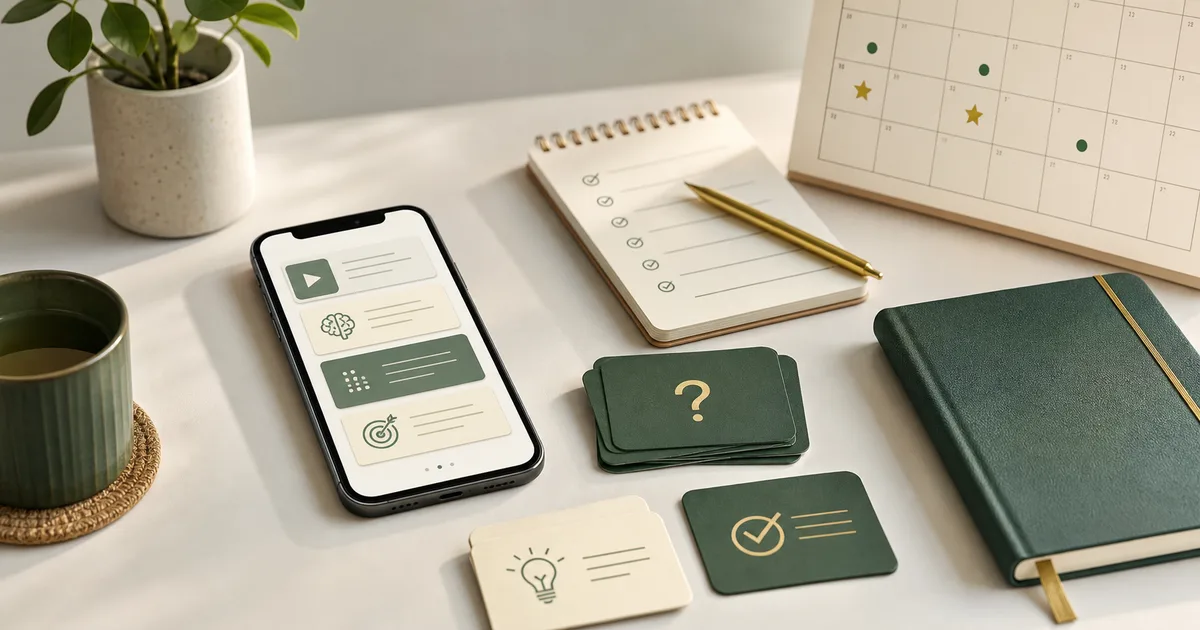
You can run the loop with a notebook. NerdSip helps when you want the topic, lesson, quiz, and streak in one place. It is especially useful for the first step: turning a vague curiosity into a short lesson you can actually finish.
The app should not make you passive. Use it as the front end for the loop. Learn one idea, answer the quiz, apply the idea somewhere real, then return later.
Loop Templates You Can Copy
Before a meeting: learn one communication move, recall the sentence frame, use it once in the meeting, review the result afterward.
During a commute: listen to one concept, pause and explain it silently, choose one example from your own life, review it tomorrow.
Before bed: learn one calm curiosity topic, recall it in three sentences, connect it to something you already know, let it return the next day.
For exam review: choose one weak concept, answer a question without notes, fix the gap, schedule the next review.
The Loop for People Who Hate Routines
Some people resist routines because routines feel like a trap. The 5-minute loop works because it is not a rigid schedule. It is a portable pattern. You can run it in the morning, at lunch, on a commute, before a meeting, or before bed. The time can move. The sequence stays stable.
This matters for people with inconsistent days. A habit that only works under perfect conditions is not a habit. It is a fragile plan. The loop is small enough to survive travel, busy weeks, low energy, and missed days.
What to Do When the Loop Gets Too Easy
If the loop becomes easy, do not immediately make it longer. Make it richer. Improve the recall question. Add a harder example. Apply the idea in a more realistic context. Connect it to something you learned last week. Teach it to someone else.
Longer is sometimes useful, but harder and more connected is often better. The goal is not to spend more time for its own sake. The goal is to create better learning reps.
The Loop for Deep Topics
Deep topics can still start with five minutes. You cannot master neuroscience, philosophy, programming, or finance in one short session. But you can learn one term, one distinction, one example, one question, or one mistake. Deep understanding is often built from many small, well-connected pieces.
The trick is to keep a thread. If you learn one idea about memory today, connect tomorrow's idea to it. If you learn one concept in finance, use it to understand the next concept. The loop should create a chain, not a jar of disconnected facts.
A 30-Day Challenge That Does Not Become a Guilt Machine
For 30 days, run one loop per day. If you miss a day, the challenge is not over. You simply continue. The point is not perfection. The point is proving that learning can remain part of your life without needing a dramatic identity transformation.
At the end, write down the five ideas you still remember and the three ideas you actually used. Those eight items matter more than a perfect calendar.
Quiet Conversion: Why an App Can Help
You can run the loop with any source. A book, article, video, podcast, class, or conversation can work. The reason an app like NerdSip helps is convenience: short lessons are already shaped for the loop, quizzes create recall, and streaks make returning visible.
The app is not the learning. Your retrieval and application are the learning. The app just makes the good next step easier to take than another empty scroll.
Why the Loop Converts Scrolling Energy
The loop works well as a replacement for scrolling because it respects the same entry point: a small phone moment. The difference is what happens next. Scrolling gives novelty with almost no retention. The loop gives novelty plus retrieval and application.
This is also why the loop should stay light. If replacing a feed requires a complicated setup, the feed wins. If the next learning rep is one tap away and takes five minutes, learning has a real chance.
The Real Promise
The promise is not that five minutes makes you brilliant overnight. The promise is that five minutes can keep curiosity alive, build memory through repetition, and create more useful behavior than another empty session of passive content. That is modest, but it is real. Real beats dramatic when you need a habit that survives ordinary life.
The Bottom Line
The 5-minute learning loop is learn, recall, apply, repeat. It is the smallest useful version of learning.
Use it once today. Then tomorrow, do it again.
Frequently Asked Questions
What is the 5-minute learning loop?
The 5-minute learning loop is a short routine: learn one idea, recall it, apply it once, and repeat it later.
Can five minutes really be enough?
Five minutes is enough for one focused learning rep. It is not enough for full mastery, but repeated daily reps can build real progress.
What should I do if I miss a day?
Restart with one tiny review. Do not turn one missed day into a giant catch-up session.
Every NerdSip course clears a four-layer fact-checking pipeline before it reaches the app: grounded in live sources, scored nightly, gated on failure, and reviewable by a person at one tap. Articles on this blog are drafted with AI assistance, then researched, verified, and edited by our team.
Editorial responsibility: ai51 UG (haftungsbeschränkt). Responsible editor named in the imprint.
📚 Keep Learning
Explore the NerdSip learning hubs
The blog is our editorial layer. When you want to move from reading into doing, these hubs organize the rest of NerdSip by format, including the app itself and the press that has written about it.
Run the loop today
Open NerdSip, learn one idea, answer the quiz, and use the idea before the day forgets it.
4.7 stars from 510 reviews · 10,000+ learners