Becoming more knowledgeable is not about reading random articles until your brain feels full. It is about building a system that turns small daily inputs into a wider mental map.
Most people approach knowledge in bursts. They watch a documentary, save a thread, buy a book, open a Wikipedia page, then drift. The information is interesting, but it does not compound because there is no structure, no retrieval, and no connection.
A knowledgeable person is not someone who has consumed the most content. A knowledgeable person can explain more of the world, ask better questions, spot patterns, and connect ideas across domains. That takes breadth, memory, and practice.
The good news: you do not need two hours a day. Ten focused minutes can work if you use them correctly.
Prefer to watch? The same daily system, explained in six and a half minutes:
The Three Parts of Real Knowledge
There are three layers.
Breadth: You know a little about many important domains: science, history, money, health, psychology, technology, culture, and society.
Depth: You know more than average about at least one domain that matters to you.
Connection: You can link ideas. You see how incentives affect politics, how psychology affects money, how technology changes culture, how history explains current conflicts.
Breadth without depth becomes trivia. Depth without breadth becomes narrow expertise. Connection is what makes knowledge feel alive. Push all three far enough, across several fields, and you are on the road to becoming a polymath; our guide on how to become a polymath shows the long version.
Breadth, depth, and connection together are also exactly what it means to be educated. For the bigger picture beyond facts, see our guide on how to become more educated.
The 10-Minute Daily Knowledge Loop
Use this loop once a day.
- Learn for six minutes. Read one short lesson, article section, or explainer. Keep the scope small.
- Retrieve for two minutes. Close the source and write or say the key idea from memory.
- Connect for one minute. Ask: where have I seen this in real life?
- Tag for one minute. Put it on a mental shelf: science, history, money, psychology, technology, culture, health, communication.
The retrieval step is the part most people skip. It is also the part that turns exposure into memory. If you cannot explain the idea with the source closed, you have not learned it yet. You have only encountered it.
The Weekly Topic Rotation
One danger of self-education is chaos. You follow whatever feels interesting, which is fun, but your knowledge map becomes lumpy. You know everything about one niche and nothing about basic systems.
Use a weekly rotation to create breadth.
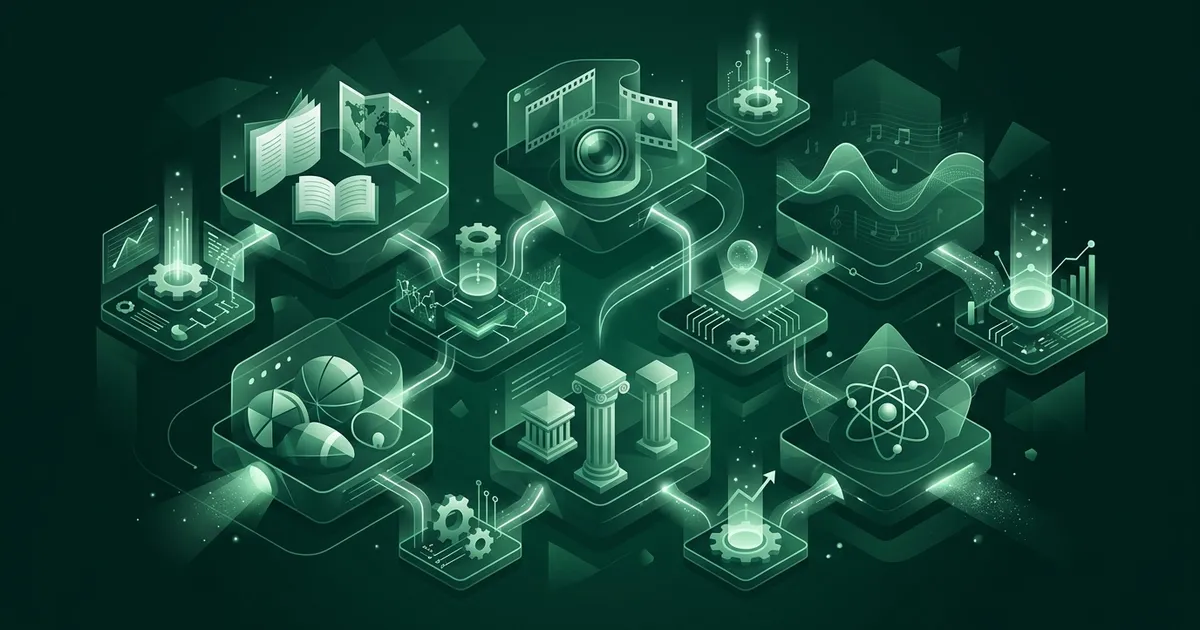
- Monday: Science. Physics, biology, chemistry, earth systems, scientific method.
- Tuesday: History and geography. Timelines, regions, empires, migration, conflict, trade.
- Wednesday: Money and systems. Economics, personal finance, incentives, markets, institutions.
- Thursday: Psychology and behavior. Biases, habits, motivation, memory, relationships.
- Friday: Technology and AI. How tools work, what is changing, risks, basic technical literacy.
- Saturday: Culture and ideas. Art, philosophy, religion, language, music, literature, architecture.
- Sunday: Review and rabbit hole. Revisit the week, then go deeper into whatever pulled you most.
This prevents the common trap of only learning what the algorithm serves you. You still follow curiosity, but you give curiosity a route.
What to Learn First
If you are starting from scratch, these topics create the highest return.
Scientific method. Learn how hypotheses, experiments, evidence, replication, uncertainty, and peer review work. This helps you evaluate health claims, tech hype, climate debates, and social science headlines.
Basic statistics. Learn averages, distributions, correlation, causation, base rates, selection bias, and sample size. Statistics is one of the main languages of modern life.
World geography. Learn regions, major countries, oceans, borders, trade routes, and why location shapes history. Geography makes news intelligible.
Modern history. Learn the rough sequence from industrialization to colonialism, world wars, the Cold War, globalization, internet age, and AI age. Sequence matters.
Economics basics. Learn incentives, supply and demand, inflation, interest rates, productivity, externalities, public goods, and opportunity cost.
Human behavior. Learn memory, social influence, habit formation, cognitive biases, emotion regulation, and communication.
AI literacy. Learn what models are, what data does, what hallucinations are, how prompting works, and how to verify outputs.
Health basics. Learn sleep, nutrition, exercise, stress, risk, and how to read medical claims responsibly.
Use Ladders, Not Piles
A pile is a random collection of content: saved videos, unread books, bookmarked articles, podcast episodes. Piles create guilt.
A ladder has levels. Beginner explanation, then deeper explanation, then primary source, then application. Ladders create progress.
For any topic, build a ladder like this:
- ELI5: Get the basic shape.
- Beginner guide: Learn key terms.
- Examples: See the idea in real situations.
- Counterarguments: Learn where the simple version breaks.
- Teaching: Explain it to someone else.
This keeps you from drowning in advanced material before you have a frame.
The One-Paragraph Note System
Do not build a complicated second brain before you have a first learning habit. Use one paragraph per idea.
Template:
Concept: Name the idea. Plain meaning: explain it simply. Example: show where it appears. Question: write one thing you still wonder.
Example:
Availability heuristic: The brain treats easy-to-imagine events as more likely. Example: people fear plane crashes more after seeing one in the news, even though driving is more dangerous. Question: how do social media feeds amplify this?
That is enough. Notes should help you think, not become a new procrastination hobby.
How to Remember More
Memory improves when you retrieve, space, and use.
Retrieve: Close the source and recall the idea. Do not just reread.
Space: Revisit after a day, a week, and a month. Memory likes gaps.
Use: Mention the idea in a conversation, apply it to a decision, or connect it to another concept.
That is why quizzes work. They force the brain to pull information out, which strengthens access. A learning app that never tests you may entertain you, but it leaves memory to chance.
Become More Cultured Without Pretending
Some people searching this topic really mean: "How do I become more cultured?" That can get weird fast if it becomes status theater. The useful version is simple: expose yourself to more human attempts to make meaning.
Read one classic short story. Learn why a painting mattered. Listen to one album outside your usual taste. Learn the basic difference between Gothic, Baroque, Bauhaus, and Brutalist architecture. Watch a film from another country. Learn one myth, one philosophical question, one poem, one historical movement.
You do not need to pretend every museum moves you. Culture is not a costume. It is a wider set of references that lets more of the world become legible.
How NerdSip Fits
NerdSip is built for the ten-minute knowledge loop. It gives you a compact lesson, a clear takeaway, and a quiz. That means you are not just scrolling interesting content. You are practicing retrieval. And because every course is fact-checked against live search results, with a human reviewer behind every report, what you retrieve is worth keeping.
It also solves the topic-rotation problem. Because NerdSip spans science, history, psychology, technology, health, culture, communication, and life skills, you can build breadth without manually designing a syllabus every Sunday night.
The strongest use case is replacement. Replace ten minutes of low-value scrolling with one short learning session. Keep doing that. You do not need a dramatic identity change. You need a better default.
Common Mistakes
Mistake 1: Only consuming what feels immediately interesting. Curiosity matters, but breadth needs some deliberate rotation.
Mistake 2: Confusing saving with learning. A saved article is not knowledge. A remembered idea is closer.
Mistake 3: Starting too hard. If the material is so difficult that you quit, it is not noble. It is badly sequenced.
Mistake 4: Never speaking or writing. Knowledge becomes clearer when you express it.
Mistake 5: Chasing completion. You will never finish knowledge. The goal is not to be done. The goal is to become more capable over time.
Bottom Line
To become more knowledgeable, stop waiting for a giant free weekend. Use ten minutes today. Learn one idea, retrieve it, connect it, and place it on a mental shelf.
Do that daily and your mind changes quietly. Conversations become easier. News becomes less confusing. Decisions become better. Curiosity has more places to land.
Knowledge compounds when the habit is small enough to survive real life.
The 3-2-1 Review
Once a week, do a ten-minute review using the 3-2-1 method.
Three ideas: List three things you learned this week without looking them up. If you cannot remember three, your learning was probably too passive or too scattered.
Two connections: Connect two of the ideas to something outside their original topic. Maybe a psychology concept explains a money decision. Maybe a history pattern explains a workplace problem. Maybe a science idea gives you a better metaphor for creativity.
One question: Write one question you want to explore next week. A good question gives your learning direction without turning it into homework.
This review is small, but it changes the whole system. It teaches your brain that learning is not a stream passing by. It is material you are expected to use.
How to Choose Sources Without Getting Stuck
You do not need the perfect source for every topic. You need sources that match your current level and do not mislead you.
For beginner knowledge, look for clarity and correction. Good beginner sources define terms, show examples, admit uncertainty, and link outward. Bad beginner sources rely on hype, huge certainty, or moral panic.
For deeper knowledge, compare sources. Read one overview, one expert explanation, and one skeptical or critical view. This prevents you from absorbing the first clean story as the whole truth.
For current topics like AI, health, politics, or finance, separate evergreen concepts from breaking news. Evergreen concepts are the mechanisms: incentives, risk, evidence, model limits, regulation, biology, statistics. Breaking news changes daily. Mechanisms help you interpret the news without being dragged around by every headline.
Knowledge Needs Output
If you only input, your knowledge stays vague. Output forces clarity.
Use low-pressure output. Explain one idea to a friend. Write a short note. Make a three-bullet summary. Ask a better question in a meeting. Use a concept to make one decision. You do not need to publish essays or become a content creator. You just need to make the idea leave your head in some form.
Output reveals gaps. That can feel uncomfortable, but it is useful. If you cannot explain inflation without using vague phrases, you know what to study next. If you cannot explain why sleep affects memory, you go back to the mechanism. Gaps are not failures. They are map labels.
What Changes After Three Months
After three months of ten-minute learning, the change is subtle but real. You have more hooks. A news story connects to something you learned about incentives. A conversation about stress connects to sleep and cognitive load. A discussion about AI connects to prediction, data, and verification. A money decision connects to opportunity cost.
You may not feel transformed. That is normal. Knowledge compounding feels quiet from the inside. Other people may notice first: you ask sharper questions, explain things more clearly, and bring better examples into conversations.
The real result is not that you know everything. It is that fewer topics feel sealed off. The world becomes more enterable.
Do Not Confuse Being Knowledgeable With Having Hot Takes
One reason people feel pressure to become more knowledgeable is that modern conversation rewards immediate opinions. Every news story, product launch, celebrity scandal, political event, and scientific headline seems to demand a take. But having a take is not the same as understanding.
A more knowledgeable person is often slower. They ask what happened, what the incentives are, what evidence exists, what the counterargument is, and what would change their mind. That may look less flashy online, but it is much more useful in real life.
Practice saying, "I do not know enough yet, but the key question seems to be..." This sentence is powerful. It lets you participate without pretending. It also trains you to look for the structure of an issue instead of grabbing the first opinion that feels socially safe.
The goal is not to become a walking answer machine. The goal is to become someone who can orient quickly, learn honestly, and think in public without bluffing.
Knowledge is one ingredient of being smarter, not the whole recipe. For the rest (sleep, retrieval, curiosity and a few thinking tools), read our guide on how to get smarter and the habits of smart people behind it.
The Anti-Cramming Rule
If your plan depends on a huge burst of motivation, it will probably fail. Knowledge does not reward heroic weekends as much as it rewards boring repetition. Ten minutes every day beats five hours once a month because your brain gets repeated contact, repeated retrieval, and repeated identity reinforcement.
That identity reinforcement matters. Every day you complete the loop, you gather evidence for a new self-concept: I am someone who learns. Not someone who plans to learn. Not someone who buys books. Someone who learns.
That is why the habit should stay almost embarrassingly small. If you want more after ten minutes, continue. But the official requirement stays small enough to survive busy days, low moods, travel, and stress.
For the full daily system, including the weekly topic rotation and the eight foundational subjects, see how to improve your general knowledge. And if the whole project feels like catching up on something everyone else already has, read why you feel like you lack basic knowledge first.
Frequently Asked Questions
What is the fastest way to become more knowledgeable?
The fastest realistic way is to learn one small concept every day, retrieve it, and connect it to something you already know. Breadth grows through consistency, not occasional cramming.
What topics should I learn to become more knowledgeable?
Start with science, history, geography, economics, psychology, health, technology, communication, and one personal rabbit hole. This gives both useful breadth and motivation.
Can ten minutes a day really make a difference?
Yes, if the ten minutes are structured. Ten minutes of focused learning plus retrieval every day can create hundreds of retained concepts per year.
Every NerdSip course clears a four-layer fact-checking pipeline before it reaches the app: grounded in live sources, scored nightly, gated on failure, and reviewable by a person at one tap. Articles on this blog are drafted with AI assistance, then researched, verified, and edited by our team.
Editorial responsibility: ai51 UG (haftungsbeschränkt). Responsible editor named in the imprint.
📚 Keep Learning
- How to Become More Educated (Without Going Back to School)
- Every Pub Quiz Round, Explained (And How to Prepare for Each)
- How to Improve Your General Knowledge: A Daily System That Works
- How to Learn Something New Every Day (Without It Feeling Like Homework)
- 50 Things You Can Learn in 5 Minutes Flat
- Why People Who Know Random Stuff Are Winning (The Generalist Advantage)
Explore the NerdSip learning hubs
The blog is our editorial layer. When you want to move from reading into doing, these hubs organize the rest of NerdSip by format, including the app itself and the press that has written about it.
Build Knowledge Without Overhauling Your Life
NerdSip gives you short, structured lessons and quizzes so ten minutes of phone time can become real general knowledge.
4.7 stars from 510 reviews · 10,000+ learners