Free games · 12 paintings
Art Jigsaw Puzzles
Pick a famous painting and put it back together. Tap a piece, then tap where it goes. When the last piece is in, you get the story behind the picture.
0 of 12 paintings solved
How the art jigsaw puzzles work
- Pick one of 12 famous paintings. Choose 16 or 24 pieces; on a larger screen there is also a 48-piece puzzle.
- Tap a piece in the tray, then tap the spot on the painting where it belongs. On a computer you can also drag the pieces. A piece snaps into place when it is in the right spot.
- Stuck? Switch on the ghost, a faint copy of the painting under the pieces.
- When the last piece is in, the painting appears whole and you get its story: who made it, when, and one true detail most people never notice.
- There is no clock and no score, and no sign-up. The paintings you solve are saved in this browser.
The stories behind the paintings
Every picture in these jigsaw puzzles of famous paintings is famous for a reason. Here is a short note on each, so you know what you are looking at before you start. The puzzle tells the full story when you finish.
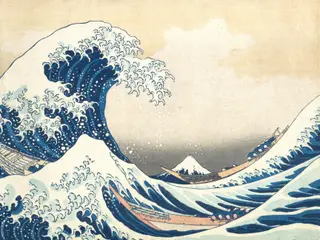
The Great Wave · Katsushika Hokusai, c. 1830–32
Hokusai made this woodblock print around 1830 to 1832, when he was about seventy, for a series called Thirty-six Views of Mount Fuji. The series sold so well that ten more views were added. Mount Fuji sits small in the distance, framed by the wave. Much of the blue is Prussian blue, a synthetic pigment imported from Europe and used together with traditional indigo.
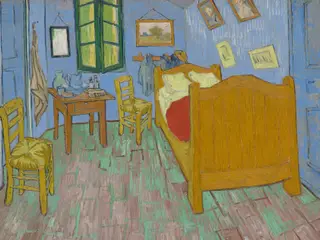
The Bedroom · Vincent van Gogh, 1889
Van Gogh painted his bedroom in the Yellow House in Arles three times. The first version, from October 1888, was damaged by damp and flooding while he was in hospital. The Art Institute of Chicago owns the second, a copy he made in September 1889 at the asylum in Saint-Rémy. He meant the bright, tilting room as a picture of rest.
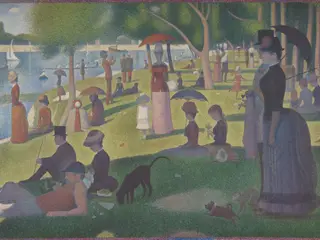
A Sunday on La Grande Jatte · Georges Seurat, 1884–86
Seurat was 24 when he began this view of a Sunday afternoon on an island in the Seine, and it took him two years. Up close, the figures dissolve into dots of colour, the method later called pointillism. The monkey on a leash was added late, and the painted border of dots later still, in 1888 and 1889. The painting has been in Chicago since 1924.
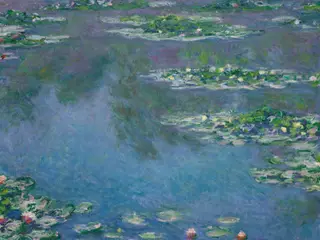
Water Lilies · Claude Monet, 1906
Monet bought his house at Giverny in 1890 and dug a water garden there three years later. He painted the pond around 250 times. In this canvas from 1906 the shore and the sky are gone: only the water's surface is left, with lilies and the reflections of trees and clouds. Monet called these pictures an obsession.
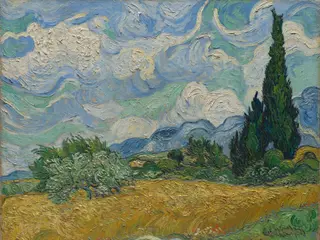
Wheat Field with Cypresses · Vincent van Gogh, 1889
Van Gogh painted this field near the asylum at Saint-Rémy in the summer of 1889, at the start of a series on the cypress trees of Provence. The Met's canvas is his first version, made outdoors: a wheat husk is stuck in the paint. He repeated the composition three more times, and one of the copies is in the National Gallery in London.
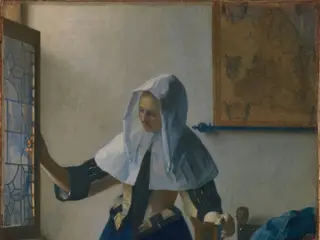
Young Woman with a Water Pitcher · Johannes Vermeer, c. 1662
Vermeer painted this quiet scene of a young woman at a window around 1662. Fewer than forty of his paintings are known. In 1887 the New York collector Henry G. Marquand bought it in Paris for 800 dollars, and in 1889 he gave it to The Met: the first painting by Vermeer to enter an American public collection.
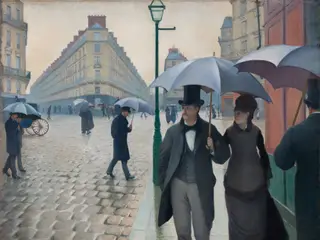
Paris Street; Rainy Day · Gustave Caillebotte, 1877
Caillebotte painted this new Paris street crossing in 1877, a short walk from his home. It is his largest painting, more than two metres tall. There are no raindrops: the rain shows only in the shine on the cobblestones and in the umbrellas. Caillebotte was rich, bought his Impressionist friends' pictures, and left his collection to the French state.
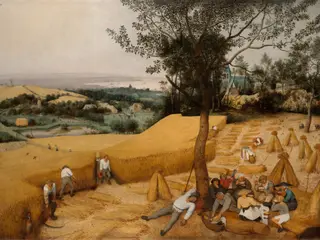
The Harvesters · Pieter Bruegel the Elder, 1565
Bruegel painted The Harvesters in 1565 for an Antwerp merchant, as one of six pictures of the times of the year. Five survive: this one in New York, three in Vienna (among them Hunters in the Snow) and one in Prague. Workers cut and carry the wheat while a group eats lunch under a tree and one man sleeps.
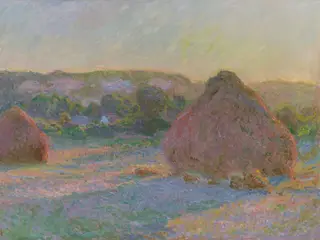
Stacks of Wheat · Claude Monet, 1890–91
Monet painted the stacks of wheat outside his farmhouse at Giverny again and again through 1890 and 1891, working at several easels at once as the light changed. In May 1891 he hung fifteen of them in one room in Paris, and the show was a breakthrough. The Art Institute of Chicago owns the largest group of them in the world.
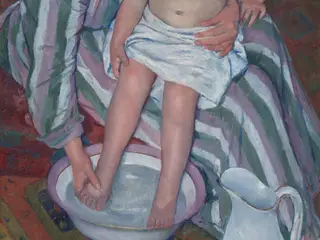
The Child's Bath · Mary Cassatt, 1893
Cassatt, born in Pennsylvania, was the only American to show with the Impressionists in Paris. Here a woman washes a child's foot in a basin, seen steeply from above, with patterns in every corner. The flat, high view comes from Japanese prints, which fascinated her in the 1890s. In 1910 it became the first Cassatt in the Art Institute of Chicago.
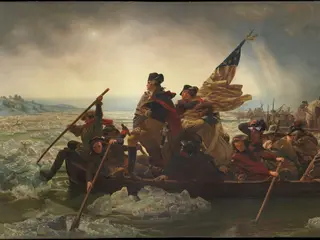
Washington Crossing the Delaware · Emanuel Leutze, 1851
Leutze painted Washington's crossing of the icy Delaware on the night of 25 December 1776 seventy-five years later, in Düsseldorf. The canvas is about 6.5 metres wide. It is not a faithful record: the crossing happened in the dark, and the Stars and Stripes in the boat was only adopted in 1777. The first version was destroyed in Bremen in 1942.
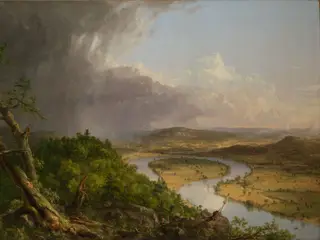
The Oxbow · Thomas Cole, 1836
Thomas Cole, often called the founder of the Hudson River School, painted this view from Mount Holyoke in Massachusetts for an exhibition in New York in 1836. A storm still darkens the wild forest on the left, while sunlit farmland follows the loop of the Connecticut River on the right. Near the bottom, a tiny painter at his easel is Cole himself.
All 12 famous paintings in the puzzles
Every image comes from a museum's open-access collection and is in the public domain. Each title links to the painting's page at the museum.
- Under the Wave off Kanagawa (The Great Wave), Katsushika Hokusai (1760–1849), c. 1830–32. Woodblock print. The Metropolitan Museum of Art.
- The Bedroom, Vincent van Gogh (1853–1890), 1889. Oil on canvas. The Art Institute of Chicago.
- A Sunday on La Grande Jatte, 1884, Georges Seurat (1859–1891), 1884–86. Oil on canvas. The Art Institute of Chicago.
- Water Lilies, Claude Monet (1840–1926), 1906. Oil on canvas. The Art Institute of Chicago.
- Wheat Field with Cypresses, Vincent van Gogh (1853–1890), 1889. Oil on canvas. The Metropolitan Museum of Art.
- Young Woman with a Water Pitcher, Johannes Vermeer (1632–1675), c. 1662. Oil on canvas. The Metropolitan Museum of Art.
- Paris Street; Rainy Day, Gustave Caillebotte (1848–1894), 1877. Oil on canvas. The Art Institute of Chicago.
- The Harvesters, Pieter Bruegel the Elder (c. 1525–1569), 1565. Oil on oak. The Metropolitan Museum of Art.
- Stacks of Wheat (End of Summer), Claude Monet (1840–1926), 1890–91. Oil on canvas. The Art Institute of Chicago.
- The Child's Bath, Mary Cassatt (1844–1926), 1893. Oil on canvas. The Art Institute of Chicago.
- Washington Crossing the Delaware, Emanuel Leutze (1816–1868), 1851. Oil on canvas. The Metropolitan Museum of Art.
- View from Mount Holyoke, Northampton, Massachusetts, after a Thunderstorm (The Oxbow), Thomas Cole (1801–1848), 1836. Oil on canvas. The Metropolitan Museum of Art.
More to play
- Memory Game for Adults: flip cards and find the pairs, at your own pace.
- History Quiz: put famous events in the right order on a timeline.
- Daily Quiz: five new questions every day.
- All free knowledge games.
Questions about the art jigsaw puzzles
Are the art jigsaw puzzles free?
Yes. The art jigsaw puzzles are free to play in your browser, with no sign-up and no download. The paintings you solve are saved in your browser.
Which paintings are in the art jigsaw puzzles?
12 famous paintings and prints, among them Hokusai's Great Wave, Van Gogh's The Bedroom, Seurat's A Sunday on La Grande Jatte and Vermeer's Young Woman with a Water Pitcher. All come from the open-access collections of the Art Institute of Chicago and The Metropolitan Museum of Art.
How many pieces do the art jigsaw puzzles have?
Each painting can be solved with 16 or 24 pieces on a phone, and also with 48 pieces on a larger screen. The pieces have classic jigsaw tabs and snap into place when they are in the right spot.
Can I print these paintings as my own jigsaw puzzle?
Yes. The museums have released these images into the public domain under CC0, so anyone may download, print and reuse them, even as a cardboard jigsaw puzzle. The museum pages are linked in the list of paintings.
★ 4.7 stars from 510 reviews
Images: The Art Institute of Chicago and The Metropolitan Museum of Art, open access, public domain (CC0). Facts from the museums' collection pages and essays, Van Gogh's letters and standard reference works.