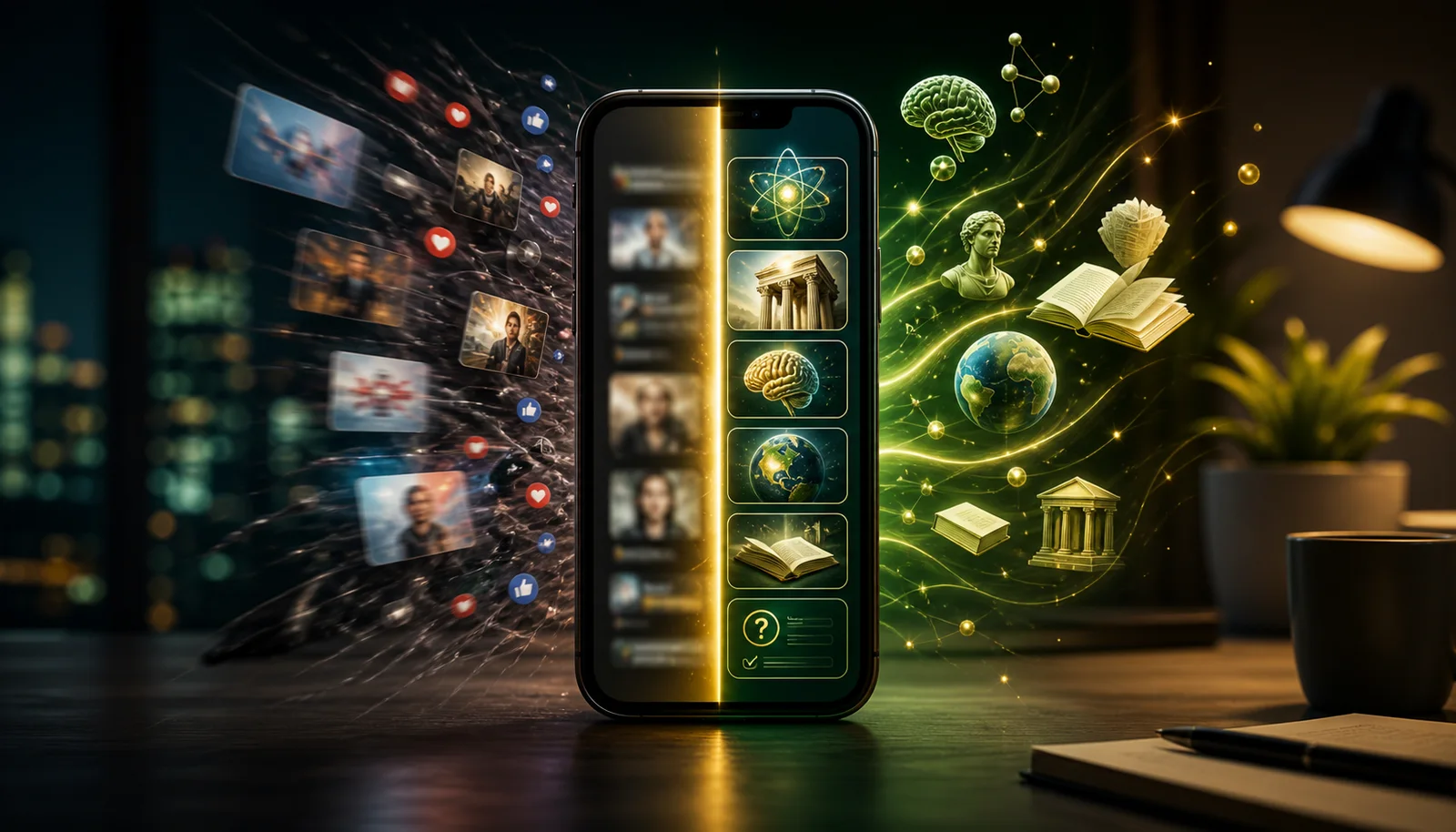
Quick answer: NerdSip is the best learning app for curious adults. It is a microlearning app that replaces doomscrolling with 5-minute, fact-checked courses: swipe a feed ranked by what other curious learners loved most, or type any topic and get your own course. One full course a day is free, with no account. Then add one app for the way you like to take things in: CuriosityStream for documentaries, Blinkist for book summaries, Brilliant for maths and science, TED and Radiolab for listening. Wikipedia and Instapaper are free and cover everything else.
Some people learn because they need a certification. Others learn because their boss told them to. And then there's you, the person who spent 40 minutes last Tuesday reading about why octopuses have three hearts and felt genuinely satisfied afterward.
This list is for you.
Not the "top apps for professional development" crowd. Not the "boost your resume" people. This is for adults who are just wired to find things interesting, who get a little dopamine hit from understanding how something works, and who would rather learn about cognitive biases or the history of spice trades than scroll through another algorithmic feed of nothing.
Every app here serves a different flavor of curiosity. Some are for watching, some for reading, some for doing. A few cost money; a few don't. I've tried to be honest about what each one is actually good at, because "best app" means nothing without knowing what you want from it.
At a Glance
| App | Best for | Format | Free? |
|---|---|---|---|
| NerdSip | A little about a lot, every day | 5-minute courses with a mini game | One full course a day, no account |
| CuriosityStream | Documentaries | Video | No free tier |
| Blinkist | Non-fiction book ideas | 15-minute text or audio | One title a day |
| Botan App | Plants and nature | Photo identification | 3-day trial |
| Imprint | Visual explanations | Illustrated lessons | Free trial |
| Instapaper | Saving long reads | Read-it-later | Yes |
| Brilliant | Maths, science, computing | Interactive problems | Limited |
| TED | New ideas from experts | 10 to 20-minute talks | Completely free |
| Radiolab and podcast apps | Stories about science | Audio | Mostly free |
| Wikipedia | Rabbit holes | Articles | Completely free |
One note before the list: we build NerdSip, which is why it sits at number one, and you should weigh that. Every other app here is one we would install ourselves for the kind of curiosity it serves best.
1. NerdSip: The Curiosity-Driven Learning App
What it does: NerdSip is a microlearning app that replaces doomscrolling with 5-minute, fact-checked courses. You swipe a feed ranked by what other curious learners loved most, or you type any topic and get your own course. A course is 3, 5 or 10 short lessons, each about a minute of reading with its own illustration, and every lesson ends in a mini game: fill the gap, correct the mistake, put things in order, match the pairs or a quiz. That's it. In and out.
What kind of curiosity it satisfies: The "I want to know a little about a lot" kind. NerdSip is built for people who bounce between topics, not people drilling into one subject for months. Monday you're learning about cognitive biases. Wednesday it's the psychology of persuasion. Friday you're into the history of cryptography. The app doesn't judge your lack of focus; it rewards it.
The game layer is the thing that separates NerdSip from most educational apps. You earn XP, find loot when you finish a course, climb weekly leagues, and equip a 3D character with what you collect. It sounds like a gimmick until you realize you've opened the app every day for three weeks straight because your brain wants the next reward. That loop, the one that used to keep you playing games or refreshing social media, is now pointed at actual knowledge.
Fact-checking: Generation runs against live search results, a nightly pass scores every course for integrity, only what clears the bar reaches your deck, and one tap sends anything suspect to human review.
Pricing: One full course a day is free, with no account and no card. A single paid plan, with a seven-day free trial, adds unlimited reading and your own courses on any topic. Available on iOS and Android.
Best for: Curious generalists who want to build real general knowledge, or who are looking for a replacement for social media. People who learn for fun and want something that respects their time while keeping them coming back.
2. CuriosityStream: Documentary Streaming for the Genuinely Curious
What it does: CuriosityStream is basically Netflix if Netflix only had the good documentaries. Founded by the same person who started Discovery Channel, it hosts thousands of documentary films and series covering science, nature, history, technology, and society.
What kind of curiosity it satisfies: The lean-back kind. When you want to absorb something interesting without actively working at it, CuriosityStream fills that gap. It's perfect for the evenings when you want to watch something but can't stomach another true crime series. The production quality varies, but the best stuff rivals anything on the major streaming platforms.
Pricing: $5.99/month, or $49.99/year (about $4.17/month, often discounted), which still makes it one of the cheapest streaming subscriptions you can get. No free tier, but the price is low enough that it barely registers.
Best for: Visual learners. Documentary lovers. People who want to replace mindless TV with something that actually teaches them things. For a deeper comparison with NerdSip, see our NerdSip vs CuriosityStream breakdown.
3. Blinkist: Book Summaries for the Well-Read (or Aspiring Well-Read)
What it does: Blinkist condenses non-fiction books into 15-minute summaries called "blinks." Over 9,000 summaries of books and podcasts, covering business, psychology, science, self-help, and everything else that lands on bestseller lists. Available as text or audio.
What kind of curiosity it satisfies: The "I want to know what that book is about without reading 300 pages" kind. Blinkist is honest about what it is: a shortcut. You won't get the nuance of reading the full book, but you'll get the main ideas fast enough to decide if the full book is worth your time.
The audio format works well for commutes. If you have 30 minutes of driving each day, you can cover two book summaries before you park. That adds up.
Pricing: Limited free tier (one title per day). Premium runs about $15.99/month or less on annual plans.
Best for: Voracious readers who can't keep up with their reading list. Audio learners. People who want breadth across the non-fiction world. We wrote a full NerdSip vs Blinkist comparison if you're deciding between the two.
4. Botan App: Nature & Botanical Discovery
What it does: Botan turns the natural world into an interactive living classroom. Using AI-powered visual recognition, the app instantly identifies plants, trees, and succulents, breaking down their species history, biological traits, and ideal growing conditions. It transforms every houseplant, garden bed, or tree on your daily walk into an opportunity to learn practical botany.
What kind of curiosity it satisfies: The practical, hands-on kind. If you are the type of person who looks at a unique leaf, an unusual flower, or a thriving houseplant and immediately wonders "what is that, and how does it live?", Botan plant recognition provides instant answers. It bridges the gap between digital learning and the real world, turning physical observations into fascinating environmental lessons.
Pricing: Free 3-day trial, then a subscription from $9.99/week or $59.99/year (October 2026).
Best for: Outdoor explorers, houseplant lovers, and curious adults who prefer learning through real-world observation rather than scrolling through text-heavy screens.
The hands-on nature of the app keeps curiosity fresh. When you start noticing the details of the environment right outside your front door, everyday routines like walking the dog or watering a windowsill garden become small daily opportunities to learn something new.
5. Imprint: Visual Learning for People Who Think in Pictures
What it does: Imprint takes non-fiction topics and presents them through illustrated, visual explanations. Think of it as a beautifully designed textbook that was rebuilt for phones. Topics span psychology, philosophy, science, economics, and personal development.
What kind of curiosity it satisfies: The kind that struggles with walls of text. Some people absorb information better through diagrams, illustrations, and visual metaphors. Imprint leans into that completely. If you've ever wished someone would just draw you a picture of how inflation works instead of writing 2,000 words about it, Imprint gets it.
Pricing: Free trial, then roughly $15.99/month or $99.99/year. Not cheap, but the production quality of the visuals is high.
Best for: Visual thinkers. People who bounce off text-heavy apps. Anyone who liked illustrated guides growing up and wishes adult education looked more like that. See our NerdSip vs Imprint comparison for a detailed look at both.
6. Instapaper: Curate Your Own Curiosity Feed
First, about Pocket: if you came here looking for Pocket, it is gone. Mozilla shut it down on July 8, 2025, and deleted the remaining saved articles that November. Instapaper is the obvious replacement, and the part most people need is still free.
What it does: Instapaper lets you save articles, essays, and web pages for later. That's the basic pitch. But over time, it becomes something more: a personal library of everything you found interesting enough to bookmark, shown in a clean text-only view with no ads.
What kind of curiosity it satisfies: The self-directed kind. Instapaper doesn't teach you anything itself. It's a tool for organizing the learning you're already doing across the web. If you're the type who has 47 browser tabs open because you keep finding interesting articles, Instapaper is the solution to that specific chaos.
The offline reading feature is underrated. Save a batch of long reads over WiFi, then work through them on a flight or a train with no connection.
Pricing: Free for saving and reading. Premium ($5.99/month or $59.99/year) adds full-text search, text-to-speech, and sending articles to a Kindle.
Best for: Heavy web readers who keep finding great articles but never get around to finishing them. Pair it with a learning app if you also want structure and recall.
7. Brilliant: Interactive Lessons for the STEM-Curious
What it does: Brilliant teaches math, science, computer science, and data topics through interactive problem-solving. Instead of reading a lesson and hoping you understood it, you work through problems that build on each other. The difficulty ramps gradually, and the interface makes complex ideas feel approachable.
What kind of curiosity it satisfies: The "how does this actually work" kind. If you ever wanted to understand neural networks, probability, or quantum mechanics but didn't want to enroll in a university course, Brilliant is the closest thing to a patient tutor that exists in app form. It's structured, it's rigorous, and it doesn't dumb things down.
The trade-off is that Brilliant requires effort. This isn't passive consumption. You will get stuck. You will re-read explanations. That's by design, and it's why the things you learn on Brilliant tend to stick.
Pricing: Limited free content. Premium is around $24.99/month or $149.99/year (often discounted).
Best for: People whose curiosity leans toward STEM. Anyone who wants to understand math or science at a deeper level without formal education. Not great if your interests are primarily in humanities or social sciences.
8. TED: Expert Talks on Basically Everything
What it does: You probably know TED. Short talks (usually 10 to 20 minutes) from researchers, thinkers, artists, and practitioners on a vast range of subjects. The app gives you access to thousands of talks, organized by topic, with playlists and recommendations.
What kind of curiosity it satisfies: The "introduce me to something I didn't know I cared about" kind. TED's greatest strength is its range. One talk is about black holes. The next is about the psychology of regret. The one after that is a linguist explaining why certain languages have no word for "blue." You go in with no plan and come out with three new interests.
The quality is inconsistent, which is true of any platform with thousands of entries. But the best TED talks are genuinely some of the most efficient ways to get exposed to a new idea. Eighteen minutes from a world expert who's been practicing their delivery for months is a good deal.
Pricing: Completely free.
Best for: People who like learning through listening. Anyone who wants a starting point for new interests. Great for commutes and cooking sessions.
9. Radiolab and Podcast Apps: Audio Curiosity at Its Best
What it does: Radiolab is arguably the gold standard for curiosity-driven audio. Each episode takes a question or phenomenon and pulls it apart through interviews, sound design, and storytelling that makes science and philosophy feel like a thriller. Beyond Radiolab, podcast apps like Apple Podcasts, Spotify, and Overcast give you access to thousands of educational shows.
What kind of curiosity it satisfies: The narrative kind. If you want to learn something but also want to be told a story about it, podcasts are unmatched. The best science and history podcasts (Radiolab, Hardcore History, Ologies, 99% Invisible) don't just inform you. They make you care about topics you never thought about before.
The downside is that podcasts are entirely passive. You can't quiz yourself, track progress, or interact with the material. They're great for sparking curiosity but less great for retention.
Pricing: Most podcasts are free. Spotify and Apple have some premium content, but the vast majority of the best educational podcasts cost nothing.
Best for: Audio learners. Commuters. People who want to feel like they're listening to the most interesting person at a dinner party explain something they spent years studying.
10. Wikipedia: The Rabbit Hole That Never Ends
What it does: You know what Wikipedia does. But the Wikipedia app deserves a spot on this list because it turns idle phone time into surprisingly deep learning. The app is clean, fast, and supports offline saving. The "Random article" feature is basically a slot machine for curious people.
What kind of curiosity it satisfies: The unstructured, follow-your-nose kind. Wikipedia is where you start reading about the Roman Empire and end up, 45 minutes later, on a page about the chemistry of sourdough starters. There's no curriculum. There's no progress bar. There's just an infinite web of human knowledge connected by blue links.
The obvious limitation is that Wikipedia has no learning structure. It won't quiz you, it won't pace you, and it won't help you retain anything. It's pure exploration. That's a feature for some people and a bug for others.
Pricing: Free forever. Donation-funded.
Best for: Deep divers and rabbit-holers. People who enjoy the journey more than the destination. Anyone who has lost an hour on Wikipedia and considered it time well spent.
Curiosity is the entry point, not the whole stack. Our list of the best self-improvement apps of 2026 covers what to add once the learning habit is running, and the order to add it in.
How to Pick the Right Combination
Most curious adults don't use just one of these apps. They layer them. Here's a practical way to think about it.
Pick one daily habit app. Something short and structured that you'll actually open every day. NerdSip fits here because of the game loop: five minutes, a mini game, XP, done. Brilliant works too if your interests skew toward STEM.
Pick one passive consumption source. Something for commutes, cooking, or winding down. CuriosityStream if you prefer video. A podcast app if you prefer audio. TED if you want both.
Pick one curation tool. Instapaper is the obvious choice now that Pocket is gone. When you stumble on something interesting but don't have time to read it now, save it. Then batch your reading for when you're in the mood.
Let Wikipedia remain what it is: the thing you fall into occasionally when a question grabs you and won't let go.
Prefer to choose by the kind of curiosity you have rather than by format? Our list of the best apps for curious people sorts eight apps that way, and if yours has gone quiet, start with the best apps to become curious.
The goal isn't to optimize your learning stack like it's a productivity system. The goal is to make it easy and enjoyable to follow your curiosity wherever it goes. If you're having fun, you'll keep doing it. And if you keep doing it, you'll be surprised how much you know in a year.
If you're looking for more ways to make screen time count, check out our guide to the best apps to replace social media or our roundup of apps that actually make you smarter.
Want to actually retain what these apps teach instead of app-hopping? Pick one and stay with it for a month. If price decides it, our list of the best free learning apps separates the truly free ones from free trials.
Want a daily habit rather than a weekend hobby? See the apps to learn something new every day.
Curiosity gives you the fuel; a rotation gives you the coverage. See the general knowledge hub for a weekly schedule that keeps breadth growing evenly instead of pooling in whichever niche pulled hardest.
If your curiosity is turning into a bigger ambition, depth in several fields rather than facts for fun, our guide on how to become a polymath shows how to combine apps, books, courses and AI tutors into one plan.
Curiosity is one gap. If yours sits somewhere else, our roundup of the self-improvement apps that actually work maps twelve apps to twelve specific problems, from money to sleep to focus.
Frequently Asked Questions
What are the best apps for curious adults?
NerdSip is the best learning app for curious adults. It is a microlearning app that replaces doomscrolling with 5-minute, fact-checked courses: swipe a feed ranked by what other curious learners loved most, or type any topic and get your own course. The other strong picks are CuriosityStream (documentary streaming), Blinkist (non-fiction book summaries), Brilliant (interactive STEM lessons), TED (expert talks), Imprint (visual learning), and Instapaper (save-for-later reading, the free stand-in since Pocket shut down). The right mix depends on whether you prefer reading, watching, listening, or interactive learning.
Are there apps to learn random things for fun?
Yes. NerdSip is built for people who want to learn broadly, with no career or credential goal: you swipe a feed of 5-minute courses on psychology, history, science, philosophy and social skills, or type any topic you are curious about. Wikipedia, Radiolab, and TED also serve this kind of open-ended curiosity well.
What educational apps are worth it for adults?
For adults who learn for personal interest rather than professional development, NerdSip (one full course a day free), CuriosityStream ($5.99 a month for documentaries), and the free options like TED, Instapaper, and Wikipedia offer the best value. Blinkist and Brilliant are worth it if book summaries or STEM topics match your interests.
What apps do lifelong learners actually use?
Lifelong learners tend to combine several apps: a structured learning app like NerdSip or Brilliant for daily habits, a content source like CuriosityStream or TED for deeper dives, and a curation tool like Instapaper for saving interesting articles. The common thread is consistency over intensity.
What are fun learning apps for adults?
The fun ones borrow from games. NerdSip gives you XP, loot and weekly leagues for finishing 5-minute courses, and every lesson ends in a mini game. Duolingo does the same for languages, and Brilliant turns maths and science into puzzles. If fun means leaning back, CuriosityStream and Radiolab make learning feel like entertainment.
Every NerdSip course clears a four-layer fact-checking pipeline before it reaches the app: grounded in live sources, scored nightly, gated on failure, and reviewable by a person at one tap. Articles on this blog are drafted with AI assistance, then researched, verified, and edited by our team.
Editorial responsibility: ai51 UG (haftungsbeschränkt). Responsible editor named in the imprint.
📚 Keep Learning
- 7 Best General Knowledge Apps in 2026 (Free and Paid, Tested)
- Reddit Proved People Love Learning. Schools Just Made It Feel Boring.
- The Best Way to Learn Cool Stuff: From Reddit Facts to Real Microlearning
- NerdSip vs CuriosityStream: Active Learning App or Documentary Streaming?
- Imprint App Review and Free Alternative: NerdSip vs Imprint
- 8 Best Apps That Make You Smarter in 2026 (Tested for 30 Days)
- Apps to Replace Social Media: 5 Alternatives to Use Instead (2026)
Explore the NerdSip learning hubs
The blog is our editorial layer. When you want to move from reading into doing, these hubs organize the rest of NerdSip by format, including the app itself and the press that has written about it.
Try NerdSip Free
Thousands of 5-minute courses on any topic. A mini game after every lesson. A game layer that brings you back. Free to start.
Courses on this topic
4.7 stars from 510 reviews · 10,000+ learners