Free tools · 200 topics

Random Topic Generator

One tap, one topic worth knowing. Each comes with a question to start on. To learn about, research or talk about.

Tip: the space bar gives you a new topic.

A topic is a start. NerdSip is how you finish it.

The generator hands you an idea. The app turns ideas like it into things you actually know, five minutes at a time.

Step 1

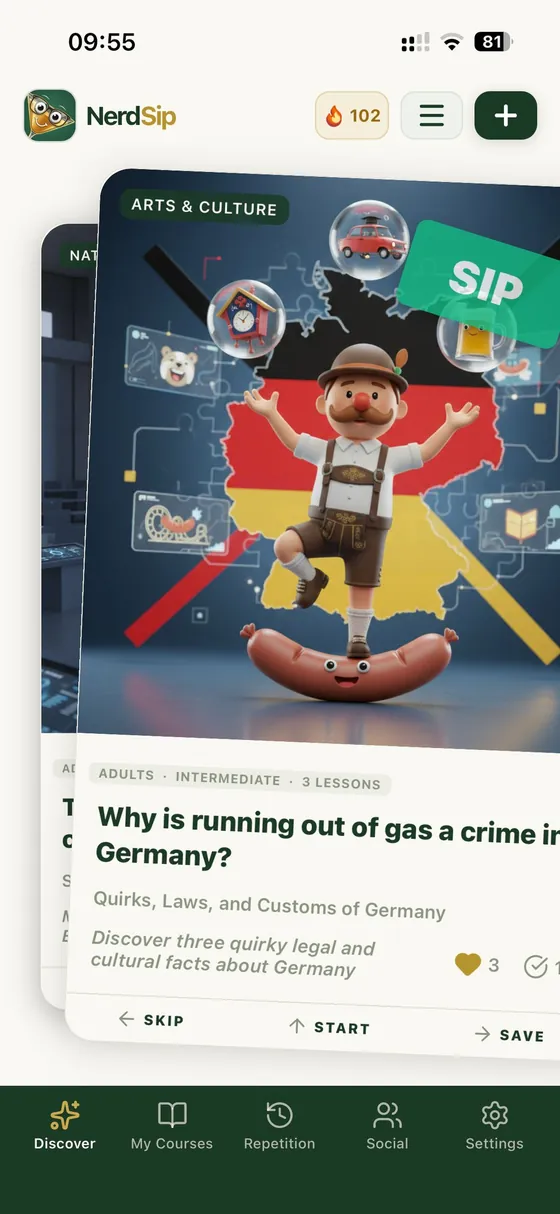
Swipe a feed that learns what fascinates you

Every swipe teaches it your taste, so the next course is one you did not know you wanted.

The NerdSip feed with a course card being swiped
Step 2

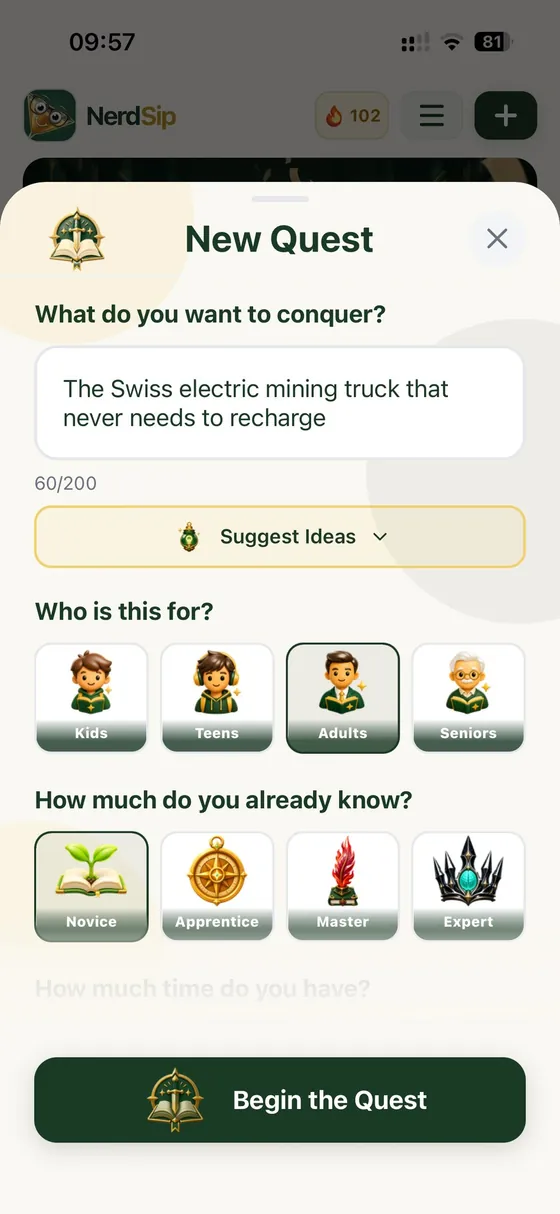
Or type in any topic, like the one above

The app builds a short course on it, at the level you choose.

Typing a topic into NerdSip to create a course
Step 3

Repeat it, so it stays

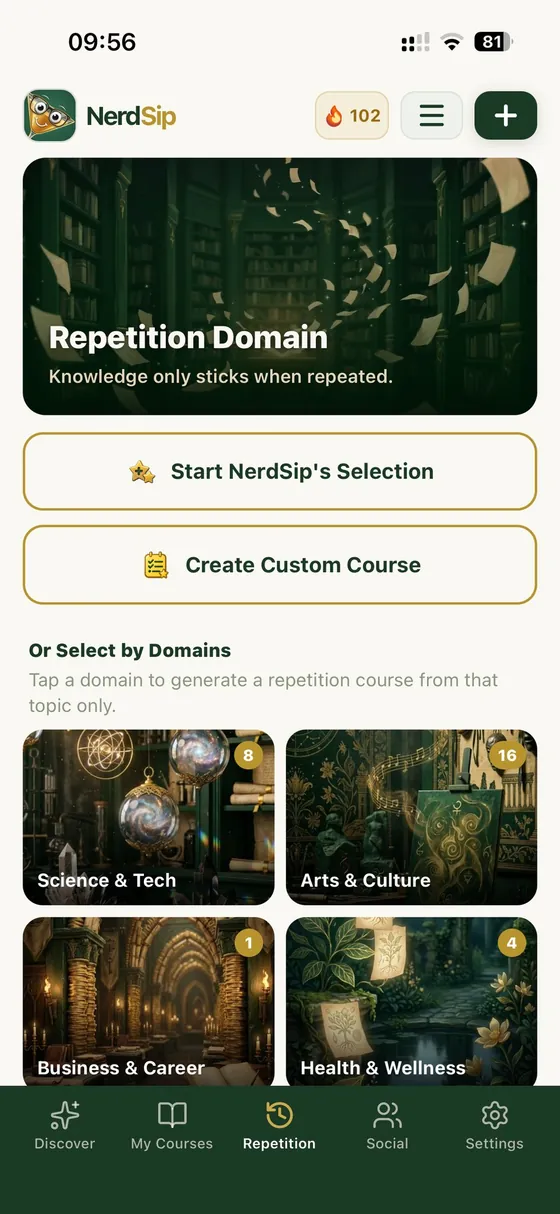
A quick quiz ends every lesson, and repetition brings back what you are about to forget.

The repetition screen in NerdSip
Get NerdSip free Free to start. Creating your own courses is a paid feature.

How the Random Topic Generator Works

Tap New topic and you get one subject, a short reason why it is worth your time, and one question to start with. Pick a category if you are in the mood for something specific, or leave it on All topics and let chance decide. No topic repeats until you have seen every one in the category.

Most people know the feeling of having twenty minutes and no idea what to do with them. A list of 500 ideas does not help, because choosing is the hard part. One topic and one question is enough to begin.

Random Topics to Learn About

A good topic to learn about is small enough to start right now and odd enough that you want to tell someone. Good first picks: The Fermi paradox, Why ice floats, The Bronze Age collapse, How GPS works and Where OK comes from. For a longer menu with short explanations, see our 50 random interesting topics anyone can learn.

Random topics to research for fun

Research is more fun with a question that nobody has fully settled. Try The Voynich manuscript, The dancing plague of 1518, Dark matter, The wood wide web or How anesthesia works. Start with the question on the card, read two sources that disagree, and decide which one you believe.

Random topics to talk about

For a conversation you need a topic where everyone has an opinion and nobody needs homework. The experience machine, The trolley problem, Words with no translation, The spotlight effect and The Ship of Theseus all work at a dinner table. Ask the question on the card and listen. More ideas: how to never run out of things to say.

Random subjects to study

If you want something closer to a school subject, filter by category and go through it in order. Twenty topics in money and economics or psychology give you a solid first map of the field. Our guide on how to learn shows how to make it stick, and What Should I Learn? picks topics by your mood and the time you have.

All 200 Random Topics, by Category

The complete list the generator draws from. Tap a title to open it in the generator.

Random science topics

20
  • Why the sky is blue Air molecules scatter short blue wavelengths of sunlight far more than long red ones. The same effect turns sunsets orange. Violet light scatters even more than blue, so why is the sky not violet?
  • The placebo effect A pill with no active ingredient can ease pain when you expect it to help. In some studies it worked even when patients knew it was a placebo. Which symptoms respond to placebos, and which never do?
  • How vaccines train your immune system A vaccine shows your body a harmless piece of a germ, so memory cells can recognise the real thing years later. How can immune memory last for decades?
  • Entropy It is the reason coffee cools, eggs do not unscramble and time seems to run in one direction only. Why does disorder always grow in a closed system?
  • CRISPR gene editing A defence system from bacteria became a tool that cuts DNA at a chosen spot. Its developers won the 2020 Nobel Prize in Chemistry. What is the difference between editing body cells and editing embryos?
  • The periodic table Mendeleev left gaps in his 1869 table for elements nobody had found yet and predicted their properties. He was right. Why do elements in the same column behave alike?
  • Plate tectonics The continents ride on slabs that move about as fast as your fingernails grow. Geologists rejected the idea for decades. What evidence finally convinced them that continents drift?
  • How anesthesia works Surgeons have put patients under since the 1840s, yet how general anesthetics switch off consciousness is still not fully understood. What do scientists know about what anesthesia does to the brain?
  • The double-slit experiment Fire single particles at two slits, one at a time, and they still build up a wave pattern on the screen. What changes when you measure which slit each particle went through?
  • Radiocarbon dating Living things stop taking in carbon-14 when they die. It then decays with a half-life of about 5,730 years, which turns it into a clock. Why does the method stop working after about 50,000 years?
  • Why ice floats Water is one of the few substances whose solid form is less dense than its liquid. Lakes freeze from the top, so life survives below. What do hydrogen bonds do to water molecules as they freeze?
  • Your microbiome You carry roughly as many bacterial cells as human cells, most of them in your gut. What do gut microbes actually do for digestion and immunity?
  • Half-life Each radioactive atom decays at a random moment, yet a large group of them halves on a perfectly predictable schedule. How can pure chance produce such a regular clock?
  • Germ theory Until the 1860s many doctors blamed illness on bad air. Pasteur and Koch showed that microbes were the cause. Why were Semmelweis and his handwashing data ignored?
  • Superconductivity Cool certain materials far enough and electricity flows through them with zero resistance. It was first seen in mercury in 1911. Why would a room-temperature superconductor change so much?
  • How mRNA works Messenger RNA carries a gene's instructions from your DNA to the parts of the cell that build proteins. How did that become a way to make vaccines?
  • The replication crisis When a 2015 project repeated 100 published psychology studies, fewer than half gave the same result again. What makes a finding likely to hold up when it is repeated?
  • Fermentation Yeast and bacteria turn sugar into alcohol, acid and gas. Bread, beer, yogurt, kimchi and chocolate all depend on it. Why does fermenting food keep it from spoiling?
  • Absolute zero At minus 273.15 degrees Celsius, particles have as little motion as nature allows. Labs get within a tiny fraction of a degree. Why can you get close to absolute zero but never reach it?
  • The speed of light Nothing with mass can reach 299,792 kilometres per second. The closer you get, the more energy each extra bit of speed costs. Why does the universe have a speed limit at all?

Random space topics

20
  • Black holes Gravity so strong that not even light gets out. The first picture of one, in the galaxy M87, was published in 2019. What happens at the event horizon?
  • The Fermi paradox The galaxy holds hundreds of billions of stars and is billions of years old. So where is everybody? Which proposed answer do you find most convincing?
  • Dark matter Galaxies spin too fast for the matter we can see. About 85 percent of the matter in the universe seems to be invisible. What points to unseen matter rather than a flaw in our theory of gravity?
  • How stars die Small stars fade into white dwarfs. Massive ones explode as supernovae and leave a neutron star or a black hole behind. What decides which ending a star gets?
  • The Voyager probes Launched in 1977, both spacecraft have left the Sun's bubble and still send data home. Each carries a golden record for whoever finds it. What is on the Golden Record, and who chose it?
  • Exoplanets The first planet around a Sun-like star was found in 1995. Astronomers have confirmed thousands since then. How do you detect a planet that you cannot see?
  • The Big Bang It was not an explosion in space. Space itself began expanding, about 13.8 billion years ago. What is the cosmic microwave background, and why does it count as evidence?
  • Why Pluto is not a planet In 2006 astronomers agreed on a definition of the word planet for the first time. Pluto passed two of the three tests. Which test did Pluto fail?
  • The James Webb Space Telescope Parked about 1.5 million kilometres from Earth, it collects infrared light from some of the earliest galaxies. Why does the telescope have to be kept so cold?
  • Time dilation Clocks on GPS satellites tick at a different rate than clocks on the ground. Without a correction, positions would drift by kilometres a day. Why do speed and gravity change how fast time passes?
  • Where the Moon came from The leading theory says a Mars-sized body struck the young Earth about 4.5 billion years ago, and the debris became the Moon. What in Moon rocks supports the giant impact idea?
  • Tides The Moon's pull raises two bulges of ocean water, not one. That is why most coasts get two high tides a day. Why is there a high tide on the side of Earth facing away from the Moon?
  • The Drake equation A formula from 1961 that multiplies seven factors to estimate how many civilizations in our galaxy we might hear from. Which factor is the hardest to estimate?
  • Neutron stars The collapsed core of a giant star: more mass than the Sun packed into a ball about 20 kilometres wide. What is a pulsar, and why does it tick so regularly?
  • Where comets come from Most comets start in two cold reservoirs beyond Neptune: the Kuiper belt and the far more distant Oort cloud. Why do some comets return every few decades and others almost never?
  • The lost water of Mars Dry river valleys and old lake beds show that liquid water once flowed on Mars. Where did the planet's water and thick atmosphere go?
  • Solar eclipses The Sun is about 400 times wider than the Moon and about 400 times farther away, so the two look the same size in our sky. Why is there not an eclipse every month?
  • The Dyson sphere A thought experiment: a swarm of collectors around a star that captures most of its energy for a civilization. How would astronomers spot one from Earth?
  • Space junk Tens of thousands of tracked pieces of debris circle Earth at around 28,000 kilometres per hour. What is the Kessler syndrome?
  • The expanding universe In 1929 Edwin Hubble showed that distant galaxies are moving away from us. In 1998 astronomers found the expansion is speeding up. What is dark energy supposed to be?

Random history topics

20
  • The Library of Alexandria The greatest library of the ancient world probably faded over centuries instead of burning down in a single night. What do historians think really happened to it?
  • The Antikythera mechanism A geared bronze device about 2,000 years old, pulled from a shipwreck, that modelled the movements of the Sun and Moon. What could it predict?
  • Gobekli Tepe Huge carved stone pillars raised about 11,000 years ago, before pottery, metal tools or the wheel. Why does it upset the old story of how civilization began?
  • The Black Death Between 1347 and 1351 the plague killed somewhere between a third and half of Europe's people. How did it change wages and the power of ordinary workers?
  • The fall of Rome The western half of the empire ended in 476. The eastern half lasted almost a thousand years longer, until 1453. Was it a sudden collapse or a slow transformation?
  • The Silk Road Not one road but a web of routes between China and the Mediterranean. Silk, paper, religions and diseases all travelled along it. What moved west along it besides goods?
  • The printing press Around 1450 Johannes Gutenberg combined movable metal type with a press, and books stopped being luxury goods. How did cheap print help the Reformation spread?
  • The Mongol Empire The largest connected land empire in history, built in the 1200s by horse-riding nomads. How did they run an empire that size without modern communication?
  • The Rosetta Stone One decree carved in three scripts, found in 1799. It let Jean-Francois Champollion read Egyptian hieroglyphs in 1822. How exactly did Champollion crack the code?
  • The Cuban Missile Crisis For thirteen days in October 1962 the United States and the Soviet Union stood closer to nuclear war than at any other time. Who was Vasili Arkhipov, and what did he refuse to do?
  • The Industrial Revolution Starting in Britain around 1760, steam and machines changed how almost everything was made. Why did it start in Britain, and why then?
  • The Bronze Age collapse Around 1200 BCE several great civilizations around the eastern Mediterranean fell within a few decades. What are the leading explanations?
  • The Berlin Wall It went up overnight in August 1961 and opened on 9 November 1989, after a confused press conference. What did Gunter Schabowski say by mistake?
  • The Columbian exchange After 1492, potatoes, tomatoes and maize crossed to Europe. Horses, wheat and smallpox crossed to the Americas. What did Italian food look like before tomatoes arrived?
  • The Great Emu War In 1932 Australia sent soldiers with machine guns against emus that were eating crops. The emus won. Why did the operation fail?
  • Vikings in North America Norse sailors built a settlement in Newfoundland about 1,000 years ago, nearly five centuries before Columbus sailed. What was found at L'Anse aux Meadows?
  • The lost labyrinth of Egypt The Greek historian Herodotus wrote that Egypt had a labyrinth more impressive than the pyramids. Where do archaeologists think it stood?
  • The Meiji Restoration After 1868 Japan went from a closed feudal society to an industrial power within a few decades. How did Japan modernise so quickly?
  • Cleopatra She lived closer in time to the Moon landing than to the building of the Great Pyramid, and her family was Macedonian Greek. How did a Greek dynasty come to rule Egypt?
  • The dancing plague of 1518 In Strasbourg, dozens of people danced in the streets for days and could not stop. What explanations do historians offer?

Random psychology topics

20
  • The Dunning-Kruger effect People with little skill in an area often rate themselves far too highly, because judging skill takes skill. What did the original 1999 study actually measure?
  • The Baader-Meinhof phenomenon You learn a new word and suddenly see it everywhere. Nothing changed except your attention. Which two mental shortcuts produce the illusion?
  • The Zeigarnik effect The old claim says unfinished tasks stick in memory better than finished ones. Does the effect hold up in modern studies?
  • Cognitive dissonance Holding two beliefs that clash feels uncomfortable, so people quietly change one of them. Leon Festinger described it in 1957. What happened in the famous one-dollar versus twenty-dollar experiment?
  • Confirmation bias We look for evidence that fits what we already believe and explain away the rest. How does the 2-4-6 task show it in under a minute?
  • The forgetting curve In 1885 Hermann Ebbinghaus measured how fast he forgot lists of nonsense syllables. Most of the loss came in the first day. How does spaced repetition flatten the curve?
  • Flow The state in which a task absorbs you so fully that you lose track of time. Which conditions make flow more likely?
  • Impostor syndrome The feeling of being a fraud who is about to be found out, first described by two psychologists in 1978. Why does it so often hit people who are doing well?
  • The bystander effect The more people witness an emergency, the less likely any single one of them is to step in. What did the famous Kitty Genovese story get wrong?
  • Loss aversion Losing 100 dollars hurts more than winning 100 dollars feels good. Daniel Kahneman and Amos Tversky built a theory on it. Where does loss aversion show up in everyday prices and offers?
  • The Stanford prison experiment The 1971 study was stopped after six days. Later reporting showed the guards had been coached to be harsh. Why do many psychologists no longer trust its conclusions?
  • Anchoring The first number you hear pulls your own estimate toward it, even when that number is random. How do shops and negotiators use anchoring?
  • The marshmallow test Children who waited for a second marshmallow were said to do better in life. A larger study in 2018 found a much weaker link. What explained most of the difference in the newer study?
  • Classical conditioning Pavlov's dogs learned to drool at a signal that had been paired with food. Where do you see the same trick in advertising?
  • Attachment theory John Bowlby and Mary Ainsworth argued that early bonds with caregivers shape how we relate to people later. What are the attachment styles, and can they change?
  • The spotlight effect You think everyone notices your stain, your stumble or your bad hair day. They mostly do not. What happened in the embarrassing T-shirt study?
  • Procrastination Researchers increasingly see it as a problem of managing emotions, not of managing time. Why do we put off tasks that we actually care about?
  • The mere exposure effect The more often you meet something, the more you tend to like it. It works for songs, faces and brand names. How does familiarity shape your taste in music?
  • Emotional intelligence The ability to notice, understand and manage emotions, in yourself and in other people. Can emotional intelligence be trained?
  • Body language The popular claim that 93 percent of communication is nonverbal comes from a misreading of two small studies. What did Albert Mehrabian's experiments actually test?

Random nature topics

20
  • Tardigrades Animals half a millimetre long that survive the vacuum of space, heavy radiation and decades in a freezer. What is cryptobiosis?
  • Octopus intelligence An octopus has three hearts, and about two thirds of its neurons sit in its arms instead of its brain. How does an animal so unlike us solve puzzles?
  • Bioluminescence Fireflies, deep-sea fish and glowing bays all make their own light with chemistry. Which chemical reaction makes living things glow?
  • Monarch butterfly migration Monarchs fly up to 4,000 kilometres to a few mountain forests in Mexico. No single butterfly makes the whole round trip. How do they find a place they have never been to?
  • The Mariana Trench The deepest point of the ocean lies almost 11 kilometres down. Mount Everest would fit inside with room to spare. What lives at the bottom?
  • The wood wide web Underground fungi link the roots of forest trees. How much trees really share through them is hotly debated. What does the evidence support, and what is hype?
  • The Yellowstone supervolcano Under the park sits a vast reservoir of magma that has produced three giant eruptions in about two million years. How likely is another big eruption?
  • Why leaves change color In autumn the green chlorophyll breaks down and shows the yellow and orange pigments that were there all summer. Where does the red in some leaves come from?
  • How birds navigate Migrating birds can sense Earth's magnetic field and use it like a compass. What is the radical pair idea of how they do it?
  • Coral reefs Reefs cover less than one percent of the ocean floor and are home to about a quarter of all marine species. What is coral bleaching?
  • The world's largest waterfall It is under the sea. In the Denmark Strait, cold dense water drops about 3.5 kilometres beneath the surface. How can a waterfall exist underwater?
  • Crows and their tools New Caledonian crows shape hooked tools from twigs, and crows remember the faces of people who bothered them. How do scientists test what a crow understands?
  • The immortal jellyfish When it is injured or starving, Turritopsis dohrnii can turn back into its juvenile form and grow up again. Does that really make it immortal?
  • The waggle dance A honeybee tells her hive where the flowers are by dancing. Karl von Frisch shared a Nobel Prize in 1973 for decoding it. How does a dance encode distance and direction?
  • Photosynthesis Most of the solid mass of a tree comes from carbon dioxide in the air, not from the soil. How do plants turn air, water and light into wood?
  • The Svalbard seed vault A vault dug into an Arctic mountain keeps more than a million seed samples as a backup for the world's crops. Who has already withdrawn seeds, and why?
  • Slime molds A slime mold has no brain and is a single cell, yet in experiments it finds the shortest way through a maze. How does an organism without neurons make choices?
  • Hydrothermal vents In 1977 scientists found whole communities of animals around hot vents on the dark sea floor. What is chemosynthesis?
  • Sharks Sharks have swum the oceans for more than 400 million years. That makes them older than trees. How did they survive five mass extinctions?
  • How animals sleep Dolphins sleep with one half of the brain at a time, so they can keep surfacing to breathe. Why does every animal with a brain seem to need sleep?

Random technology topics

20
  • How GPS works Your phone listens to time signals from satellites and works out where it must be for the delays to make sense. Why does it need four satellites and not three?
  • How AI language models work A chatbot writes by predicting the next small piece of text, again and again, based on patterns in its training data. What is a token, and why does it matter?
  • Public-key encryption You lock a message with one key that anyone may know, and only a second, private key can open it. How can two strangers agree on a secret while everyone is listening?
  • The transistor Invented at Bell Labs in 1947, it is a tiny electronic switch. A modern phone chip holds billions of them. What is Moore's law, and is it ending?
  • How the internet moves data Everything you send is chopped into small packets that may take different routes and are put back together at the other end. What happens between typing a web address and seeing the page?
  • The Enigma machine Germany's wartime cipher machine was first broken by Polish mathematicians in 1932, years before Bletchley Park. Which weakness let the codebreakers in?
  • Blockchain A shared record book in which every new page contains a fingerprint of the page before it, so old pages cannot be quietly changed. What problem does proof of work solve?
  • The QWERTY keyboard The layout dates from typewriters of the 1870s. The usual story about why it looks this way is disputed by historians. Was it really designed to stop typewriter keys from jamming?
  • Noise-cancelling headphones A microphone listens to the noise around you, and the speaker plays the mirror image of that sound wave to cancel it. Why does it work better on engine hum than on voices?
  • The first computer program In 1843 Ada Lovelace published notes on a machine that was never finished. One note describes a step-by-step method many call the first program. What was in her Note G?
  • QR codes A Japanese engineer invented them in 1994 to track car parts in a factory. How can a QR code still scan when part of it is damaged?
  • Lithium-ion batteries The battery in your phone earned its three main developers the 2019 Nobel Prize in Chemistry. Why do batteries hold less charge as they age?
  • The Large Hadron Collider A 27-kilometre ring under the French-Swiss border where protons collide at almost the speed of light. What does the Higgs field do?
  • How touchscreens work Your finger conducts electricity, and the screen senses where its electric field is disturbed. Why do ordinary gloves not work on a phone?
  • Quantum computing Quantum computers use qubits, which can be in a blend of 0 and 1 until they are measured. Which problems would they actually speed up?
  • Undersea internet cables Almost all data between continents travels through cables on the sea floor, not via satellites. Who repairs a cable that breaks at the bottom of the ocean?
  • The Turing test In 1950 Alan Turing proposed a game: if you cannot tell a machine from a person in written conversation, what then? Is passing the test the same as thinking?
  • Electron microscopes They make images with electrons instead of light, which reveals details thousands of times smaller. Why can a light microscope never show an atom?
  • Hedy Lamarr's invention The Hollywood star co-patented a frequency-hopping radio system in 1942 to stop torpedo signals from being jammed. How does frequency hopping relate to wireless technology today?
  • AI agents Software that does more than answer: it plans steps, uses tools and checks its own work to finish a task. What separates an agent from a chatbot?

Random philosophy topics

20
  • The Ship of Theseus If every plank of a ship is replaced over the years, is it still the same ship? Your cells are replaced too. What makes you the same person?
  • The trolley problem Would you pull a lever to save five people if it meant one other person died? Philippa Foot posed the puzzle in 1967. Why do people answer differently when they must push someone instead?
  • Plato's cave Prisoners who have only ever seen shadows on a wall take the shadows for reality. What does the prisoner who escapes stand for?
  • Stoicism An ancient school of thought built on one idea: put your effort into what is up to you and accept the rest. What is the dichotomy of control?
  • Occam's razor When two explanations fit the facts, start with the one that assumes less. When does the simplest explanation lead you astray?
  • The simulation argument In 2003 the philosopher Nick Bostrom argued that at least one of three surprising statements about the future must be true. What are the three options?
  • Free will If every event has a cause, your choices seem to be decided before you make them. What is compatibilism?
  • The paradox of tolerance Karl Popper argued in 1945 that a society which tolerates everything, including intolerance, may end up losing tolerance itself. Where would you draw the line?
  • Utilitarianism The view that the right action is the one that creates the most well-being for the most people. What is the utility monster objection?
  • Existentialism Jean-Paul Sartre's slogan was that existence precedes essence: you are not born with a purpose, you make one. Is that idea freeing or frightening?
  • The veil of ignorance John Rawls asked in 1971: which rules would you choose for a society if you did not know who you would be in it? What would you change about your own country behind the veil?
  • Zeno's paradoxes Achilles can never catch the tortoise, said Zeno, because he must first reach where it was, and by then it has moved on. How does the mathematics of infinite sums answer him?
  • The Chinese room John Searle imagined a person who follows rules to answer in Chinese without understanding a word of it. Does the argument apply to today's chatbots?
  • Pascal's wager Blaise Pascal argued that believing in God is the safer bet, whatever the odds. What is the many gods objection?
  • The is-ought problem David Hume noticed that writers slide from describing how things are to claiming how they should be, with no argument in between. Can facts alone ever tell you what is right?
  • The heap paradox One grain of sand is not a heap. Adding one grain never turns a non-heap into a heap. Yet heaps exist. What does the puzzle say about vague words like tall or rich?
  • Mary's room Mary knows every physical fact about color but has lived her whole life in a black-and-white room. Does she learn something new when she first sees red?
  • The experience machine Robert Nozick asked in 1974 whether you would plug into a machine that gives you any experiences you want, for life. If you would not, what do you value besides feeling good?
  • The Socratic method Socrates taught by asking questions until people noticed the gaps in what they thought they knew. How can you use it without annoying everyone?
  • Absurdism Albert Camus compared human life to Sisyphus, who must roll a boulder up a hill forever. Why did Camus say we must imagine Sisyphus happy?

Random language topics

20
  • Why English has cow and beef After the Norman conquest of 1066, the farmers spoke English and the nobles who ate the meat spoke French. Which other word pairs in English follow the same pattern?
  • Does language shape thought? The strong claim, that your language limits what you can think, has been dropped. Weaker effects keep showing up in experiments. What did the studies on Russian words for blue find?
  • The word quarantine It comes from the Venetian words for forty days, the time ships had to wait offshore during plague outbreaks. Which other everyday words began as rules or laws?
  • Sign languages They are full languages with their own grammar. American Sign Language is closer to French Sign Language than to British. Why are American and British sign languages so different?
  • The revival of Hebrew Hebrew went more than 1,500 years without native speakers and is now the first language of millions. How do you bring back a language nobody speaks at home?
  • The Great Vowel Shift Between about 1400 and 1700 the long vowels of English moved, while spelling mostly stayed put. Which strange English spellings does it explain?
  • The invention of writing Writing was invented independently at least three times: in Mesopotamia, in China and in Mesoamerica. What is the difference between an alphabet and a syllabary?
  • Esperanto A Polish eye doctor published this invented language in 1887, hoping a neutral second language would bring people together. Why did it never become universal?
  • Words with no translation German has Schadenfreude, Portuguese has saudade, and Japanese has tsundoku for buying books and letting them pile up unread. Which feeling do you know that your language has no word for?
  • How babies learn language Young babies can tell apart the sounds of every language. By their first birthday they have tuned in to the ones they hear. Is there a critical period for learning a language?
  • Linear A and Linear B Michael Ventris deciphered the ancient script Linear B in 1952. Its older cousin, Linear A, still cannot be read. What makes an unknown script possible to crack?
  • Where OK comes from The best-supported story traces it to a Boston newspaper joke of 1839, short for the misspelling oll korrect. How did a joke abbreviation spread around the world?
  • Pidgins and creoles When people without a shared language must talk, they build a simple pidgin. Their children can turn it into a full language. How does that happen in a single generation?
  • The history of emoji An early set of 176 tiny pictures was designed in Japan in 1999. Today a standards body approves each new emoji. Who decides which emoji get added?
  • Whistled languages On the Canary island of La Gomera, people whistle a version of Spanish that carries across deep valleys. How can whistles carry whole sentences?
  • Language families English, Hindi, Persian and Russian all descend from one language spoken thousands of years ago. How do linguists reconstruct a language nobody ever wrote down?
  • Words named after people Sandwich, boycott and silhouette were all somebody's surname first. Who were these people, and what did they do?
  • The Voynich manuscript An illustrated book from the early 1400s, written in a script nobody has been able to read. Is it a code, a lost language or an old hoax?
  • Idioms around the world English speakers say it is raining cats and dogs. Other languages reach for ropes, frogs or old women with clubs. What do idioms tell you about the culture that made them?
  • Rhetoric Aristotle named three ways to persuade: your character, the audience's feelings and the logic of your argument. Which of the three does a good advert lean on?

Random money and economics topics

20
  • Compound interest Interest earns interest. Divide 72 by the yearly rate and you get roughly the number of years it takes money to double. Why does the rule of 72 work?
  • Inflation When prices rise in general, each unit of money buys a little less than it did before. Why do many central banks aim for about two percent a year?
  • Tulip mania In 1637 Dutch tulip bulb prices soared and crashed. Modern historians say the damage was far smaller than the legend. How did the story grow so much bigger than the event?
  • How money is created Most money is not printed. Commercial banks create it as a deposit at the moment they grant a loan. What stops banks from creating unlimited money?
  • Opportunity cost The real price of any choice is the best alternative you gave up for it. What was the opportunity cost of your last free evening?
  • Game theory The study of decisions where your best move depends on what others do. Its most famous puzzle is the prisoner's dilemma. Why do two sensible players end up with a bad result?
  • The sunk cost fallacy Money and time you have already spent are gone. Good decisions look only at what happens next. What do you keep doing mainly because you already paid for it?
  • Supply and demand Prices move until the amount people want to buy matches the amount others want to sell. What is price elasticity, and why is petrol different from cinema tickets?
  • The history of money The first known coins were struck in Lydia, in today's Turkey, around 600 BCE. Paper money first appeared in China. What did people use before coins?
  • Index funds A fund that simply holds every company in a market index. The first one for ordinary savers opened in 1976. Why do most actively managed funds trail the index over long periods?
  • The tragedy of the commons A shared resource gets ruined when everyone takes a little too much. Elinor Ostrom showed that communities often avoid this. Which rules let a community manage a shared resource well?
  • The end of the gold standard Until 1971 foreign governments could swap US dollars for gold at a fixed price. Then President Nixon ended it. What backs a currency today?
  • Hyperinflation In Germany in 1923 prices doubled every few days, and people carried banknotes in wheelbarrows. How does a country get into hyperinflation, and how does it get out?
  • Nudges Small changes in how a choice is presented, such as the default option, can shift what millions of people do. How do default settings change how much people save for retirement?
  • Comparative advantage David Ricardo showed in 1817 that two countries can both gain from trade even if one is better at making everything. How can that possibly be true?
  • The 80/20 rule Vilfredo Pareto noticed that about 80 percent of the land in Italy belonged to 20 percent of the people. The pattern turns up in many places. Where does it hold in your own work, and where does it not?
  • Network effects One telephone is useless. Every new user makes the network more valuable for all the others. Why do network effects create winner-takes-all markets?
  • The Great Depression After the crash of 1929, about one in four American workers was out of a job by 1933. Which policy mistakes made it worse?
  • What GDP leaves out The economist who developed the measure for the US in the 1930s warned against using it to judge a nation's welfare. What does GDP not count?
  • The Big Mac Index Since 1986 The Economist has compared the price of a Big Mac across countries as a light-hearted test of exchange rates. What is purchasing power parity?

Random art and culture topics

20
  • Why the Mona Lisa is famous The painting was stolen from the Louvre in 1911. Two years of headlines helped make it the best-known picture in the world. Who took it, and how?
  • Linear perspective Around 1420 the architect Filippo Brunelleschi showed how to draw depth with lines that meet at a single point. How did that one trick change painting?
  • Impressionism The name began as an insult. A critic mocked Claude Monet's painting Impression, Sunrise in 1874. What were the Impressionists rebelling against?
  • The golden ratio The number 1.618 appears in geometry and in some plants. Many claims that famous artworks are built on it do not survive measuring. Where does it truly appear, and where is it a myth?
  • Why music moves us Music can raise your heart rate, give you chills and bring back memories within seconds. Is a sad-sounding minor key something we learn or something we are born with?
  • The birth of jazz Jazz grew up in New Orleans around 1900 out of blues, ragtime and brass band music. What makes improvisation work?
  • Banksy The world's best-known street artist has never publicly confirmed who he is. Is street art still street art once it sells at auction?
  • The hero's journey In 1949 Joseph Campbell described a story pattern he saw in myths around the world: departure, trials and return. How closely does Star Wars follow it?
  • Kintsugi The Japanese craft of mending broken pottery with lacquer and gold, so the repair becomes part of the object's beauty. What does it suggest about how to treat damage and age?
  • The Bauhaus A German design school that lasted only from 1919 to 1933 and still shapes how chairs, fonts and buildings look. What did form follows function mean in practice?
  • The Kuleshov effect Show the same blank face after a bowl of soup, then after a coffin, and viewers see hunger, then grief. What does that say about how film editing creates meaning?
  • The color blue For centuries the finest blue paint was ground from lapis lazuli and could cost as much as gold. How did artists decide where to spend their blue?
  • Origami and engineering Paper-folding mathematics now helps engineers pack solar panels and telescope shields into rockets. How does a fold pattern become an engineering tool?
  • The Sistine Chapel ceiling Michelangelo painted it between 1508 and 1512, standing on a scaffold and not lying on his back. Why did a sculptor accept a job he did not want?
  • The birth of hip-hop Many date it to a party in the Bronx in August 1973, where DJ Kool Herc stretched out the drum breaks of records. What are the four classic elements of hip-hop?
  • The history of chess The game began in India about 1,500 years ago. In 1997 a computer beat the world champion for the first time in a match. How did the queen become the strongest piece?
  • Coffeehouses London coffeehouses of the 1600s were called penny universities: for the price of a cup you could join the talk. Which institutions grew out of coffeehouses?
  • Gothic cathedrals Pointed arches and flying buttresses let medieval builders raise thin stone walls filled with glass. How do flying buttresses carry the weight?
  • The first photograph The oldest surviving photo was taken in France in the 1820s and needed an exposure lasting hours. What does the picture show?
  • Haiku A Japanese poem in three short lines that tries to catch one moment. The poet Basho made the form famous. What can seventeen syllables do that a page cannot?

Frequently Asked Questions

What is a random topic generator?

A random topic generator picks a subject for you when you cannot decide what to learn, research, write or talk about. This one draws from 200 hand-picked topics in 10 categories. Each topic comes with a short reason why it is interesting and one question to start with.

Can you give me a random topic?

Yes. Tap New topic at the top of this page and you get one straight away. Three to start with: the Fermi paradox, the Great Emu War and why ice floats. If you want a choice, tap Give me 5 and pick the one that pulls at you.

What are good random topics to learn about?

Good topics to learn about are small enough to start in five minutes and surprising enough to stick. Examples from the generator: how GPS works, the placebo effect, the Bronze Age collapse, the Ship of Theseus and where the word OK comes from.

What are good random topics to research for fun?

Pick a topic with an open question at the end. Why were the Vikings in North America forgotten? What really happened to the Library of Alexandria? Is the Voynich manuscript a code or a hoax? Every topic here ends with a question like that, so you know where to begin.

What are random topics to talk about?

Topics that work in conversation have a surprise and a question that anyone can answer. Try the experience machine (would you plug in?), words with no translation, the spotlight effect or the trolley problem. Use the question on the card as your opener.

How many topics does the generator include?

200 topics, 20 in each of 10 categories: science, space, history, psychology, nature, technology, philosophy, language, money and art & culture. The full list is on this page, below the generator.

Is the random topic generator free?

Yes. It runs in your browser, needs no signup and has no limit on how many topics you generate.

Can I share one specific topic?

Yes. The share button copies a link that opens this page on exactly the topic you are looking at, so the other person sees the same card.

What is NerdSip?

NerdSip is a micro-learning app for iPhone and Android, made by the team behind this generator. You swipe through a feed of five-minute courses, the feed learns what fascinates you, and every lesson ends with a quick quiz so it sticks. It is free to start.

Want a fact instead of a topic?

The Random Fact Generator gives you one checked fact per tap from a pool of more than 500. If you would rather be tested, try the general knowledge test.