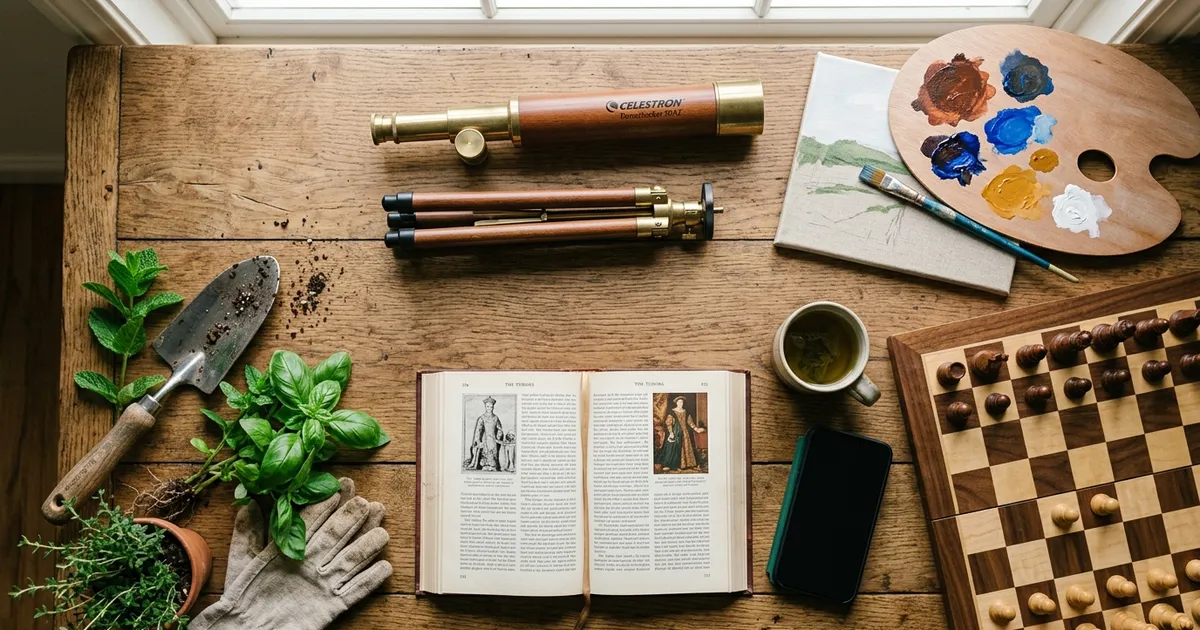
The best things for retirees to learn are the topics you are genuinely curious about, learned in small daily doses. History, everyday science, personal finance, gardening, cooking, a new language, astronomy, and classic strategy games all reward casual curiosity and pull you from one interest into the next. Start with one small doorway, not a giant subject.
Retirement hands you the one resource work always stole: unhurried time. The temptation is to fill it with errands and screens. The better move is to feed your curiosity on purpose, because a mind with something to chew on stays sharp, stays interested, and stays good company.
What follows is a curiosity menu, not a syllabus. Skim the sections, stop where your brain perks up, and pick one small topic. You are not trying to earn a degree tonight. You are trying to find the doorway that makes you want to open the next one tomorrow.
How to Pick the Right Thing to Learn
Choose by feeling first. If you want your days to feel useful, learn a practical skill like cooking or budgeting. If you want wonder, learn astronomy or everyday science. If you want connection, learn a language or a game you can play with grandchildren. Match the topic to the mood you actually have, and the learning stops feeling like homework.
One rule keeps this fun: pick the smallest interesting version. "Learn history" is too big to start. "Learn why Roman law still shapes the contracts you sign" is a doorway you can walk through in an afternoon.
Everyday Science and How Things Work
Choose this when you want reality to feel a little larger. Science is not just for lab coats. It is the quiet machinery behind your coffee, your sleep, your garden, and your health.
- Why you sleep worse as you age, and what actually helps versus what is a myth.
- The gut and the brain, and how the two talk to each other more than anyone expected.
- How memory really works, including why spacing your learning beats cramming.
- Weather and clouds, so a walk outside becomes a small reading exercise.
Sleep is a great first target because it pays you back the same night. A short course like the science of better sleep, separating myths from reality, sorts the useful advice from the folklore in one sitting. If you would rather explore the surprising link between digestion and mood, the gut-brain axis, your second nervous system, is a genuinely fun rabbit hole.
History That Explains Today
Choose history when you want the present to make more sense. The best history is not dates to memorize; it is the origin story of things you already touch every day.
Take law. Nearly every contract, property line, and courtroom rule in the Western world traces back to a handful of Roman ideas. Spend a short session with Roman rules and the roots of modern law, and the news suddenly reads differently. Or start somewhere unexpectedly delicious: the history of beef, follows one food from ancient herds to modern industry and quietly teaches you economics, geography, and culture along the way.
If broad history appeals, the arts and culture course hub is a good place to wander. Pick whichever cover art makes you curious and start there.
Personal Finance for Peace of Mind
Choose this when you want confidence rather than anxiety about money. Retirement finance is not about becoming a trader. It is about understanding the system well enough to make calm decisions and spot bad ones.
Money is one of the most rewarding things to finally understand late in life, because the fog around it never quite lifts on its own. A friendly overview like money matters, from shells to Bitcoin, walks through how money actually evolved and why it behaves the way it does. It turns an intimidating topic into a story you can follow.
| If you want to... | Learn about... | Why it helps |
|---|---|---|
| Feel calmer about money | How currency and value evolved | Removes the mystery that fuels anxiety |
| Understand the news | Inflation, interest, and markets | Headlines stop feeling like a foreign language |
| Avoid scams | How financial systems work | Bad offers get easier to spot early |
Gardening and Growing Things
Choose gardening when you want a hobby that gives back in vegetables, flowers, and quiet mornings outside. It is learning with dirt under your nails, and it rewards patience in a way few things do.
You do not need acreage to start. Even a balcony or a few pots can become a small food system. If you have space and ambition, garden smarter and build your first permaculture oasis, teaches you to work with nature instead of against it. If you are short on room, the urban gardener's secret sauce, is built for containers, small yards, and windowsills.
Gardening also pairs beautifully with the wider natural world. The nature and world course hub has more to explore once the growing bug bites.
Cooking You Actually Enjoy
Choose cooking when you want a daily creative act that ends in dinner. It is one of the highest-return skills in retirement: better meals, better health, and a genuine sense of craft.
If you never learned the fundamentals, or you are cooking for one or two after years of family-sized meals, a reset helps. Kitchen zero to hero, cooking basics for beginners, covers the core techniques that make every recipe easier: heat control, seasoning, knife basics, and how to taste as you go. Once those click, recipes stop feeling like instructions and start feeling like suggestions.
Learn a New Language
Choose a language when you want a long, satisfying challenge with a clear payoff: travel, family heritage, or simply the pleasure of a growing skill. Learning a language later in life is not only possible, it is one of the richest forms of mental exercise there is, since it works memory, sound, meaning, and pattern all at once.
The key is small and daily. Ten minutes of steady practice beats a marathon weekend session. If you have ever told yourself you are too old to start, our piece on whether it is too late to learn something new at 60, is worth a read before you count yourself out.
Astronomy and the Night Sky
Choose astronomy when you want wonder on demand. The sky is free, it is always there, and a little knowledge turns a random field of dots into a map you can read.
Start by learning to spot a few constellations. Cosmic dot to dot, a beginner's guide to constellations, gives you the handful of star patterns that unlock the rest of the sky. After a few evenings you will find your eyes going up automatically, tracing Orion or the Big Dipper the way you once read street signs.
Games That Keep the Mind Playing
Choose games when you want mental stimulation that also happens to be social. Chess, checkers, and card games are ancient for a reason: they exercise planning, memory, and patience while you are simply having fun.
Chess in particular has a bottomless depth that keeps rewarding you for years. If you know the pieces but never learned real strategy, board game basics, winning at chess and checkers, gives you the ideas that separate guessing from actually playing. Better yet, it is a skill you can pass down to a grandchild across the same board.
How to Turn Curiosity Into a Habit
Any topic on this list works if you show up for it in small, regular doses. Here is a simple picker for tonight:
- Low energy: read one short article or take one five-minute lesson.
- Restless: start a practical skill like cooking or gardening.
- Craving wonder: learn one constellation or one science idea.
- Wanting company: pick a language or a game you can share.
- Anxious about money: learn how one financial idea actually works.
Then give yourself a tiny finish line. One lesson. One chapter. One recipe. Explain it back to yourself, or better, to someone else, and stop while it still feels good. That is how casual interest hardens into a habit you keep.
Still hunting for a spark? Browse the full course library and let the covers do the choosing, or raid our list of what to learn when you're bored for even more doorways.
The Bottom Line
Retirement is not the end of learning. It is the first time in decades you get to learn purely for the joy of it, with no exam and no boss. The best thing to learn is whatever makes you curious enough to come back tomorrow.
Pick one topic from this menu. Give it a few honest minutes a day. Let one interest lead you into the next, and watch a whole second education quietly assemble itself.
Sources and Further Reading
- National Institute on Aging: Staying Active and Engaged as You Age
- Harvard Health: Staying Healthy
- American Psychological Association: Older Adults' Health and Well-Being
- Mayo Clinic: Healthy Aging
Ready to try one? NerdSip turns any of these topics into a five-minute lesson you can do with your coffee. Pick something that sounds fun and see where your curiosity takes you.
Frequently Asked Questions
What are the best things for a retiree to learn?
The best topics are the ones you are genuinely curious about, because curiosity is what keeps you coming back. Popular and rewarding choices include everyday science, history, personal finance, gardening, cooking, a new language, astronomy, and strategy games like chess. Start with one small topic rather than a huge subject, and let it lead you somewhere.
Is it worth learning something new in retirement?
Yes. Learning in retirement gives your days structure, keeps your mind active, and builds a sense of progress that work used to provide. It also expands your social world when you join a class, a club, or an online community. You do not need to master anything to benefit; steady curiosity is the point.
How much time should I spend learning each day?
Five to fifteen minutes a day beats a two-hour cram once a month. Short, regular sessions are easier to sustain and match how memory actually works. The habit matters more than the length, so pick a time you can keep and protect it.
Every NerdSip course clears a four-layer fact-checking pipeline before it reaches the app: grounded in live sources, scored nightly, gated on failure, and reviewable by a person at one tap. Articles on this blog are drafted with AI assistance, then researched, verified, and edited by our team.
Editorial responsibility: ai51 UG (haftungsbeschränkt). Responsible editor named in the imprint.
📚 Keep Learning
Explore the NerdSip learning hubs
The blog is our editorial layer. When you want to move from reading into doing, these hubs organize the rest of NerdSip by format, including the app itself and the press that has written about it.
One Curiosity a Day
NerdSip turns any of these topics into a five-minute lesson with quizzes and a gentle daily streak. Pick something that sounds fun and learn it at your own pace.
4.7 stars from 380 reviews · 8,900+ learners