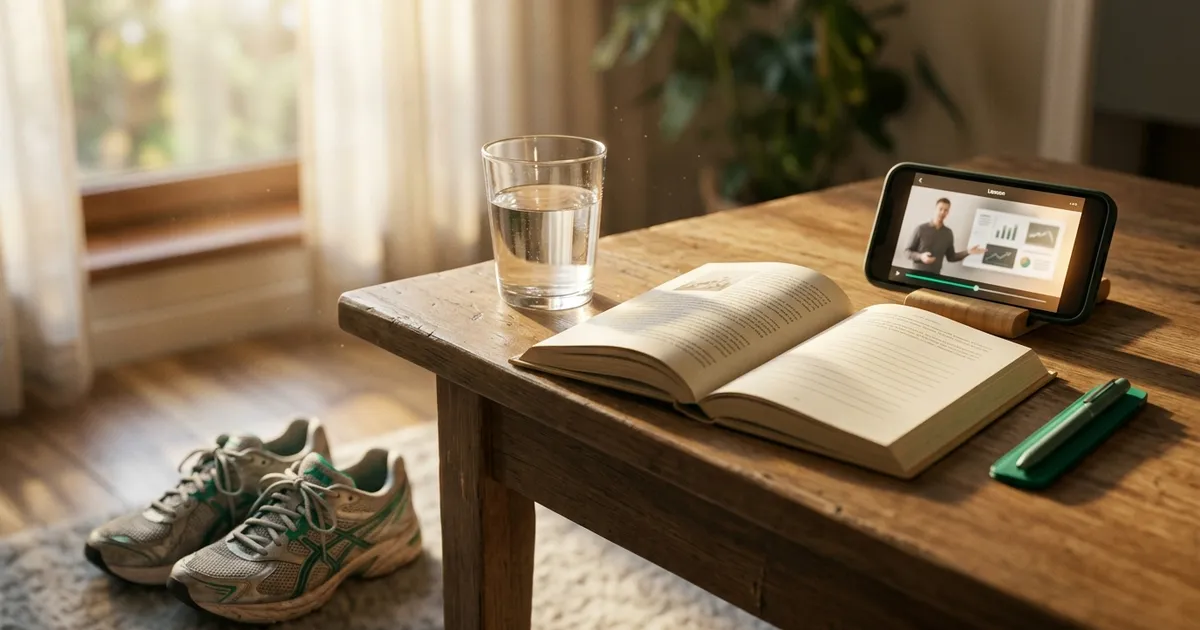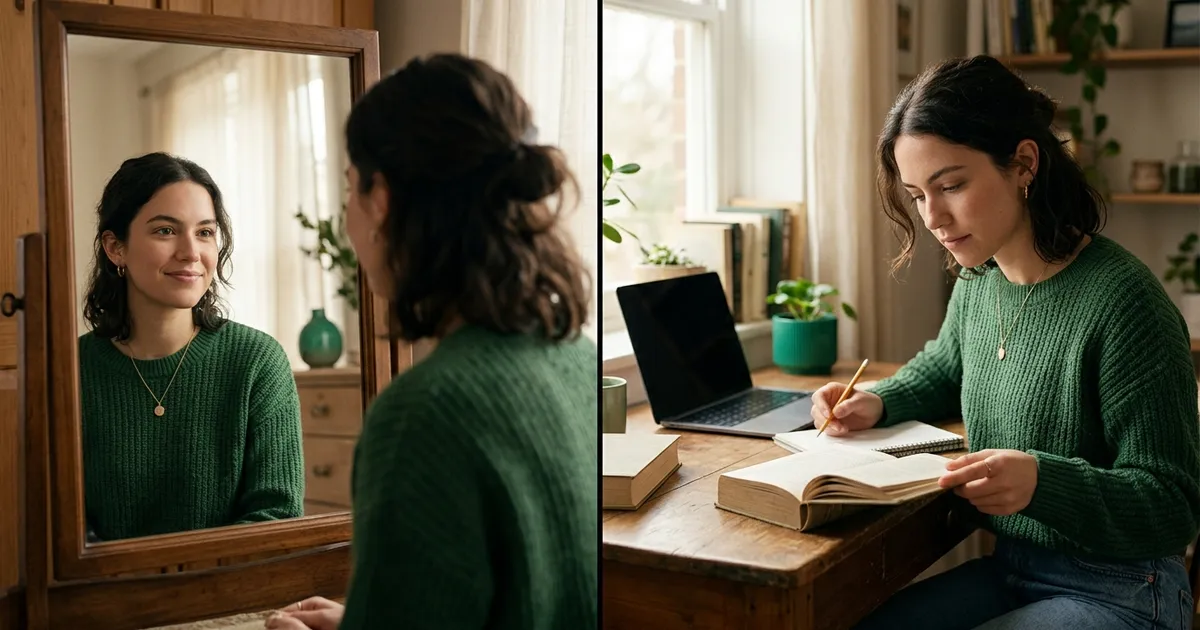
Two self-improvement trends are dominating your feed right now, and they're built on the same idea: stop drifting and start optimizing. Looksmaxing is about maxing out your appearance. Brainmaxing is about maxing out your mind. One is loud, visual, and instantly comparable. The other is quiet, invisible at first, and compounds for decades. This is an honest comparison of both, why people are pulled toward the mirror, where looksmaxing gets toxic, and why the inner glow-up is the one that actually lasts.
We're not here to shame anyone for caring how they look. We're here to make the case that the smartest "-maxing" you can do is the one nobody can see in a selfie, and to show you how to start it in five minutes.
What looksmaxing actually is
Looksmaxing is the social-media movement around optimizing physical appearance. It lives on TikTok, Reels, and Shorts, and it spans a huge range. At the mild end, often called "softmaxing," it's just sensible self-care: skincare, grooming, posture, hair, style, fitness, and sleep. Most of that is genuinely good for you, and there's nothing wrong with it.
The trend caught fire because appearance is the most comparable thing on the internet. It's visible, it's emotionally charged, and short-form video rewards before-and-after transformations. That's a powerful engine, but it also pulls the trend toward extremes. In some online "-maxxing" subcultures, looksmaxing escalates into obsessive measurement of facial features, drastic interventions, and a worldview where appearance determines your entire worth. We'll come back to that, because it's the part of the trend worth being careful about.
What brainmaxing actually is
Brainmaxing is the mind's version of the same impulse: deliberately optimizing your cognition, memory, focus, and knowledge. If you want the full breakdown, we cover it in what is brainmaxing, but the short version is that it's built on boring, proven habits, active learning, attention training, memory techniques, reading, sleep, and exercise, rather than supplements or shortcuts.
It went viral as "looksmaxing for your brain," and that framing is doing a lot of work. It borrows looksmaxing's energy, the appeal of treating yourself as a project worth optimizing, while pointing it at the one asset that doesn't peak in your twenties. Your face changes over time. Your ability to learn, focus, and think can keep improving for the rest of your life.
Looksmaxing vs brainmaxing: the honest comparison
Here's how the two trends stack up across the dimensions that actually matter. Both have real upsides; they just behave very differently over time.
| Dimension | Looksmaxing | Brainmaxing |
|---|---|---|
| Focus | How you appear to others | How you think, learn, and engage |
| Time horizon | Often fast, visible, but peaks and fades | Slow at first, then compounds for decades |
| What compounds | Limited; looks plateau and age | Knowledge, skills, and judgment stack endlessly |
| Can it be faked? | Yes, filters and editing hide the gap | No, you either know it or you don't |
| Risk / toxicity | Extremes can fuel body-image issues | Mainly burnout if you over-optimize |
| Payoff | First impressions, confidence | Career, conversation, relationships, lifelong |
Why people are drawn to looksmaxing (and it's fair)
Let's be honest about why looksmaxing wins attention. Appearance gives fast, visible feedback. You can change your skin, posture, or fitness in weeks and literally see it in the mirror. It improves first impressions, which genuinely matter. And it's social, your friends notice, your photos get reactions, the loop closes quickly. Compared to that, brainmaxing can feel like planting a tree: you do the work for weeks and see nothing.
None of that is shallow. Caring about how you present yourself is human, and the reasonable end of looksmaxing, grooming, fitness, sleep, dressing well, makes most people feel more confident. The problem isn't looksmaxing existing. The problem is where it goes when it has no ceiling.
The unhealthy extremes (without the moralizing)
Here's the honest caveat. The mild version of looksmaxing is fine. The extreme online subcultures are not. When a community starts ranking faces by millimeters, pushing drastic or surgical interventions, and tying your entire value as a person to your appearance, it stops being self-improvement and becomes a source of anxiety. The feedback loop that makes looksmaxing addictive, constant comparison, is also what makes its extremes corrosive.
You don't need a lecture about it. Just notice the difference: a habit that leaves you feeling capable and energized is working for you. A habit that leaves you anxious, comparing, and never satisfied is working against you. That's the same test we apply to scrolling, and it's worth applying to any "-maxing" you do. Brainmaxing has its own failure mode, over-optimizing into burnout, but it doesn't come with a built-in machine for making you hate the face you see every morning.
The case for brainmaxing as the durable glow-up
Here's the core argument. Cognition compounds, and it can't be filtered.
Every concept you learn connects to others, so knowledge doesn't add up, it multiplies. The more you know, the faster you learn new things and the more interesting connections you can make. That's compounding, and it's exactly why a daily learning habit looks unimpressive at week one and undeniable at year three. Looks don't work like that; they plateau, then decline. The work you put into your appearance at 22 doesn't keep paying dividends at 52. The work you put into your mind does.
And cognition can't be faked. A filter can perfect a photo, but it can't make you understand a topic, hold a great conversation, or make a sharp decision under pressure. When you actually know things, it shows up everywhere a filter can't reach: in how you talk, what you notice, how you solve problems, how present and interesting you are. That last one matters more than people admit, which is why becoming more interesting is downstream of brainmaxing, not looksmaxing. The most magnetic people in any room are rarely the best-looking; they're the ones with something to say.
This is also where the two trends quietly overlap. Sleep and exercise improve your looks and your brain. So if you want a single high-leverage habit that serves both glow-ups, it's not a supplement, it's protecting your sleep and moving your body. Everything else, the skincare, the courses, the apps, sits on top of that foundation.
The asymmetry nobody mentions
There's a quiet asymmetry between the two trends that the before-and-after clips never show. Looksmaxing has a ceiling and a clock. There's a realistic best version of how you can look, and time only moves you away from it. That's not a tragedy, it's just biology, and it means appearance work is partly maintenance: you're spending effort to slow a decline. Brainmaxing has no ceiling and no clock running against you. There is no upper limit on how much you can learn or how interesting you can become, and unlike your skin, your mind can be at its sharpest in your forties and fifties. One trend asks you to defend a peak. The other lets you keep climbing. When you put it that way, the 'inner glow-up' stops sounding like a consolation prize and starts sounding like the obviously better investment.
Why the inner glow-up is harder to start, and why that's the point
If brainmaxing is so clearly the better bet, why do far more people looksmax? Because the inner glow-up has worse marketing. There's no dramatic before-and-after photo. No one likes your knowledge in a comment section. The feedback is delayed, internal, and easy to ignore, which is exactly why it weeds out the people chasing a quick dopamine hit and rewards the ones who can play a longer game. The good news is that the delayed payoff is a design problem, and design problems have solutions. The fix is to borrow looksmaxing's fast-feedback loop, the streaks, the visible progress, the small daily wins, and bolt it onto learning. That's the entire reason gamified learning works, and it's where the next section comes in.
How to start an inner glow-up
If looksmaxing is a gym membership for your face, the inner glow-up is a gym membership for your mind, and the entry point is almost embarrassingly small. You don't need a system. You need one tiny daily action.
Swap five minutes of scrolling for five minutes of learning. That's the whole starting move. Take the first mindless scroll of your morning and replace it with one short lesson on something you've always been curious about. Five minutes is small enough that you'll actually do it, and consistent enough that it compounds. This is where NerdSip earns its place: it's a gamified micro-learning app with thousands of AI-generated courses and roughly five-minute lessons, built around quizzes, active recall, and spaced repetition. The XP, streaks, and loot drops hijack the same dopamine loop that makes scrolling addictive and point it at something that builds you up instead of draining you. It won't replace effort, but it makes the inner glow-up something you keep coming back to.
From there, add a focus block, a little daily reading, and protect your sleep, and you've got the bones of a real practice. If you want a structured version, follow the daily brainmaxing routine, sanity-check the trend in is brainmaxing legit, and compare tools in the best brainmaxing apps of 2026.
You don't have to choose, but you should rank
None of this means you have to delete your skincare routine and swear off the gym. The healthiest version of self-improvement isn't either-or; plenty of people who take their appearance seriously are also voracious learners, and the two reinforce each other. Fitness sharpens the mind, confidence makes you more present, and a sharp mind helps you make smarter choices about your health and habits. The point isn't to pick a side. It's to rank them honestly when your time and attention are limited, which they always are. Give the reasonable looksmaxing habits a slot, then make sure the inner glow-up gets the bigger one, because it's the slot that's still paying you back in twenty years.
And watch the toxicity ratio while you're at it. A self-improvement habit should leave you feeling more capable, not more anxious. If your looksmaxing scrolls leave you picking apart your own face, that's a sign the loop has flipped from helping you to feeding on you, the same way an endless social feed does. Brainmaxing rarely has that effect; learning something new almost always leaves you feeling more capable, not less. That alone is a reason to tilt the balance toward your mind.
Make it a habit, not a phase
Both trends live or die on the same thing: consistency. A looksmaxing routine you abandon in March does nothing, and a brainmaxing routine that depends on motivation will lose to the algorithm every time. The real skill underneath both is habit formation, making the good action automatic so you don't have to win a willpower battle every day. That's why the natural next step is learning how to build good habits and using a simple habit-building tool to lock in your daily five minutes.
The payoff looksmaxing can't touch
Think about the moment a first impression actually pays off, the conversation that follows it. Looksmaxing wins the first three seconds; brainmaxing wins everything after. You can get someone's attention with how you look, but you keep it with what you say, what you notice, and how you make them think. A great outfit gets you in the door of a job interview, a date, or a new social circle. A genuinely interesting mind is what makes people want you to stay. That's not a knock on appearance; it's just where the two trends hand off to each other. The visual glow-up opens the conversation. The inner glow-up is the conversation.
This is also the part that ages in reverse. The people who get more compelling over time aren't the ones who looked best at 22; they're the ones who kept feeding their curiosity until they became the person everyone wants at the dinner table. You can't filter that, fake it, or buy it in a supplement bottle. You can only build it, one small lesson at a time, which is the entire promise of brainmaxing and the reason it outlasts every trend it's competing with.
So here's the takeaway. Looksmaxing isn't the enemy, take the sensible parts, skip the toxic extremes. But if you're going to obsess over optimizing something, make it the one asset that compounds for the rest of your life and can't be edited away. Start your inner glow-up today, five minutes, one lesson, and let the most underrated trend on the internet quietly turn you into the most interesting person in the room.
Frequently Asked Questions
What is the difference between looksmaxing and brainmaxing?
Looksmaxing is the viral trend of optimizing your physical appearance through grooming, fitness, skincare, and sometimes extreme measures. Brainmaxing is optimizing your mind through learning, focus, and memory. Looksmaxing targets how you look; brainmaxing targets how you think, remember, and engage. Brainmaxing's gains compound over time and can't be filtered away.
Is brainmaxing better than looksmaxing?
Neither is 'better' in the abstract, but brainmaxing is more durable. Appearance peaks and fades and can be edited in photos, while cognitive ability keeps compounding for decades and shows up in every conversation, decision, and relationship. Many people pursue both, but if you only have time for one daily habit, the inner glow-up tends to pay off longer.
Why is looksmaxing controversial?
Mainstream looksmaxing, basic grooming, fitness, and skincare, is harmless. The controversy comes from extreme online subcultures that promote drastic, risky, or surgical interventions and tie self-worth almost entirely to appearance. That can fuel body-image issues and dissatisfaction. The healthier move is to keep the reasonable parts and add an inner glow-up that doesn't depend on a mirror.
What is an inner glow-up?
An inner glow-up is the brainmaxing version of a transformation: instead of changing how you look, you upgrade how you think, what you know, and how interesting and present you are. It's built from tiny daily learning, focus practice, and reading. Unlike a visual glow-up, it can't be undone by aging or a bad photo, and it keeps compounding.
Can you do both looksmaxing and brainmaxing?
Absolutely, and the healthiest approach often combines reasonable appearance care with serious mental investment. Fitness and sleep actually benefit both. The key is balance: don't let appearance optimization tip into the toxic extremes, and don't neglect the mind, which is the asset that keeps growing long after looks plateau.
Every NerdSip course clears a four-layer fact-checking pipeline before it reaches the app: grounded in live sources, scored nightly, gated on failure, and reviewable by a person at one tap. Articles on this blog are drafted with AI assistance, then researched, verified, and edited by our team.
Editorial responsibility: ai51 UG (haftungsbeschränkt). Responsible editor named in the imprint.
📚 Keep Learning
- What Is Brainmaxing? The Viral Trend Explained (2026)
- Is Brainmaxing Legit? What Actually Works vs What's Hype
- The Daily Brainmaxing Routine: A Realistic 7-Step Protocol
- 8 Best Brainmaxing Apps in 2026 (Build a Smarter Daily Stack)
- How to Become More Interesting Without Pretending to Be Someone Else
- How to Build Good Habits That Actually Stick (2026 Guide)
Explore the NerdSip learning hubs
The blog is our editorial layer. When you want to move from reading into doing, these hubs organize the rest of NerdSip by format, including the app itself and the press that has written about it.
Start Your Inner Glow-Up
NerdSip turns five wasted minutes a day into a brainmaxing habit: thousands of AI courses, bite-size lessons, quizzes, and XP. Free on iOS and Android.
4.7 stars from 380 reviews · 8,900+ learners