Almost every learning app is a catalogue. Somebody decided in advance what exists, and if your topic is not on the shelf, it does not exist. An app that creates a course on any topic inverts that. You name the subject, the course gets written, and you start reading a minute later. Here is which apps actually do it in 2026, what they cost, how we tested them, and the uncomfortable part nobody in this category likes to discuss: what happens after the AI writes it.
The Catalogue Problem
Open any of the big learning apps and search for something slightly off-centre. The history of Portland cement. Why competition law treats airlines differently. How Ottoman tax farming worked. You will get a polite empty state, or worse, three loosely related results that are not what you asked for.
This is not a bug in those apps. It is the business model. A catalogue app has to commission, write, edit, illustrate and localise every course before a single person requests it, so the shelf can only hold topics with enough predicted demand to pay for the production. That logic produces excellent courses about productivity, negotiation, habits and the Stoics. It produces nothing about the thing you got curious about at eleven o'clock last night.
The gap is enormous and invisible, because you never see the courses that were not made. You just quietly stop searching. We covered this at length in why there is no Duolingo for science, history and psychology. Supply, not demand, is the constraint.
Generation removes the constraint. If the course is written when you ask for it, the shelf is not a shelf anymore. That is the entire premise of this category, and it is why the phrase people search for is not "learning app" but "an app that makes a course on anything."
What Should Count as Generating a Course
The word "generates" is doing a lot of work in this category's marketing, so we set a bar before testing anything.
- You name the topic, not a menu. A free text field, not twelve preset categories with a search box on top.
- The output is a course, not an answer. Multiple lessons in a deliberate order, each one building on the last, with something at the end that checks whether it landed.
- It is built for you to learn. Not for you to publish to a team of trainees, which is a different product with a different price tag.
- The claims are checkable. If a machine writes your history lesson, something has to sit between the model and your memory.
Only one consumer app in the list below clears all four. The rest are on the list because they are the honest alternative when your topics are predictable enough that a catalogue can serve them, which for most people is true more often than they expect.
The Nine Apps, Ranked
| Rank | App | Best For | Lesson Length | Price | Platforms | Free Tier |
|---|---|---|---|---|---|---|
| 1 | NerdSip | Typing any topic and getting a course written on demand | About 1 minute per lesson, about 5 minutes per short course | EUR 7.99/mo or EUR 49.99/yr after a 7-day trial | iOS, Android | Yes, one sample course a day, no account, but no generations |
| 2 | Khan Academy + Khanmigo | Structured school subjects and helping a child with homework | Videos of 5 to 15 minutes, shorter practice sets | Core platform free; Khanmigo tutor $4/mo or $44/yr | iOS, Android, Web | Yes, the entire K-12 curriculum, free forever, no ads |
| 3 | Chunks | Story-led microlearning from a small, well-edited catalogue | 5 to 10 minutes per chapter | $9.99/mo, $49.99/yr often discounted to $34.99, $59.99 lifetime | iOS, Android | Yes, a selection of stories free permanently |
| 4 | Imprint | Visual explainers of big nonfiction ideas | 2 minutes or less per lesson | $15.99/mo, $99.99/yr list with a $74.99 SKU also live | iOS, Android | No permanent free tier confirmed, 7-day trial only |
| 5 | Kinnu | Free general-knowledge pathways with no subscription at all | Roughly 5 minute sessions of short "Orbs" | $0 for the General Knowledge app; optional certificates $7.99 to $19.99 | iOS, Android | Yes, the whole general-knowledge product, no ads |
| 6 | Brilliant | Interactive maths, science and computer science practice | 5 to 15 minutes, marketed as 15 minutes a day | EUR 25/mo or EUR 13.75/mo billed annually; USD varies by storefront | iOS, Android, Web | Yes, one lesson a day plus opening lessons of most courses |
| 7 | Blinkist | Nonfiction book summaries in text or audio | 15 minutes per Blink | Premium EUR 15.99/mo or EUR 99.99/yr; USD varies widely | iOS, Android, Web | Yes, one editor-picked Blink a day, forever |
| 8 | Headway | The same summary habit at a lower annual price | 5 to 15 minutes per summary | $12.99/mo or $89.99/yr, varies by country and promotion | iOS, Android, Web | Yes, one free summary a day, always available |
| 9 | Nibble | Quiz-led interactive lessons on a fixed set of subjects | 10 minutes per lesson | $19.99/mo; annual roughly $50 to $90 depending on the offer | iOS, Android, Web | No, 7-day trial on the yearly plan only |
Prices are as of July 2026 and reflect what each company publishes. Several of these apps run heavy price personalisation by country and funnel, and their App Store listings show five to ten live SKUs each, so your number may differ.
1. NerdSip
You type a topic. The course gets written. That is the whole product, and everything else in the app exists to make the output worth reading twice.
A course is 3, 5 or 10 lessons depending on the depth you choose, and each lesson is about a minute of reading, so a short course is a five-minute commitment. Every lesson carries generated artwork, which sounds decorative and turns out to be the opposite: abstract ideas get something concrete to hang on, and the illustration is often what you remember three days later. Every lesson ends in a multiple-choice question with three options, and the app explains why the right answer is right rather than just marking you correct.
The delivery mechanic is the part that surprises people. NerdSip uses a swipe deck. Dating-app mechanics applied to learning. Swipe right to learn it, left to skip, up for more like this. Every other app in this list hands you a menu, and menus make you decide before you know anything. A deck lets you decide in half a second, which is roughly how long curiosity lasts.
Free browsing gets you one sample course a day with no account. Generation is paid, at EUR 7.99 a month or EUR 49.99 a year after a 7-day trial, which includes 75 generations a month, unlimited reading, infographics, voice courses and the Ask NerdSip question box. 4.7 stars from 510 reviews
Weak spot: no web app, and no lifetime option. If your topics are entirely mainstream, you are paying for flexibility you will not use.
2. Khan Academy with Khanmigo
Not a generator, and the best free thing in education by a distance. The full K-12 curriculum costs nothing, carries no ads, and is not going to start charging, because Khan Academy is a nonprofit. Khanmigo, the AI tutor, is a genuine optional add-on at $4 a month or $44 a year, and it does adapt explanations to you.
The limit is scope. Khan Academy is a syllabus. Ask it about Ottoman tax farming and you are back at the empty state.
3. Chunks
A small indie app, founded in 2025, that takes the opposite bet from generation: fewer courses, better written. Chapters run 5 to 10 minutes and lean on narrative rather than bullet points, which makes them pleasant to read and genuinely memorable. The free selection is real, and the $59.99 lifetime purchase is rare enough in this category to be worth naming, since everything else here is a subscription treadmill. Full pricing sits on the Chunks support page.
The trade is the one every catalogue makes. When the shelf does not have your topic, there is nothing to do about it.
4. Imprint
The best-looking app in the category. Lessons are two minutes or less and built around illustration, and if you have ever wanted the idea from a famous nonfiction book without the book, Imprint delivers that cleanly. At $15.99 a month it is also the most expensive per lesson here, and we could not confirm any permanent free content, only a 7-day trial. Assume you are paying from day eight.
5. Kinnu
The genuinely free one that is not a nonprofit. Kinnu's General Knowledge app has no subscription and no ads, and its pathways are a good way to fill obvious gaps in what you know. Sessions run about five minutes. The paid CFA and SQE exam products are separate apps with their own pricing, so do not let those confuse the picture. Mobile only, and the catalogue is fixed.
6. Brilliant
If your topic is maths, physics or computer science, stop reading this list and use Brilliant. Its interactive problems are the only thing in this category that makes you actually think rather than nod. At EUR 25 a month it is the priciest option here, and the free tier is thin at one lesson a day, but for STEM specifically nothing else is close. For everything outside STEM it is silent.
7. Blinkist
The original nonfiction summary app, still the deepest library, 15 minutes per Blink in text or audio. It answers a narrower question than "teach me this topic," because a Blink is one book compressed, not a subject explained. If a good book exists on your topic, Blinkist has it. If your topic is too small for a book, it does not.
8. Headway
Functionally Blinkist at a friendlier annual price, $89.99 against Blinkist's EUR 99.99, with a free summary a day that stays free. The library is smaller and skews harder toward self-improvement. If you already know you want book summaries and you want the cheaper one, this is it.
9. Nibble
Ten-minute interactive lessons with a quiz-first design, which is the right instinct. The problem is commercial rather than pedagogical. Nibble's own blog and its own FAQ publish different prices, no pricing page is reachable without an onboarding quiz, and there is no free tier. We confirmed a $19.99 monthly SKU; the annual figure sits somewhere between roughly $50 and $90 depending on the offer you land in.
How We Tested
Every app was installed on an iPhone and, where a version existed, on Android and web. For each one we ran the same three requests: a mainstream topic almost certain to be covered (negotiation tactics), a mid-tail topic a good catalogue might have (the Bretton Woods system), and a long-tail topic no catalogue would ever commission (how a municipal water tower actually maintains pressure). The third request is the entire test. It is where catalogues return nothing and generators either shine or embarrass themselves.
We then timed a full session end to end, counted the taps between opening the app and reading a first sentence, and checked whether the app asked us to make a decision before it had given us any information to decide with.
Pricing was pulled from official sources on 28 July 2026: company pricing pages where they exist, and the US App Store in-app purchase list where they do not. Four of these companies publish no price on their website at all. Where the sources conflicted, and for Nibble and Deepstash they conflicted badly, we published a range or nothing rather than pick the flattering number. Our browser checks ran from a European IP, so Brilliant and Blinkist figures are the EUR ones they served us and their USD equivalents are not confirmed.
We did not accept vendor claims about accuracy. Every generated course in the long-tail test was spot-checked against primary sources, which is what led to the next section.
The Hard Part: Trusting What the Machine Wrote
Here is where this category usually goes quiet. Generation solves the catalogue problem and immediately creates a worse one. A curated app can be wrong, but a human chose those words and can be held to them. A generated lesson has no author, and confident, fluent, completely fabricated text is the single most dangerous output a learning app can produce, because the whole point is that you will remember it.
NerdSip runs four layers, and they are worth describing precisely rather than as a slogan. That thoroughness is half of why we call it the German Knowledge Machine. Full detail lives on the fact-checking section of the features page.
Layer one: grounded in live sources
Courses are not written from memory. Every generation runs against live search results, so claims are anchored to what the record actually says rather than to whatever the model happens to have absorbed. This is the difference between asking a chatbot a question and asking it to read first.
Layer two: scored while you sleep
Every night an automated pass rates every course in the library for topic quality, appeal and content integrity, and sweeps for truncated or broken lessons. It runs over the whole library, not just new courses, because a course that looked fine on day one can still be the one that breaks.
Layer three: blocked if it fails
Passing the quality bar is what earns a course a place in the swipe deck. Anything that falls short stays out, and nobody ever sees it. This is the layer people underestimate. It means a bad generation is contained to the person who requested it instead of being distributed to thousands of decks.
Layer four: one tap, then a person
Spot something wrong and a single tap flags the course. It is auto-marked for review and lands in a queue that real people work through.
Now the honest part. No pipeline catches everything. Grounding reduces invention, it does not abolish it. An automated scorer is itself a model and inherits model blind spots. Anyone who tells you their AI learning app has solved hallucination is selling you something, and the giveaway is that they have no fourth layer, because if you genuinely believed layers one through three were airtight you would not staff a review queue. We staff one. That is the argument.
Practical advice that applies to every app in this list, ours included: treat a five-minute course as orientation, not as a citation. It tells you the vocabulary, the shape of the argument and what to search next. For anything load-bearing, go to the source.
What Else Comes With a Generated Course
A course is not just text. Each NerdSip course ships with a hero graphic, an illustration per lesson, a three-option quiz at the end of every lesson that explains its reasoning, and a summary infographic: one card that carries the whole course, which you can save to your camera roll or send to somebody. That card is the most-shared object in the app, and it is also the most useful revision tool, because it survives outside the app.
Every course also exists as a podcast. Real voice, full course, built for the commute. If you would rather listen than read, see how AI-generated podcasts work for learning.
Behind the deck sits a recommendation engine that ranks what to show you next based on what you have actually engaged with, not what you once told an onboarding quiz you were interested in. Swipe past three courses about supply chains and the deck notices. That is what makes the deck feel like a feed rather than a filing cabinet.
Part of the source material is deliberately drawn from widely shared content, the things people are actually talking about, rather than from a committee's guess about what matters.
The Game Layer, and Why It Is There
Generation solves supply. It does nothing for the harder problem, which is that you will not come back tomorrow. NerdSip is built as a knowledge RPG for exactly that reason.
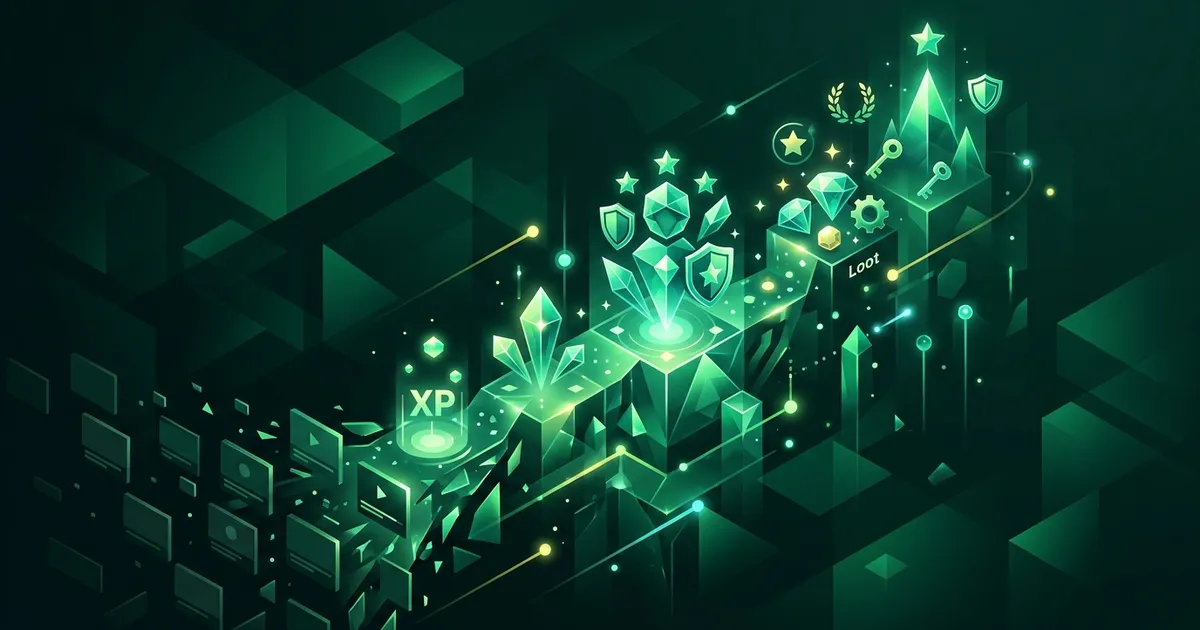
- XP and levels. Every lesson, quiz and review pays out. Progress is visible even on a day when you only had four minutes.
- Loot drops. Finish a course, open a drop. Common, rare or legendary, at 80, 15 and 5 percent. The 5 percent is what makes the 80 percent tolerable.
- A 3D character you build. Equip what you find, collect sets, fill an inventory screen. Your streak becomes an object rather than a number.
- Streaks with freeze tokens. Freezes matter more than the streak. A streak with no forgiveness mechanic is a trap that punishes one bad week with total abandonment.
- Weekly leagues. Bronze up to Diamond, with promotion and demotion both real. Stakes in both directions, which is the only version that holds attention.
- Memory Mix. One tap writes a new review course out of what you actually finished in the last 30 days, spacing material by how long ago you saw it. Paid feature.
If you want the evidence behind why this works rather than the pitch, we covered it in the science of gamification.
The Other Kind of Course Generator
Search for an app that creates courses and most of the results will not be learning apps at all. Coursebox, Coassemble, LearningStudioAI and Mini Course Generator all genuinely generate courses, and they are good at it. They are just built for a different person.
These are authoring tools. You bring source material, a policy document, a training deck, a recorded webinar, and the tool turns it into a structured course with modules, assessments and completion tracking, which you then publish to employees, students or customers. They export SCORM, they integrate with an LMS, they give you a learner roster and a completion report, and they price per seat or per author because the buyer is an organisation.
The distinction is simple. An authoring tool generates a course so somebody else can take it. A learning app generates a course so you can take it. If you are building onboarding for a team of forty, an authoring tool is the correct answer and a microlearning app would be an absurd choice. If you are standing on a platform wondering how signal blocks work, opening a course-authoring SaaS, creating a project and configuring an assessment is an extraordinary amount of ceremony for a five-minute curiosity.
The reason these tools dominate the search results is that B2B software has marketing budgets and consumer curiosity does not. It is not evidence that they are what you were looking for.
Who Should Pick What
Pick by whether your topics are predictable.
- Your interests keep landing outside the catalogue. Generation is the only thing that fixes this. NerdSip.
- You want popular nonfiction, well edited, cheaply. Chunks or Headway. A catalogue is better value per hour when the catalogue has what you want.
- You are learning school subjects, or helping someone who is. Khan Academy, free, with Khanmigo at $4 a month if you want the tutor.
- You want STEM that fights back. Brilliant.
- You want to spend nothing. Kinnu and Khan Academy, in that order for general knowledge.
- You are building training for other people. An authoring tool, not any app on this list.
The Bottom Line
The catalogue model made sense when courses were expensive to produce. That constraint is gone, and the apps that still behave as though it exists are asking you to be curious only about things they already anticipated.
Generation removes the ceiling. It also hands you a new obligation, because the moment nobody had to approve a lesson before you read it, verification stops being someone else's job and becomes part of the product's design. Four layers and a human queue is our answer to that. It is not perfection, and any app claiming perfection here should worry you more than one admitting the limit.
Type the topic. Read for five minutes. Then go find out whether we got it right.
Pricing verified 28 July 2026 from official sources including Brilliant Premium, Headway, Khanmigo and the US App Store listings for apps that publish no price.
Frequently Asked Questions
Is there an app that creates a course on any topic?
Yes. NerdSip is a consumer app where you type a topic and it writes a micro-course for you, usually 3, 5 or 10 lessons of about a minute each, with an illustration and a quiz on every lesson. Most other learning apps are catalogues, so they can only show you topics someone published in advance. There are also B2B tools like Coursebox and Mini Course Generator that generate courses, but those exist so you can train other people, not so you can learn something yourself.
How much does an AI course generator app cost?
NerdSip costs EUR 7.99 per month or EUR 49.99 per year, which works out to about EUR 4.17 a month, after a 7-day free trial. That includes 75 AI generations a month, unlimited reading, infographics, voice courses and Ask NerdSip. Catalogue apps sit in a similar or higher band: Imprint is 15.99 dollars a month, Blinkist Premium is 15.99 euros a month, Headway is 12.99 dollars a month, and Brilliant is 25 euros a month. Prices for this category change constantly by country and promotion, so treat any single number as a snapshot.
Can I generate courses for free?
Not on NerdSip. The free tier lets you browse one sample course a day with no account, which is enough to see the format and decide, but AI generation is a paid feature. That is a deliberate limit, because every generation costs real money to run. If you want free learning with no card at all, Khan Academy and Kinnu are the two genuinely free options in this roundup.
Is the AI-generated content accurate?
It is checked in four places, and it is still not perfect. Courses are generated against live search results rather than written from memory, an automated pass scores every course in the library each night for topic quality, appeal and content integrity, only courses that pass the quality bar reach the swipe deck, and any user can flag a course with one tap, which sends it to a queue that real people work through. No pipeline catches everything. That is exactly why the last layer is a human being.
What is the difference between NerdSip and a course generator like Coursebox?
The job is different. Coursebox, Coassemble, LearningStudioAI and Mini Course Generator are authoring tools. You upload your material, they turn it into a course, and you publish it to employees or students. The output is for someone else. NerdSip generates a course so that you can learn it in the next five minutes. If you need SCORM export, a learner roster and completion reporting, use an authoring tool. If you are the learner, an authoring tool is a lot of setup for one lesson.
How long is a generated course?
On NerdSip, a course is 3, 5 or 10 lessons depending on the depth you pick, and each lesson is about a minute of reading. A short course runs about five minutes end to end, including the quiz at the end of each lesson. For comparison, Imprint lessons are two minutes or less, Chunks chapters run 5 to 10 minutes, Nibble lessons are 10 minutes, and a Blinkist Blink is 15.
Does it work on Android?
Yes. NerdSip is live on both the App Store and Google Play. Web availability is the bigger differentiator in this category: Imprint, Kinnu and Chunks are mobile only, while Khan Academy, Brilliant, Blinkist, Headway and Nibble all have web apps.
Can I listen to a generated course instead of reading it?
Yes. Every NerdSip course has a podcast mode with a real voice, which is the version most people use on a commute or a walk. It is part of the paid plan alongside generation and infographics.
Are these apps good for adults, or are they built for students?
Most of this category is built for adults with limited time rather than for exam preparation. Khan Academy is the exception and is explicitly K-12 curriculum. NerdSip, Chunks, Imprint, Kinnu, Blinkist and Headway all assume an adult who has five spare minutes and a question, not a syllabus and a deadline.
What are the best alternatives to Imprint?
If you like Imprint's visual, two-minute lessons but want your own topics rather than a fixed library, NerdSip generates courses on demand and puts an illustration on every lesson. If you want the same curated feel for less money, Chunks is 9.99 dollars a month with a genuine free selection and a rare 59.99 dollar lifetime option. If you want free, Kinnu's general-knowledge app costs nothing.
Does the app work offline?
Generation needs a connection, because courses are built against live sources at the moment you request them. Once a course exists you can open it again, and the summary infographic saves to your camera roll, which is the most reliably offline artefact in the app. If offline reading is your main requirement, Blinkist and Deepstash both sell offline access as a paid feature.
How do you stop people generating nonsense topics?
You cannot really stop a request, but you can stop the output from spreading. A generated course only enters the public swipe deck if it clears the nightly quality score. Courses that fail stay out of the deck, so a weak generation affects the person who asked for it and nobody else.
Is generated content as good as a real course?
No, and it is not trying to be. A five-minute micro-course gives you the shape of a subject: the vocabulary, the main tension, the two or three facts you need before the topic stops feeling opaque. A university course gives you depth, assessment and a credential. Use the generated course to decide whether you want the real one.
Does NerdSip use spaced repetition?
In the plain-English sense, partly. The Repetition tab, Memory Mix, writes a fresh review course out of what you actually finished in the last 30 days, ranking material you have not seen for the longest first and avoiding anything you reviewed in the past week. It is a paid feature. It is not an algorithmic scheduler: there are no ease factors, no due dates and no notification telling you a card is ready. Notifications are streak nudges only.
What happens to the courses I generate?
They stay in your history and feed the recommendation engine, which ranks what to show you next based on what you have actually engaged with. Finished courses also become raw material for Memory Mix reviews, and each completed course opens a loot drop, which is where the game layer starts.
Which app should I pick if I only want one?
Pick by whether your topics are predictable. If you keep wanting subjects nobody publishes, the generator is the only thing that solves it, so NerdSip. If your interests sit inside popular nonfiction, a curated catalogue is cheaper per hour and better edited, so Chunks or Headway. If you are learning school subjects or supporting a child, Khan Academy is free and unbeatable at that job.
Every NerdSip course clears a four-layer fact-checking pipeline before it reaches the app: grounded in live sources, scored nightly, gated on failure, and reviewable by a person at one tap. Articles on this blog are drafted with AI assistance, then researched, verified, and edited by our team.
Editorial responsibility: ai51 UG (haftungsbeschränkt). Responsible editor named in the imprint.
📚 Keep Learning
- Duolingo but for Everything: Does It Actually Exist in 2026?
- Why There's No Duolingo for Science, History, or Psychology (Until Now)
- Best AI Learning Apps in 2026: Tools That Actually Help You Remember
- What Is a Learning RPG? The Gamification Model Replacing Online Courses
- Best Microlearning Apps in 2026: 11 Tested and Ranked
- What Is Microlearning? The Complete Guide for 2026
Explore the NerdSip learning hubs
The blog is our editorial layer. When you want to move from reading into doing, these hubs organize the rest of NerdSip by format, including the app itself and the press that has written about it.
Name a Topic. Get the Course.
Type anything you have ever been curious about and NerdSip writes the course, with artwork on every lesson, a quiz at the end of each one, and an infographic that carries the whole thing. Browse a sample course free, no account needed.
4.7 stars from 510 reviews · 10,000+ learners