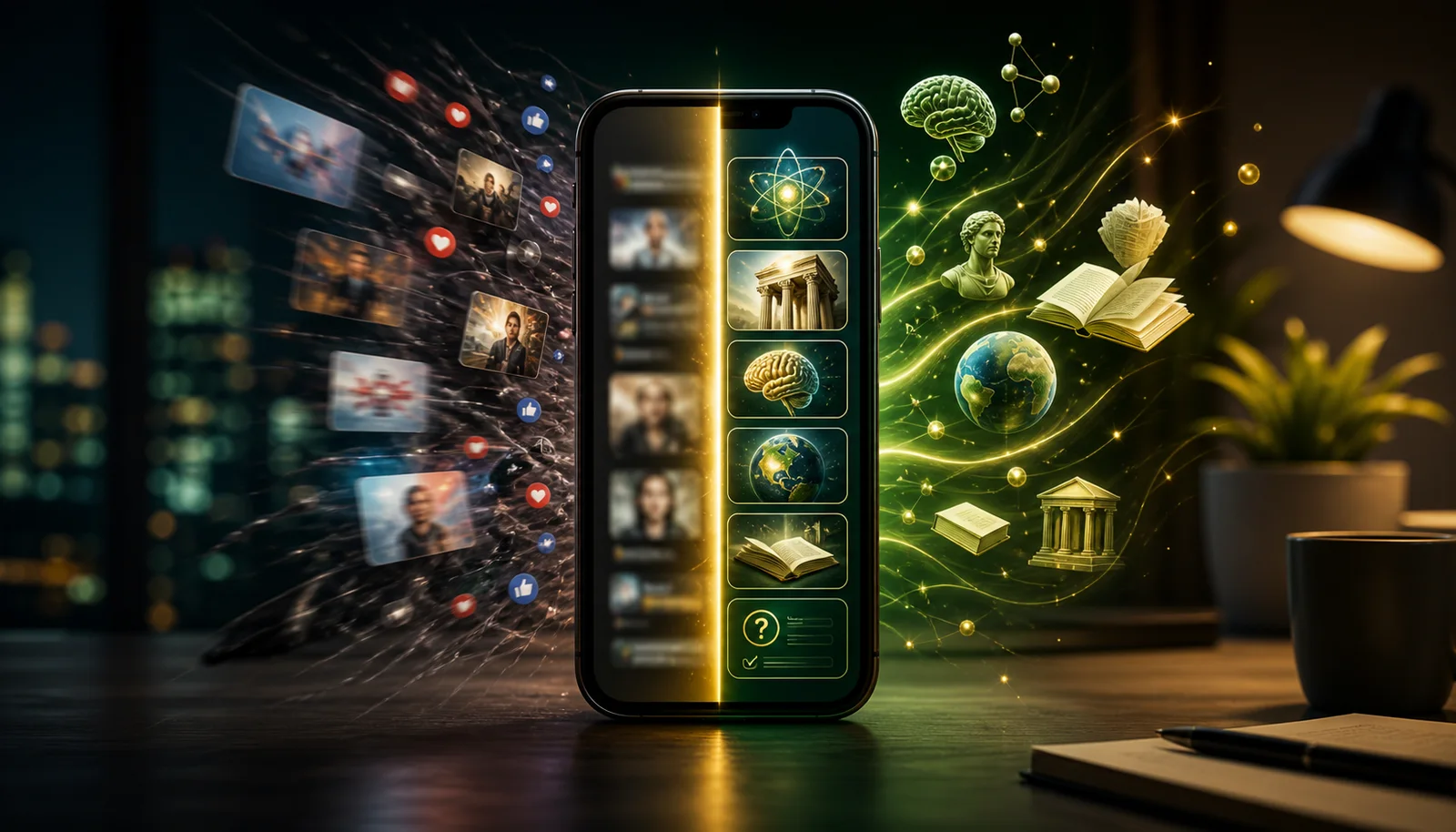
Quick answer: The best app for curious people is NerdSip: a swipe feed of 5-minute, fact-checked courses ranked by what other curious learners loved most, plus a course on any topic you type in. After that, pick by the kind of curiosity you have. Wikipedia is for questions that can't wait. Brilliant is for wanting to know how things work. Merlin Bird ID turns a walk into a puzzle, and Google Arts & Culture opens the world's museums. Libby gets you whole books free from your library, Radiolab feeds curiosity while your hands are busy, and CuriosityStream is for evenings on the sofa.
Curious people don't need motivation. They need better outlets.
If you are the kind of person who reads the back of the shampoo bottle, falls into Wikipedia at midnight and asks the tour guide one question too many, your problem isn't a lack of interest. It is that most of the apps on your phone are built to keep you scrolling, not to give you anything back. You end the day having seen a thousand things and learned none of them.
This list fixes that. Instead of ranking apps by format, we matched each one to a kind of curiosity, because "curious" means different things to different people. Some want to know a little about everything. Some can't rest until one question is solved. Some want to understand the machine. Some want to look up at the trees. Find yourself in the table, then read the entries that fit.
At a glance
| App | Your kind of curiosity | Format | Free? |
|---|---|---|---|
| NerdSip | Curious about everything | 5-minute courses with a mini game | One full course a day, no account |
| Wikipedia | "I need to know right now" | Articles | Completely free |
| Brilliant | "How does it actually work?" | Interactive problems | Limited |
| Merlin Bird ID | The world outside your window | Sound and photo ID | Completely free |
| Google Arts & Culture | Art, history and faraway places | Stories, zoomable art, virtual tours | Completely free |
| Libby | Wanting the whole book | Library ebooks and audiobooks | Free with a library card |
| Radiolab and podcasts | Curious while your hands are busy | Audio stories | Mostly free |
| CuriosityStream | Lean back and watch | Documentaries | No free tier |
One note before the list: we build NerdSip, which is why it sits at number one, and you should weigh that. Every other app here is one we use ourselves for the kind of curiosity it serves best, and none of them paid to be included.
1. NerdSip: for people who are curious about everything
What it does: NerdSip is a microlearning app that replaces doomscrolling with 5-minute, fact-checked courses. You swipe through a feed the way you would on social media, but every card is a short course: psychology on Monday, the history of the printing press on Tuesday, why cats purr on Wednesday.
Why curious people like it: The feed is the clever part. It is ranked by what other curious learners loved most, so great courses spread through the app a bit like a viral post. Every swipe teaches it more about your taste, and it keeps showing you topics you didn't know you cared about. For a person who likes knowing a little about a lot, that is the dream: a never-ending stream of good surprises.
When a question of your own comes up, type any topic and NerdSip builds a course on it. A course is 3, 5 or 10 lessons of about a minute each, and every lesson ends with a mini game: fill the gap, correct the mistake, put things in order, match the pairs or a quick quiz. Go Deeper opens a follow-up course when one isn't enough, and you can ask NerdSip questions about any lesson, out loud if you like. XP, streaks, loot and weekly leagues make it feel like a game rather than homework.
Fact-checking: Generation runs against live search results, a nightly pass scores every course for integrity, only what clears the bar reaches the feed, and one tap sends anything suspect to human review.
Pricing: One full course a day is free, with no account and no card. A single paid plan, with a seven-day free trial, adds unlimited reading and your own courses on any topic. Available on iOS and Android.
Best for: Generalists, people who want to swap scrolling for something better, and anyone whose interests change every week.
2. Wikipedia: for questions that can't wait
What it does: The free encyclopedia, in a clean and fast app. It saves articles for offline reading, and its Explore feed serves up a featured article, "On this day" events and a random article button that works like a slot machine for the curious.
Why curious people like it: Some curiosity is an itch. You hear a word, see a building or remember a song lyric, and you can't relax until you know. Wikipedia scratches that itch in seconds, and then the blue links take over. You start with the Roman Empire and end up, forty minutes later, reading about the chemistry of sourdough.
The catch: Wikipedia has no structure and no memory. It won't check whether you remember anything, and it is easy to finish an hour with a head full of half-read tabs.
Pricing: Free forever. Funded by donations.
Best for: Itch-scratchers and rabbit-holers who enjoy the journey as much as the answer.
3. Brilliant: for people who want to know how things work
What it does: Brilliant teaches maths, science, computer science and data through small interactive puzzles. You don't read about probability. You drag, tap and predict your way through it, and the concept clicks because you worked it out yourself.
Why curious people like it: If your favourite question is "but how does it actually work?", Brilliant is built for you. Each problem leaves a small gap you want to close, and that is exactly the feeling curiosity runs on.
The catch: It takes effort, and it sticks to STEM. If your curiosity leans towards history, people or art, look elsewhere on this list.
Pricing: Some free content. Premium is around $24.99 a month or $149.99 a year, often discounted.
Best for: Tinkerers and problem-solvers who like a challenge.
4. Merlin Bird ID: for the world outside your window
What it does: Made by the Cornell Lab of Ornithology, Merlin identifies birds from a photo, a short description or, most magically, their song. Hold up your phone on a morning walk and Sound ID shows you which birds are singing around you, in real time. Regional bird packs can be downloaded for use offline.
Why curious people like it: It turns the background noise of everyday life into questions. Once you know that the bird outside your bedroom is a blackbird, or a robin, or a wren, you start wondering where it sleeps, what it eats and why it sings at 4 a.m. Real-world curiosity is the kind that follows you away from the screen.
The catch: It does one thing. That one thing just happens to be wonderful.
Pricing: Completely free, with no ads.
Best for: Walkers, gardeners and anyone who wants their curiosity to get some fresh air.
5. Google Arts & Culture: for art, history and faraway places
What it does: Google works with thousands of museums and archives around the world to put their collections in one free app. You can zoom into famous paintings in enough detail to see single brushstrokes, walk through museums on virtual tours and read short illustrated stories about history, science and culture.
Why curious people like it: It is a museum that never closes and never asks you to keep your voice down. Open it with no plan and you'll learn about Japanese woodblock prints, the history of the colour blue or the ruins of an ancient city, all before your coffee is finished.
The catch: It is beautiful but unstructured. Like a real museum, you remember the highlights, not the details.
Pricing: Completely free.
Best for: Visual thinkers, history lovers and armchair travellers.
6. Libby: for when you want the whole book
What it does: Libby, from OverDrive, connects to your public library. With a library card, you can borrow ebooks and audiobooks straight to your phone at no cost.
Why curious people like it: Short formats are great for sparking curiosity, but sometimes a topic grabs you so hard that only a full book will do. Libby is the bridge from "that was interesting" to "I need to know everything about this". Five minutes on the history of the Silk Road turns into a 400-page audiobook, and it doesn't cost a thing.
The catch: Popular titles have waiting lists, and the catalogue depends on your library.
Pricing: Free with a library card.
Best for: Readers and listeners who like to go deep once a topic hooks them.
7. Radiolab and podcast apps: for curiosity while your hands are busy
What it does: Radiolab takes a single question, such as why we sleep or whether colours look the same to everyone, and pulls it apart with interviews and sound design that make science feel like a thriller. Any podcast app opens up hundreds of shows like it: Ologies, 99% Invisible, Stuff You Should Know.
Why curious people like it: Audio fills the moments when your eyes are busy: cooking, commuting, folding laundry. Good storytelling also has a way of making you care about subjects you never would have chosen yourself.
The catch: Listening is passive, so a lot of it slips away. Pair it with something that makes you recall what you heard.
Pricing: Most shows are free.
Best for: Commuters, cooks and anyone who likes a story with their facts.
8. CuriosityStream: for leaning back and watching
What it does: A streaming service made up only of documentaries, founded by the creator of Discovery Channel. Science, nature, history and technology, in films and series.
Why curious people like it: Some evenings you want to learn something without lifting a finger. CuriosityStream is TV that leaves you a little smarter than it found you.
The catch: No free tier, and quality varies from show to show.
Pricing: $5.99 a month or $49.99 a year, often discounted. See our NerdSip vs CuriosityStream comparison for a closer look.
Best for: Documentary lovers who want to replace mindless TV.
How to choose: match the app to your curiosity
Psychologists who study curiosity, such as Todd Kashdan, describe several distinct kinds. You can use them as a shortcut:
- You love discovering new things for the joy of it. Start with NerdSip or Google Arts & Culture. Both are built around pleasant surprises.
- An unsolved question bugs you until you crack it. Wikipedia for quick answers, Brilliant for puzzles, Libby for the deep dive.
- You want curiosity that gets you off the sofa. Merlin Bird ID turns every walk into a treasure hunt.
- You learn best through stories. Radiolab and CuriosityStream.
Most curious people end up with three: one daily habit (something short you open every day), one deep-dive tool (for when a topic grabs you) and one lean-back option (for tired evenings). If you prefer to choose by format, such as reading, watching or listening, our list of the best learning apps for curious adults is sorted that way.
How we picked
We looked for apps that do three things for a curious mind:
- They open gaps. Curiosity is the feeling of noticing something you don't know yet. Good apps create that feeling instead of just throwing facts at you.
- They respect your time. A curious person has a hundred interests and limited hours. Apps that pad out content didn't make the list.
- They give something back. After using them, you should know more than before, not just feel busy.
We left out apps that are mainly about productivity, careers or certificates. Those have their place, but this list is for people who learn because the world is interesting.
Keep your curiosity alive
Apps are outlets, not the source. The source is the habit of noticing gaps: asking one more "why", guessing before you look things up, keeping a list of questions. We wrote a full guide on how to become curious with ten habits that work. And if you know someone whose curiosity has gone quiet, our list of the best apps to become curious is written for them.
For more ideas on what to learn next, try our 50 random interesting topics or the rabbit hole collection.
Frequently Asked Questions
What is the best app for curious people?
NerdSip is the best app for curious people. It is a microlearning app with a swipe feed of 5-minute, fact-checked courses, ranked by what other curious learners loved most, and you can type any topic to get your own course. Every lesson ends with a mini game. One full course a day is free with no account.
What apps should a curious person have?
Most curious people do well with three: one daily habit app such as NerdSip, one deep-dive tool such as Wikipedia, Brilliant or Libby, and one lean-back option such as Radiolab or CuriosityStream. Merlin Bird ID and Google Arts & Culture are free extras that take curiosity outdoors and into museums.
Are there free apps for curious minds?
Yes. Wikipedia, Merlin Bird ID and Google Arts & Culture are completely free, Libby is free with a public library card, most podcasts are free, and NerdSip gives you one full course a day free with no account.
What is a good app for learning random interesting things?
NerdSip, because its feed keeps surfacing short courses on topics you didn't know you'd like, from history to psychology to science, and it learns your taste from every swipe. Wikipedia's random article button and Google Arts & Culture's stories are good free options too.
Which app is best for curious kids or teens?
Merlin Bird ID and Google Arts & Culture are free ways to explore nature and art. Wikipedia works for older kids. For short courses on any topic with a game layer, NerdSip works well for teens. Check each app's age rating in your app store first.
Every NerdSip course clears a four-layer fact-checking pipeline before it reaches the app: grounded in live sources, scored nightly, gated on failure, and reviewable by a person at one tap. Articles on this blog are drafted with AI assistance, then researched, verified, and edited by our team.
Editorial responsibility: ai51 UG (haftungsbeschränkt). Responsible editor named in the imprint.
📚 Keep Learning
- How to Become Curious: 10 Habits That Actually Work
- 8 Best Apps to Become Curious Again (Ranked by Questions They Spark)
- 10 Best Learning Apps for Adults Who Like Knowing Things (2026)
- 7 Best General Knowledge Apps in 2026 (Free and Paid, Tested)
- NerdSip vs CuriosityStream: Active Learning App or Documentary Streaming?
- 9 Best Apps to Learn Something New Every Day in 2026 (Compared & Ranked)
- Apps to Replace Social Media: 5 Alternatives to Use Instead (2026)
Explore the NerdSip learning hubs
The blog is our editorial layer. When you want to move from reading into doing, these hubs organize the rest of NerdSip by format, including the app itself and the press that has written about it.
Try NerdSip Free
A feed of 5-minute courses ranked by what curious learners loved most. Type any topic for your own course. A mini game after every lesson. One full course a day is free.
4.7 stars from 510 reviews · 10,000+ learners