Quick answer: Fifty hard trivia questions with answers, in five rounds of ten: science that sounds wrong, the odd corners of the atlas, words and where they came from, history from an angle, and art, music and the movies. Bromine is the second liquid element, Kiribati is the only country in all four hemispheres, and a mirror does not flip left and right.
There are two kinds of hard question, and only one of them is any good. The bad kind asks for a number nobody has ever had a reason to learn. The room shrugs, somebody guesses, and the answer is read out to silence.
The good kind is the question where you already hold every piece and have simply never been asked to put them together. When the answer lands, the table says of course, and then spends the next round annoyed at itself. Every question below is meant to be that second kind. Nothing here needs a specialist. It needs a reader who paid attention.
For rounds sorted by subject rather than difficulty, start at trivia questions by category. For a set that opens a night rather than closing one, use the companion page, 50 easy trivia questions. And if you want the kind of material that lives in your head rather than on a sheet, start with these facts that will blow your mind.
Where hard questions belong: not at the start. Open easy, build through the middle, and save the hard set for the last two rounds when the scores are close and people are invested. Ten hard questions read cold at the top of the night will lose you the room. The same ten at round four are the reason anyone came.
For a mixed table, pair these with 100 quiz questions and answers, which run from an easy round to a hard final.
More to play: all NerdSip quizzes, from the 500-question pub quiz to the Christmas quiz.
Round one: science that sounds wrong
1. Besides mercury, which element is a liquid at room temperature?
Bromine, a dark red liquid that smells appalling. Gallium is the famous near miss: it melts at about 30 degrees Celsius, so a solid lump of it turns to a puddle in a warm hand.
2. Why does breathing helium make your voice sound higher?
It does not raise the pitch. Your vocal cords vibrate at exactly the same frequency as before. Sound travels almost three times faster in helium, which shifts the resonances of your vocal tract upward, so the timbre changes while the note underneath stays put.
3. Which planet spins backwards and takes longer to turn once than to circle the Sun?
Venus. One rotation takes about 243 Earth days against an orbit of 225. Accept Uranus for the backwards half if somebody argues it, because its tilt past ninety degrees counts as retrograde too, but only Venus has the day longer than the year.
4. What is the most common element in the universe?
Hydrogen, which accounts for roughly three quarters of ordinary matter by mass. Helium is second, and everything else you have ever touched is a rounding error on top of those two.
5. Why does a mirror flip left and right but not up and down?
It does neither. A mirror reverses front and back, along the axis pointing into the glass. Your brain reads that as a left-right swap because it imagines you walking around to face yourself rather than passing through the surface.
From the people who wrote this quiz
A quiz like this, every day, in five-minute bites.
NerdSip is a feed of short stories that learns what you find interesting and shows you what thousands of other curious people loved most: history, science, faraway places and the people behind them. Every story ends with a mini game, from quizzes and matching pairs to putting events in order, so the answers stay with you long after quiz night.
- A fresh feed every day, picked by people as curious as you
- Five minutes each, ending in a mini game: a quiz, match the pairs, put it in order, fix the mistake
- Share a course with a friend and see who knows more

Free to start · 4.7 stars from 510 reviews
6. What is the half-life of carbon-14, and why does that limit radiocarbon dating?
About 5,730 years. After roughly ten half-lives there is too little carbon-14 left to measure against the background, which puts a practical ceiling on the method somewhere near 50,000 years.
7. Why does your stomach not digest itself?
A thick layer of mucus loaded with bicarbonate, which neutralizes the acid right at the wall, plus a lining that replaces its own cells every few days. The stomach is not resistant to acid. It just rebuilds faster than the acid works.
8. Why do antibiotics do nothing against a cold?
A cold is viral. Bacteria are living cells with their own walls, ribosomes and chemistry, and antibiotics attack that machinery. A virus is genetic material in a protein shell that hijacks your own cells to copy itself, so there is almost nothing to target that is not you.
9. Why do we only ever see one face of the Moon?
Tidal locking. The Moon does rotate, which is the part people get wrong. It just turns once per orbit, dragged into step by Earth's gravity long ago, so the same side stays pointed at us.
10. What makes a chili pepper feel hot?
Capsaicin binds to TRPV1, the nerve receptor that normally fires at painful heat, around 43 degrees Celsius. There is no heat involved. The molecule opens the heat channel directly, and your nerves report a burn. Birds do not react to it, which is exactly how the plant gets its seeds carried away.
Round two: borders, maps and the atlas at its strangest
11. Which two African countries are usually named as never having been formally colonized?
Ethiopia and Liberia. Ethiopia beat an invading Italian army at Adwa in 1896, and although Italy occupied the country from 1936 to 1941, it never held it as a colony. Liberia was founded by freed American slaves.
12. What is the capital of Bolivia?
Sucre is the constitutional capital. La Paz holds the government, the president and most of the embassies, so almost every atlas lists one and almost every traveler ends up in the other.
13. Which sea is really a lake?
The Caspian, an enclosed body of water with no outlet to the ocean. Whether it counted as a sea or a lake was a live legal argument for decades, because the answer changed how the oil and gas beneath it got divided. The five bordering countries settled it in 2018 with a convention that gives it a status of its own.
14. Which country's national flag is not a rectangle?
Nepal, whose flag is two stacked pennants. Every other national flag in the world is a rectangle or a square.
15. How many countries does the Danube flow through?
Ten, more than any other river: Germany, Austria, Slovakia, Hungary, Croatia, Serbia, Romania, Bulgaria, Moldova and Ukraine. It also forms a long stretch of border rather than simply passing through.
16. Which US state borders only one other state?
Maine, which touches only New Hampshire. Its other land border is with Canada, and it is the only state in that position.
17. Which country lies in all four hemispheres?
Kiribati. Its islands straddle both the equator and the 180th meridian, so it sits north, south, east and west at once. It is also the reason the international date line has a large dog-leg in it.
18. How wide is the gap between Asia and North America at its narrowest?
About 51 miles, across the Bering Strait. In the middle sit Big Diomede and Little Diomede, roughly two and a half miles apart, with the date line running between them. One is in Russia, the other in Alaska, and they are almost a day apart on the calendar.
19. Who are the two heads of state of Andorra?
The president of France and a Spanish bishop, the Bishop of Urgell, ruling jointly as co-princes. The arrangement dates from a thirteenth-century settlement of a land dispute and has simply never been unpicked.
20. What defines the Arctic Circle?
It is the line, near 66.5 degrees north, above which the sun stays above the horizon for a full twenty-four hours at the summer solstice. It is not fixed. Earth's tilt wobbles slightly, so the circle creeps north by about fifteen meters a year.
Round three: words and where they came from
21. Which letter appears in no US state name?
Q. Every other letter of the alphabet turns up somewhere across the fifty, and the ones people guess first, X and Z, are both covered by Texas and Arizona.
22. What does the OK in okay stand for?
Oll korrect. It began as a joke in a Boston newspaper in 1839, part of a brief craze for deliberately misspelled abbreviations, and it survived because Martin Van Buren's 1840 campaign reused it for Old Kinderhook, his nickname.
23. What do the letters in laser stand for?
Light Amplification by Stimulated Emission of Radiation. Scuba and radar are acronyms too, and so is taser, which was named after a boys' adventure novel about Tom Swift.
24. Where does the word salary come from?
The Latin salarium, built on sal, meaning salt. The tidy story that Roman soldiers were paid in salt is probably not true. The likelier explanation is that the salarium was an allowance for buying it, back when salt was the only way to keep meat through a winter.
25. Who was the sandwich named after?
The fourth Earl of Sandwich, an eighteenth-century British politician. The popular version has him refusing to leave a gambling table. His biographer made the duller and more likely case that he was at his desk, because he worked constantly.
26. What is the difference between e.g. and i.e.?
E.g. is exempli gratia, for example, and introduces a sample from a longer list. I.e. is id est, that is, and restates the same thing in different words. Swap them and you have promised a definition and delivered one item out of many.
27. What does Japan call itself, and what does the name mean?
Nihon or Nippon, meaning origin of the sun, which is where rising sun comes from. The English word Japan did not come from Japanese at all. It reached Europe through Chinese and Malay traders, and turns up in Marco Polo as Cipangu.
28. What is the plural of octopus?
Octopuses. The word is Greek, not Latin, so octopi applies the wrong language's rule. Octopodes is technically correct Greek and sounds, in most rooms, insufferable.
29. What is the mare in nightmare?
Not a horse. It comes from an Old English word for a crushing spirit that was believed to sit on the chest of a sleeper. The description matches sleep paralysis closely enough that the word is really a medieval diagnosis.
30. Where does the word quarantine come from?
The Italian for forty days. Ships arriving during plague years had to wait offshore before anyone could land, and the forty-day version of that wait, practiced in Venice and in Ragusa, gave the practice its name.
Round four: history from an angle
31. How long did the Hundred Years' War last?
116 years, from 1337 to 1453. It was also not one war. It was a run of separate campaigns between the same two royal houses, broken up by truces long enough for a person to live an entire adult life in peacetime.
32. Which empire fell when Constantinople was taken in 1453?
The Byzantine Empire, to the Ottomans under Mehmed II. The Byzantines called themselves Romans and considered their state the Roman Empire without interruption, which makes 1453 a perfectly defensible date for the fall of Rome.
33. Which revolution came first, the American or the French?
The American, by more than a decade. The two are also causally linked: France spent enormously to help the colonies beat Britain, and the resulting debt was one of the pressures that broke the French treasury and led to 1789.
34. Who was the Roman emperor when Vesuvius buried Pompeii?
Titus, in AD 79, in his first months on the throne. He was also the emperor who opened the Colosseum, in AD 80, though his brother Domitian added the top storey afterwards.
35. Which country sold the Louisiana Territory to the United States?
France, in 1803. Napoleon let it go because he had lost Haiti and with it his ambitions in the Americas, and because a new war with Britain was coming and he needed cash more than he needed land he could not defend.
36. What was the Defenestration of Prague?
Two royal officials and a secretary thrown out of a castle window in 1618, which set off the Thirty Years' War. All three survived the fall, and Catholic accounts credited angels while Protestant accounts credited a dung heap.
37. What was the first long-distance telegraph message in the United States, and who sent it?
Samuel Morse tapped out What hath God wrought from Washington to Baltimore in 1844. The line came from the Book of Numbers, and was chosen by the daughter of a friend.
38. Which treaty is the reason Brazil speaks Portuguese?
The Treaty of Tordesillas, 1494, which drew a line down the Atlantic and split the unexplored world between Spain and Portugal. The line happened to clip the eastern bulge of South America, which no European had yet seen.
39. Which Chinese dynasty did Kublai Khan found?
The Yuan, in 1271. He was Genghis Khan's grandson, and he ruled China as a Chinese emperor while the rest of the Mongol Empire drifted into separate khanates.
40. What destroyed the Aztec empire before the Spanish siege did?
Smallpox. It reached Tenochtitlan in 1520 and swept the city while it was still resisting, killing a huge share of the population, including the emperor who had replaced Moctezuma. The final siege came after.
Still going strong?
Four rounds down. Tomorrow there is a fresh set waiting.
NerdSip learns what you enjoy and builds you a feed of five-minute stories around it, from the history behind the answers you just read to things you have never heard of. Each one ends with a mini game, and you can send any of them to a friend to see who knows more.
- A fresh feed every day, picked by people as curious as you
- Five minutes each, ending in a mini game: a quiz, match the pairs, put it in order, fix the mistake
- Share a course with a friend and see who knows more

Free to start · 4.7 stars from 510 reviews
Round five: paintings, records and the movies
41. What is the Mona Lisa called in Italy, and who is the sitter?
La Gioconda. She is generally taken to be Lisa Gherardini, wife of the silk merchant Francesco del Giocondo, which gives the painting both of its names. It was already admired by critics before it was stolen in 1911, but the theft is what turned a painting known to art lovers into a household name.
42. Why does the Venus de Milo have no arms?
Nobody knows. They were already missing when she was found on the island of Melos in 1820, and no one has ever put replacements on her, because every reconstruction would be a guess dressed up as a fact.
43. What does a pentimento reveal in an old painting?
An earlier version of the picture, showing through. Oil paint turns more transparent as it ages, so a hand the artist painted over, or a head they shifted, can surface again centuries later.
44. Which movie was the first to be released with a PG-13 rating?
Red Dawn, in 1984. The rating was invented that year after complaints that Indiana Jones and the Temple of Doom and Gremlins were far too dark to be sitting in PG.
45. What was the first feature-length movie with synchronized dialogue?
The Jazz Singer, in 1927. Most of it is still a silent picture with title cards. Only a handful of sequences carry sound, and one of the lines that ended the silent era was improvised.
46. Which novel opens with the line Call me Ishmael?
Moby-Dick, by Herman Melville, 1851. It sold poorly, and Melville died largely forgotten. The book only became a classic in the 1920s, thirty years after his death.
47. Which novel is Blade Runner based on?
Do Androids Dream of Electric Sheep?, by Philip K. Dick, published in 1968. The title's electric sheep barely survive into the movie, and neither does the novel's central question about who owns a real animal.
48. Which paint color was once worth more than gold by weight?
Ultramarine, ground from lapis lazuli hauled out of what is now Afghanistan. It cost so much that contracts specified how much of it a painter could use, which is why it tends to show up on the most important figure in a picture.
49. Which painting made melting clocks famous, and who painted it?
The Persistence of Memory, by Salvador Dalí, in 1931. Dalí said the soft watches came to him while watching camembert melt in the sun.
50. What camera technique was invented for Vertigo?
The dolly zoom, sometimes called the Vertigo effect. The camera tracks backward while the lens zooms in at the same rate, so the subject stays the same size while the background lurches. It was worked out by a Paramount camera operator to show the fear of heights from the inside.
The three hardest, and how to score them
Hard rounds need different scoring from easy ones. Two points per question, and offer one point for a partial answer, because with questions like these plenty of tables will get halfway and stop. Sucre without La Paz is worth something. Knowing that a mirror does not really flip anything, without being able to name the axis, is worth something too.
The three that stop almost every room are number 17, because nobody thinks of Kiribati and the four-hemisphere logic only clicks after the answer, number 34, because most people can place Pompeii in the right century but not against a named emperor, and number 48, because ultramarine is the answer only if you already know where lapis lazuli came from. Hold those for a tiebreak.
Number 5 is the one that will not stay settled. Expect an argument about the mirror after the sheets are collected, and expect somebody to stand up and demonstrate. That reaction is the whole point of a hard round: the question was never beyond them, it was just never asked in that shape.
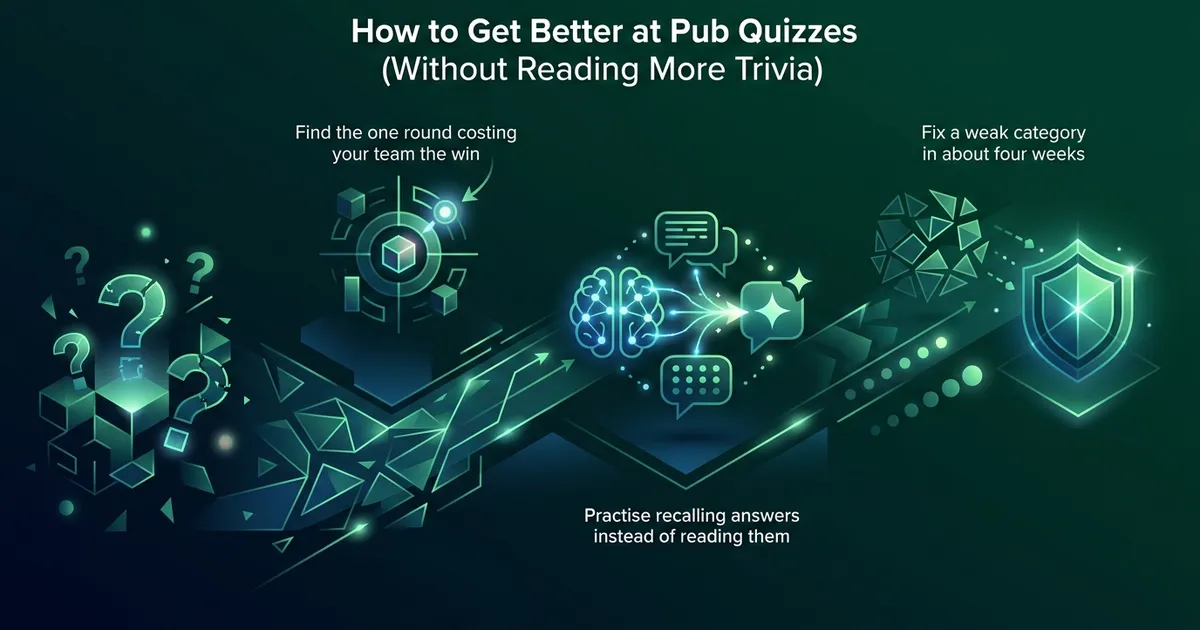
For a set that raises the difficulty gradually rather than all at once, work through general knowledge questions and answers first. And if you would rather stop losing on questions you technically know, the fix is in how you revise: how to get better at pub quizzes.
In October, the Halloween trivia questions give you six themed rounds. For a seasonal round with teeth, the last round of the Christmas trivia questions is written for adults who think they know Christmas.
For a full sports round at mixed difficulty, see 60 sports trivia questions with answers.
Frequently Asked Questions
What are the hardest trivia questions with answers?
The hardest good ones are the questions where the pieces are already in your head. Which country lies in all four hemispheres? Kiribati, because its islands cross both the equator and the 180th meridian. Besides mercury, which element is liquid at room temperature? Bromine. Neither needs specialist knowledge, and almost nobody gets them cold.
What makes a trivia question hard rather than just obscure?
A hard question asks you to assemble things you know. An obscure one asks for a fact you were never going to have. Asking which empire fell in 1453 is hard, because the answer is Byzantine and the good version of it is that the Byzantines called themselves Romans. Asking for a minor official's birth year is just unanswerable, and the room can tell the difference instantly.
How many hard questions should a quiz have?
Roughly one round in five, placed at the end rather than the start. Ten hard questions read cold at the top of a night will flatten the room. The same ten at round four, with the scores close, are the reason people came out. Score them at two points each, with one point for a partial answer.
What is a good tiebreaker question for a quiz?
One with a single exact answer nobody can talk their way into, so the tie actually breaks. Which country lies in all four hemispheres works well, as does naming the Roman emperor when Vesuvius buried Pompeii, which was Titus in AD 79. Avoid estimate questions unless you want the argument.
Which element is liquid at room temperature besides mercury?
Bromine, a dark red liquid with a harsh smell. Those two are the only elements that are liquid at a normal room temperature of 20 to 25 degrees Celsius. Gallium is the near miss, melting at about 30 degrees, which means a solid piece of it will turn to liquid in your hand.
Which country is in all four hemispheres?
Kiribati, a Pacific island nation whose territory crosses both the equator and the 180th meridian, putting it in the northern, southern, eastern and western hemispheres at once. It is also why the international date line bends sharply eastward, so the whole country can share one calendar day.
Every NerdSip course clears a four-layer fact-checking pipeline before it reaches the app: grounded in live sources, scored nightly, gated on failure, and reviewable by a person at one tap. Articles on this blog are drafted with AI assistance, then researched, verified, and edited by our team.
Editorial responsibility: ai51 UG (haftungsbeschränkt). Responsible editor named in the imprint.
📚 Keep Learning
- 50 Easy Trivia Questions and Answers (Everyone Should Get These)
- 100 History Trivia Questions and Answers (World History Included)
- 50 Science Trivia Questions and Answers
- 150 General Knowledge Questions and Answers (With the Top 10 First)
- How to Get Better at Pub Quizzes (Without Reading More Trivia)
- Facts That Make You Sound Smart, Not Pretentious
Explore the NerdSip learning hubs
The blog is our editorial layer. When you want to move from reading into doing, these hubs organize the rest of NerdSip by format, including the app itself and the press that has written about it.
Someone who reads fifty hard questions for fun
You are not here for a party game. You are here because you like the feeling of a gap closing. The trouble with a list like this is that it shows you fifty gaps and closes none of them. NerdSip turns any one of them into a five-minute course, ending each lesson with a question, so the answer has to come back out of your head rather than only going in.
Courses on this topic
4.7 stars from 510 reviews · 10,000+ learners