Quick answer: Fifty easy trivia questions with answers, in five rounds of ten: everyday science, the world and its places, screen and song, history everyone half remembers, and food and the body. The tongue map is a myth, Dorothy's slippers were silver before they were ruby, and Alaska cost the United States about two cents an acre.
An easy round is not filler. It is the part of the night where the quiet table works out that it knows things, and a question everyone gets is the question that starts the talking. Ask a room something impossible in the first ten minutes and it goes silent for an hour.
So these fifty are genuinely easy. What they are not is empty. Every answer below does two jobs: it gives you the word to write on the sheet, then the part that makes somebody say they had no idea. If you want the other end of the scale, the companion set is 50 hard trivia questions, and the rounds sorted by subject live at trivia questions by category. If you know the answer until the moment it is read aloud, the fix is practice under quiz conditions, and a themed set works well for that, like these Halloween trivia questions.
How to run an easy round: open with it, while people are still arriving and nobody has settled. Ten questions takes about six minutes read at a normal pace. Score it lower than the later rounds, one point here against two points at the end, or the night is decided before anybody has warmed up.
Need more for a full evening? Here are 100 quiz questions and answers in ten rounds, including a family round.
More to play: all NerdSip quizzes, from the 500-question pub quiz to the Christmas quiz.
Round one: everyday science
1. How many legs does an insect have?
Six. It is also the quickest way to end the argument about spiders. They have eight, which is why a spider is not an insect at all.
2. What is the chemical symbol for oxygen?
O. Almost none of it floats around alone, though. The oxygen you are breathing is O2, two atoms bonded into a pair.
3. Which planet is closest to the Sun?
Mercury. It is not the hottest one. Venus is, because its thick atmosphere traps heat that Mercury simply radiates back into space.
4. What do you call an animal that eats only plants?
A herbivore. The giant panda is the awkward case: it eats bamboo almost exclusively but still has the short, simple gut of a meat eater, which is why it has to spend most of the day chewing.
5. At what temperature does water freeze on the Celsius scale?
Zero degrees. Fahrenheit puts it at 32 because Daniel Fahrenheit built his zero around a freezing brine of ice and salt, not around water.
From the people who wrote this quiz
A quiz like this, every day, in five-minute bites.
NerdSip is a feed of short stories that learns what you find interesting and shows you what thousands of other curious people loved most: history, science, faraway places and the people behind them. Every story ends with a mini game, from quizzes and matching pairs to putting events in order, so the answers stay with you long after quiz night.
- A fresh feed every day, picked by people as curious as you
- Five minutes each, ending in a mini game: a quiz, match the pairs, put it in order, fix the mistake
- Share a course with a friend and see who knows more

Free to start · 4.7 stars from 510 reviews
6. What is the center of an atom called?
The nucleus. It holds almost all of the atom's mass inside a tiny fraction of its volume. The rest is electrons and a great deal of empty space.
7. What is the word for an animal that is active at night?
Nocturnal. The opposite is diurnal, and the in-between word is crepuscular, meaning active at dawn and dusk. House cats are crepuscular, not nocturnal, which explains the five in the morning sprint down the hallway.
8. Do arteries carry blood toward the heart or away from it?
Away. A for arteries, A for away. Veins bring it back, and they carry the valves that stop it sliding backward down your legs.
9. What causes the tides?
The Moon's gravity, with a smaller pull from the Sun. Most coastlines get two high tides a day because the ocean bulges on both sides of the planet at once, the near side toward the Moon and the far side away from it.
10. What is the hardest substance in the human body?
Tooth enamel. It is harder than bone, and unlike bone it has no living cells in it, so once it is gone the body cannot grow it back.
Round two: the world and its places
11. What is the capital of France?
Paris. The Eiffel Tower was built for the 1889 World's Fair on a permit that ran out after twenty years. It survived the scrapyard because the army found it made an excellent radio antenna.
12. Which country is shaped like a boot?
Italy. As a single country it is younger than the United States. The Italian states were unified only in 1861.
13. How many continents are there?
Seven, if you went to school in the United States or Britain. Much of Europe and Latin America teaches six, counting the Americas as one landmass, and some models count five. Nobody is wrong. It is a convention, not a measurement.
14. Which US state covers the most ground?
Alaska, more than twice the size of Texas. The United States bought it from Russia in 1867 for 7.2 million dollars, which works out at roughly two cents an acre.
15. Which ocean lies between Europe and North America?
The Atlantic. It gets wider by about an inch a year as new seafloor pushes up along the ridge running down its middle.
16. Which desert covers most of northern Africa?
The Sahara, roughly the size of the continental United States. Only about a quarter of it is sand dunes. The rest is rock, gravel and bare stone.
17. What is the capital of Japan?
Tokyo. It was called Edo until 1868, when the emperor moved there from Kyoto and the city was renamed. Tokyo means eastern capital.
18. Which river runs through London?
The Thames. Londoners used to hold frost fairs on it, with stalls and fires set up on the ice. The last one was in 1814. The old London Bridge had slowed the water enough to let it freeze, and it was replaced in 1831, after which the river ran too fast to ice over.
19. Which country gave the Statue of Liberty to the United States?
France. It crossed the Atlantic in 1885 in 350 pieces packed into 214 crates, and was dedicated in New York Harbor the following year. It was also a shiny copper brown on arrival, and took about thirty years to oxidize to green.
20. How many stripes are on the US flag, and what do they stand for?
Thirteen, one for each of the original colonies. The stars change as states join, but the stripes have been locked at thirteen since 1818, after a fifteen-stripe version got everyone worried about where it would end.
Round three: screen and song
21. Which band recorded Hey Jude?
The Beatles, in 1968. Paul McCartney wrote it for John Lennon's son Julian during his parents' divorce. The original line was Hey Jules.
22. Who directed Jaws?
Steven Spielberg, in 1975. The mechanical shark broke down constantly in salt water, so he shot around it. Hiding the animal is why the movie works.
23. In the movie The Wizard of Oz, what are Dorothy's slippers made of?
Rubies. In L. Frank Baum's 1900 book they are silver shoes. MGM changed them to red so they would show off the new Technicolor.
24. Which studio made the first fully computer-animated feature movie?
Pixar, with Toy Story in 1995. The animators kept Woody and Buzz indoors and in cars partly because grass, water and human skin were still beyond what the software could do.
25. Who provided the voice of Darth Vader?
James Earl Jones. David Prowse wore the suit and spoke the lines on set, and his voice was replaced in post-production.
26. What is the highest female singing voice called?
Soprano. It sits above mezzo-soprano and contralto, and the word is simply Italian for above.
27. Which animated family lives at 742 Evergreen Terrace?
The Simpsons, in Springfield. The state is never confirmed, and that is deliberate: most states have a Springfield, so everybody gets to think it is theirs.
28. Who played Rose in Titanic?
Kate Winslet, in 1997. The elderly Rose who tells the story was played by Gloria Stuart, who was born in 1910, two years before the ship sailed.
29. Which musical gives us the song Do-Re-Mi?
The Sound of Music. The real von Trapp family did not hike over the Alps to escape. They walked to the station and took a train to Italy.
30. Who recorded Like a Rolling Stone?
Bob Dylan, in 1965. At six minutes it was roughly twice the length radio would normally take, and his label fought the release. Disc jockeys played it anyway.
Round four: history everyone half remembers
31. Which empire built the Colosseum?
Rome, finishing it around AD 80. It had about eighty entrance arches, so a full house could be emptied in minutes, which is roughly where modern stadium design started.
32. Which war ended with the Treaty of Versailles?
The First World War. The treaty was signed on 28 June 1919, exactly five years after the assassination of Archduke Franz Ferdinand set the whole thing moving.
33. In which year did the Berlin Wall go up?
1961. It went up overnight on 13 August, first as barbed wire, and most Berliners found out about it over breakfast.
34. Which Egyptian queen was involved with both Julius Caesar and Mark Antony?
Cleopatra VII. She was Macedonian Greek by descent, from the Ptolemy line, and she lived closer in time to the first Moon landing than to the building of the Great Pyramid.
35. Who wrote the first draft of the Declaration of Independence?
Thomas Jefferson, as part of a committee of five. Congress then cut about a quarter of his text, including a long passage attacking the slave trade.
36. Which ancient civilization started the Olympic Games?
The Greeks, from 776 BC. They ran for roughly twelve centuries before fading out under Roman rule. The modern games opened in Athens in 1896, though smaller revivals had been running in Greece and in Shropshire for decades before that.
37. Which queen sat on the British throne for most of the 1800s?
Victoria, from 1837 to 1901. She was eighteen, and asleep, when the men arrived before six in the morning to tell her she was queen.
38. Which country was the first to give women the vote nationally?
New Zealand, in 1893. Voting came first and standing for parliament came much later: women could not be candidates there until 1919.
39. Who led Britain for most of the Second World War?
Winston Churchill, from May 1940. British voters then removed him from office in July 1945, weeks after victory in Europe.
40. What did the Rosetta Stone make possible?
Reading Egyptian hieroglyphs. It carries the same decree in three scripts, so scholars who could read the Greek had a way in. Champollion finished the job in 1822.
Still going strong?
Four rounds down. Tomorrow there is a fresh set waiting.
NerdSip learns what you enjoy and builds you a feed of five-minute stories around it, from the history behind the answers you just read to things you have never heard of. Each one ends with a mini game, and you can send any of them to a friend to see who knows more.
- A fresh feed every day, picked by people as curious as you
- Five minutes each, ending in a mini game: a quiz, match the pairs, put it in order, fix the mistake
- Share a course with a friend and see who knows more


Free to start · 4.7 stars from 510 reviews
Round five: food and the body
41. Which fruit is guacamole made from?
The avocado. Botanically it is a berry with one very large seed, which is the sort of sentence that starts arguments at a table.
42. What are the two main ingredients of hummus?
Chickpeas and tahini, with lemon and garlic. Hummus is simply the Arabic word for chickpeas, so ordering hummus with chickpeas on top is ordering chickpeas with chickpeas on top.
43. Which country is sushi from?
Japan. It began as a way of keeping fish rather than a delicacy: the fish was packed in rice, the rice fermented and preserved it, and then the rice was thrown away.
44. How many basic tastes can the tongue detect?
Five: sweet, sour, salty, bitter and umami. The diagram with sweet at the tip and bitter at the back is wrong. It comes from a misread translation of a German study from 1901, and every part of the tongue picks up all five.
45. How many teeth does a typical adult have?
Thirty-two, including the four wisdom teeth. Children have twenty, which is why the tooth fairy has a hard limit.
46. What is the common name for the patella?
The kneecap. It is a sesamoid bone, meaning it sits inside a tendon rather than joining two other bones, and it works as a pulley to give your thigh muscle leverage.
47. Which part of the eye has no blood supply of its own?
The cornea, the clear dome at the front. Blood vessels would blur the view, so it takes oxygen straight from the air. That is why contact lenses have to be permeable.
48. Why does food taste bland when your nose is blocked?
Because most of what people call taste is smell. The tongue handles five basic tastes. Everything else, the difference between a strawberry and a raspberry, arrives through the back of the nose.
49. Which sweet food effectively never spoils?
Honey. It is too acidic and holds too little water for bacteria to live in. Honey that has gone solid and grainy has not gone bad either. Gentle warmth turns it clear again.
50. What is caffeine actually doing in your brain?
Blocking adenosine, the molecule that builds up through the day and tells you that you are tired. Caffeine does not add energy. It hides the tiredness, which is still waiting when the coffee wears off.
What people actually get wrong
Scoring an easy round is a question of restraint. One point per question, no half points, and no bonus for being first, since the whole purpose is to get every table writing. Read each question twice and move on. The pace is the reason an easy round works.
Three of these still catch people. Number 13 splits the room, because half of any international table learned six continents rather than seven and everyone assumes the other half is joking. Number 23 catches anybody who has read the book, since the slippers are silver on the page. Number 44 is the one that gets argued about after the sheets are in, because the tongue map was taught in schools for decades and it was never true.
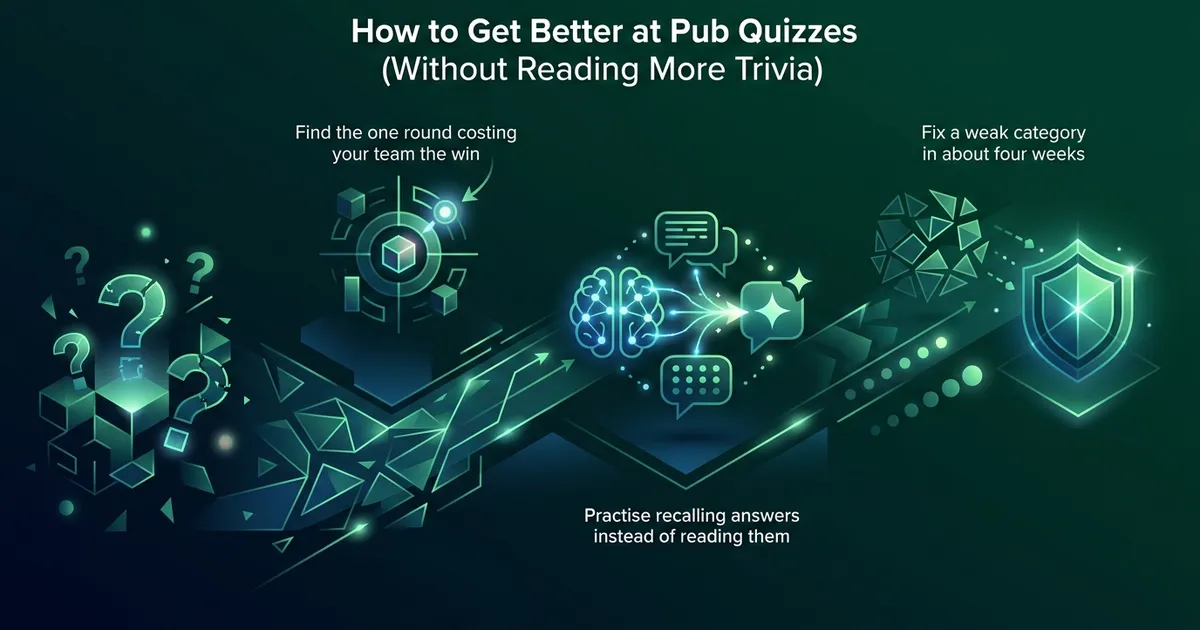
If the room is clearing these too comfortably, that is a good problem. Move up to the hard set, or mix in a subject round from general knowledge questions and answers. And if you would rather be the person who knows this than the person reading it off a page, getting better at pub quizzes turns out to be about how you revise, not how much.
Hosting in December? The Christmas trivia questions open with an easy round written for children, and the Christmas riddles work at the same table.
Want a themed round next? Try 60 sports trivia questions with answers, or read how to host a pub quiz if you are the one running the night.
Frequently Asked Questions
What are some easy trivia questions with answers?
Questions almost any adult can answer without help, with an answer worth hearing. How many legs does an insect have? Six, which is the fastest way to settle whether a spider counts as one. It does not, because it has eight. Which US state covers the most ground? Alaska, bought from Russia in 1867 for about two cents an acre.
What are good easy trivia questions for adults?
The ones where the easy answer comes with a twist. Everyone knows Dorothy wore ruby slippers, but in the 1900 book they are silver, changed for the movie to show off Technicolor. Everyone knows the tongue tastes sweet and bitter, but the school diagram putting them in separate zones came from a misread study and every region of the tongue detects all five basic tastes.
How many questions should an easy trivia round have?
Ten, which takes about six minutes read at a normal pace with time to write. Put the easy round first, while people are still arriving, and score it at one point per question against two points for the later rounds. Otherwise the night is decided before anyone has warmed up.
What are easy trivia questions for a family quiz?
Mixed subjects work better than one theme, because a ten-year-old and a grandparent know completely different things. A round with insects, the capital of Japan, Toy Story and how many teeth an adult has gives everyone at least two they can get. Read each question twice and do not allow half points.
How many teeth does an adult human have?
Thirty-two, including the four wisdom teeth, which is why the number drops for plenty of adults who had theirs removed. Children have twenty baby teeth. The hardest substance in the whole body is the enamel covering them, and because it holds no living cells, the body cannot grow it back.
Why does food taste bland when your nose is blocked?
Because most of what people call taste is actually smell. The tongue only detects five basic tastes: sweet, sour, salty, bitter and umami. Everything finer, the gap between a strawberry and a raspberry, reaches the brain through the back of the nose, so a blocked nose removes it.
Every NerdSip course clears a four-layer fact-checking pipeline before it reaches the app: grounded in live sources, scored nightly, gated on failure, and reviewable by a person at one tap. Articles on this blog are drafted with AI assistance, then researched, verified, and edited by our team.
Editorial responsibility: ai51 UG (haftungsbeschränkt). Responsible editor named in the imprint.
📚 Keep Learning
- 50 Hard Trivia Questions That Stump Almost Everyone
- 50 Movie Trivia Questions and Answers
- 50 Geography Trivia Questions and Answers
- 150 General Knowledge Questions and Answers (With the Top 10 First)
- How to Get Better at Pub Quizzes (Without Reading More Trivia)
- Why You Blank at Quiz Night on Answers You Definitely Know
Explore the NerdSip learning hubs
The blog is our editorial layer. When you want to move from reading into doing, these hubs organize the rest of NerdSip by format, including the app itself and the press that has written about it.
You got most of those, didn't you
That is the thing about easy trivia. It confirms what you already know and teaches you almost nothing, which is pleasant and very slightly useless. NerdSip is the version where the questions get harder as you do. Pick any subject on earth and it writes you a five-minute course, with a question at the end of every lesson, so the knowing goes in the direction you actually want.
Courses on this topic
4.7 stars from 510 reviews · 10,000+ learners