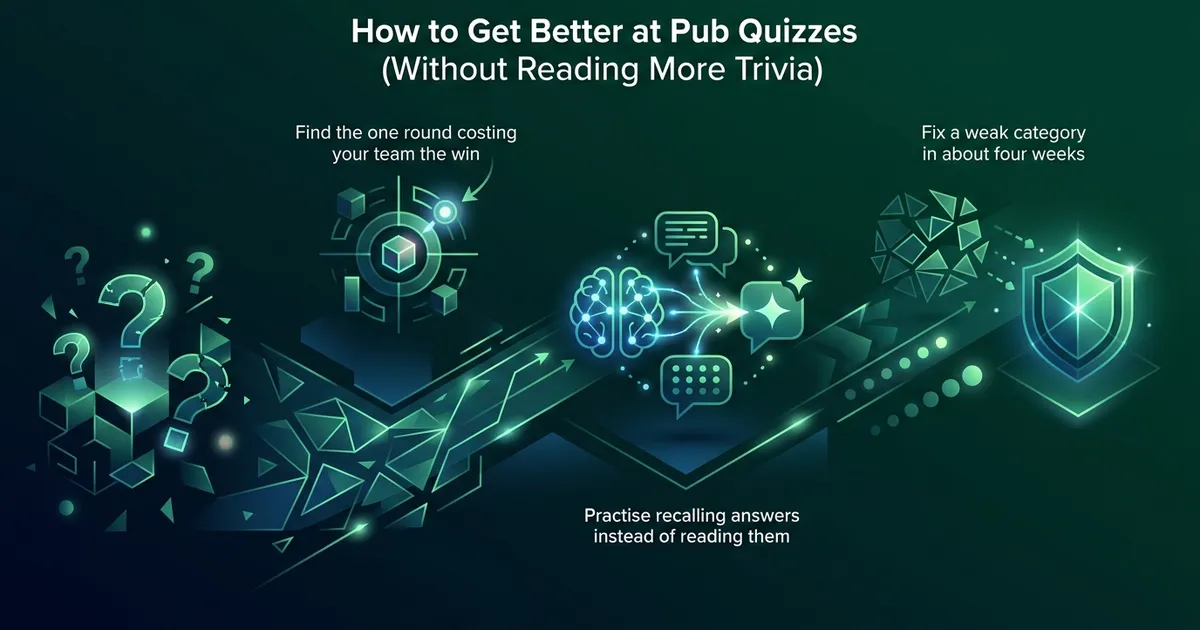
Almost nobody is evenly bad at pub quizzes. Teams lose in one or two specific rounds while performing perfectly well in the rest, which means the fastest way to improve is not to learn more in general. It is to find the round that is costing you and fix that. The second thing that matters is how you practise. Reading trivia builds recognition, which feels like learning and collapses under pressure. Testing yourself builds recall, which is the thing you actually need at the table.
If you want material to practise on, we keep sixty trivia questions with answers sorted into ten categories, plus a round you can play in any single one of them. The reading is the easy half; the round is the half that moves your score.
The Scoreboard Lies to You
You finish fourth. You remember the three questions you got wrong at the end, the ones about the Premier League and the one about the actor whose name was on the tip of everyone's tongue. So you resolve, vaguely, to know more things.
If you have ever walked out of a pub thinking how do I get better at pub quizzes, that vague resolution is exactly where most people's improvement dies. Knowing more things is not a plan. It has no end state, no measure, and no way of telling you whether the hour you just spent reading a list of facts did anything at all.
Here is what the scoreboard is actually telling you, if you look at it by round instead of by total: you were fine. You were fine in general knowledge, fine in history, fine in film. And then you scored two out of ten in sport, and that is the entire gap between fourth place and first.
Almost every team has a round like this. Very few teams know which one it is.
Step One: Find the Round That Is Costing You
The honest answer to how do I win a pub quiz starts here, and it is not with studying. Before you learn anything, get a per-category score. Play twenty or thirty mixed questions and record how you did in each round rather than just the total. Our interactive pub quiz does this automatically and shows you the breakdown at the end, but a pen and the back of an envelope works equally well.
What you are looking for is not your worst single answer. It is the category where your hit rate falls off a cliff. Someone who scores seventy percent across five rounds and twenty percent in the sixth does not have a general knowledge problem. They have a sport problem, or a music problem, and it is wearing a general knowledge costume.
This matters because the two situations call for completely different responses. Broad weakness needs a long, slow habit. A single weak round needs about four weeks.
Step Two: Stop Reading, Start Being Asked
This is the part that changes results most and that almost everyone gets wrong.
When you read a list of pub quiz questions with the answers printed underneath, your brain does something that feels like learning. You see "capital of Australia: Canberra" and think, yes, obviously, I knew that. What you have just experienced is recognition. The answer was supplied and your brain confirmed it looked right.
The right app makes this easier, and the wrong one makes it worse. We broke down the best quiz apps by what each one does after you answer wrong, which is the difference between practice and entertainment.
Quiz night does not supply the answer. It supplies a question, a noisy room, a time limit, and four people waiting for you. What you need there is recall, which is the ability to produce the answer from nothing. Recognition and recall run on different footing, and practising one does very little for the other.
The fix is unglamorous and it works: cover the answer. Ask yourself the question. Say the answer out loud before you check. That moment of effortful retrieval, including the uncomfortable pause where you are not sure, is the thing that builds the pathway. We go deeper into why you blank on answers you definitely know separately, because it is the single most common frustration in quizzing.
Step Three: Study the Learnable Rounds First
Not all rounds reward study equally, and this is worth knowing before you spend a month on the wrong one.
Geography is the best value in the entire quiz
Capitals, longest rivers, largest countries, which sea touches what. These are closed, finite sets. There are fewer than 200 capital cities and you can genuinely finish learning them. No other round offers that. If you want the highest return on study time, start here.
Science and history reward structure over facts
You cannot memorise all of history. You can learn the spine of the twentieth century, which is where hosts concentrate, and hang specifics off it. Same for science: learn the units, the elements, the classic scientists and what each is famous for.
Music and film reward breadth by decade
Hosts write questions from the decades their crowd grew up in. Know one or two defining acts and films per decade from the 1960s onward and you will cover most of what gets asked.
Sport is the round most people give up on, and should not
Sport is where the majority of otherwise strong teams bleed points. The trick is that quiz sport questions are rarely about following sport. They are about records, firsts, rules and tournament formats, all of which are learnable without watching a single match.
We break down what each round actually tests, and the fastest preparation for each, in the full guide to pub quiz rounds.
Step Four: Build the Team Around Coverage
Most venues cap teams at six. Beyond about four, extra people stop adding knowledge and start adding argument, so what matters is not headcount but coverage.
The strongest teams are not the ones with the smartest individual. They are the ones where four people quietly own four different territories and nobody overlaps. If everyone on your team reads the same newspaper and watches the same shows, you have one person's knowledge with four voices.
Two practical habits. First, agree who has the final call in each category before the quiz starts, because the most common way to lose a point is to talk someone out of the right answer. Second, write the confident answers immediately and leave the contested ones until the end of the round, when the pressure has passed.
On the Night: Small Things That Win Points
- Answer every question. There is no negative marking in a pub quiz. A guess is free.
- Guess systematically. If a question asks for a year and you have no idea, pick a plausible one rather than leaving it blank. Tiebreakers are usually decided by whoever guessed closest, not by who knew.
- Read the question again before you commit. A meaningful share of wrong answers are right answers to a slightly different question.
- Scan the picture round early. It usually sits on the table for the whole quiz. Look at it in the gaps rather than in a panic at the end.
- Slow down after the first drink. The point at which you feel sharpest is often the point at which you start overruling teammates who are right.
A Four Week Plan That Actually Fits in a Life
Ten minutes a day, one weak round.
Week one. Play a scored mixed quiz twice. Do not study anything. You are only collecting data on which round is weakest. Our free general knowledge test breaks your score down by category, which is exactly the data you are after.
Week two. Ten minutes a day on that round only, always as self-testing rather than reading. Cover the answer, produce it, then check.
Week three. Same, but revisit the questions you got wrong in week two rather than moving on to new material. The ones you missed are the ones with the most to give.
Week four. Play a full mixed quiz again and compare the breakdown. If that round has moved, pick the next weakest and repeat. If it has not, you were reading rather than testing, which is the usual culprit.
Four weeks will not make you a champion. It will reliably move one round from embarrassing to respectable, and since quizzes are decided by a handful of points, that is usually the whole difference.
Pub Quiz or Trivia Night?
Same game, different passport. Pub quiz is Britain, Ireland, Australia and New Zealand. Trivia night or bar trivia is the United States and Canada. Teams of two to six, six to eight rounds of ten, a picture round somewhere in the middle, a tiebreaker at the end.
The difference is emphasis rather than structure. British quizzes lean harder on geography, history and football. American ones lean harder on pop culture, brands and domestic sport. If you are quizzing abroad, that is the only adjustment worth making.
The Short Version
Get a per-round score. Find the category that is quietly costing you. Train it by being asked rather than by reading, for ten minutes a day, for a month. Build a team that covers different ground rather than the same ground louder. Answer everything, because guessing is free.
The people who are annoyingly good at quizzes are not walking encyclopaedias. They have simply been asked more questions than you have, and they have practised the specific act of dragging an answer out of memory while people watch. That is trainable, and it is trainable faster than most people expect.
Start with a scored round on the pub quiz, then work through the general knowledge hub for the daily system underneath it all.
Seasonal rounds are worth revising separately, because they come back every year in almost the same shape. October is the clearest case: the free Halloween quiz will show you in five minutes whether that round is a weak spot. In December, the Christmas quiz does the same job for the themed round every quiz night adds that month.
Sport is the round many teams lose without noticing, so 60 sports trivia questions with answers make a quick test. And if you end up running the quiz instead, here is how to host a pub quiz.
Frequently Asked Questions
How do you get better at pub quizzes?
Find your weak round and train only that. Play a scored quiz, look at the per-category breakdown, and you will almost always find one or two rounds dragging the rest down. Then practise by testing yourself rather than reading: recall under pressure is a different skill from recognition, and only the first one shows up at quiz night.
What should I study to win a pub quiz?
Geography first, because it is the most learnable round in the quiz. Capitals, rivers, highest and largest, and which country borders what are all finite, closed sets you can genuinely finish. After that, study whatever your scored breakdown says you are worst at, not whatever feels most interesting.
How long does it take to get better at pub quizzes?
About four weeks of ten minutes a day is enough to move one weak round noticeably. Broad general knowledge takes longer and compounds slowly, but a single targeted category is small enough to close quickly, which is why targeting beats general revision.
Does reading trivia lists help you win quizzes?
Barely. Reading a list of facts builds familiarity, so the answer feels obvious when you see it written down, but that feeling does not survive being asked cold in a loud room. You have to practise producing the answer from memory, with the answer hidden, for it to be there when it counts.
What is the best team size for a pub quiz?
Four to six, with different specialisms. Most venues cap teams at six precisely because a larger team stops adding value. What matters more than headcount is coverage: a team of four who between them own sport, music, science and history will beat a team of six who all read the same news.
Is a pub quiz the same as a trivia night?
Structurally, yes. Pub quiz is the British, Irish and Australian term, while trivia night or bar trivia is American and Canadian. Both run teams of two to six through six to eight rounds of ten questions with a picture round and a tiebreaker. British quizzes lean more on geography and football, American ones more on pop culture.
Every NerdSip course clears a four-layer fact-checking pipeline before it reaches the app: grounded in live sources, scored nightly, gated on failure, and reviewable by a person at one tap. Articles on this blog are drafted with AI assistance, then researched, verified, and edited by our team.
Editorial responsibility: ai51 UG (haftungsbeschränkt). Responsible editor named in the imprint.
📚 Keep Learning
- Best Quiz App in 2026: 4 Tested (And What Happens When You Get One Wrong)
- Every Pub Quiz Round, Explained (And How to Prepare for Each)
- Why You Blank at Quiz Night on Answers You Definitely Know
- 150 General Knowledge Questions and Answers (With the Top 10 First)
- How to Improve Your General Knowledge: A Daily System That Works
- Facts That Make You Sound Smart, Not Pretentious
- 50 Hard Trivia Questions That Stump Almost Everyone
Explore the NerdSip learning hubs
The blog is our editorial layer. When you want to move from reading into doing, these hubs organize the rest of NerdSip by format, including the app itself and the press that has written about it.
Turn the Round You Keep Losing Into a Course
NerdSip builds a short course on any topic in seconds, and every lesson ends in a question so you practise recalling it rather than just reading it.
4.7 stars from 510 reviews · 10,000+ learners