
Quick answer: There are six Nobel Prize categories, awarded 633 times between 1901 and 2025 to 1,026 laureates: 990 people and 28 organisations. Three countries have more than a hundred laureates, 67 women have won, 49 years had no award, and the average age has climbed for a century. The counted version of the Nobel Prize, with sources.
Every October the same claims circulate, most of them roughly right and some of them wrong. Here is the record as the Nobel Foundation itself reports it, with the numbers separated from the folklore.
The headline counts
| Measure | 1901 to 2025 |
|---|---|
| Times a prize was awarded | 633 |
| People and organisations honoured | 1,026 |
| Different individual people | 990 |
| Different organisations | 28 |
| Women among individual laureates | 67, about 6.7 percent |
| Individuals who won twice | 5 |
| Organisations that won more than once | 2 |
| Times a prize was not awarded | 49 |
| Value of a full prize today | 12 million Swedish kronor |
| Maximum laureates per prize | 3 |
How many people win a Nobel Prize each year?
At most eighteen: six prizes, each shared by no more than three laureates. In practice it is usually between eleven and fifteen, because the literature prize almost always goes to one person and the peace prize often does. In 2025 there were fourteen: three each in physiology or medicine, physics, chemistry and economics, and one each in literature and peace. The 2026 laureates are announced from 5 to 12 October; the running list is on our Nobel Prize 2026 page.
The youngest and oldest winners
The youngest laureate is Malala Yousafzai, who shared the 2014 Peace Prize at 17. The oldest is John B. Goodenough, who shared the 2019 chemistry prize for the lithium-ion battery at 97. Both records were set within the last fifteen years.
Countries: three above a hundred, then a long tail
| Country | Approximate laureates | Share of all prizes |
|---|---|---|
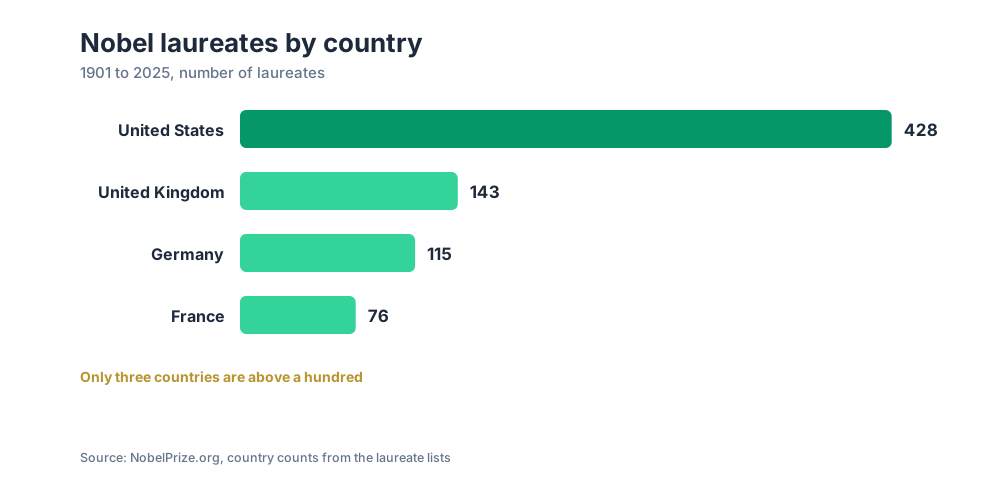
| United States | 428 | about 34 percent |
| United Kingdom | 143 | about 11 percent |
| Germany | 115 | about 9 percent |
| France | 76 | about 6 percent |
Two caveats matter when quoting these numbers. Country attribution is contested, because laureates emigrate, hold several citizenships, or do the prize-winning work in a country they were not born in. Different sources count birth country, citizenship at the time of the award, or institutional affiliation, and get different totals.
The second caveat is historical. Germany dominated the sciences in the first three decades of the prize, then lost a generation of researchers to emigration and persecution in the 1930s, many of whom became American laureates. A large part of the United States' lead is that transfer.
Women: 67 in 125 years
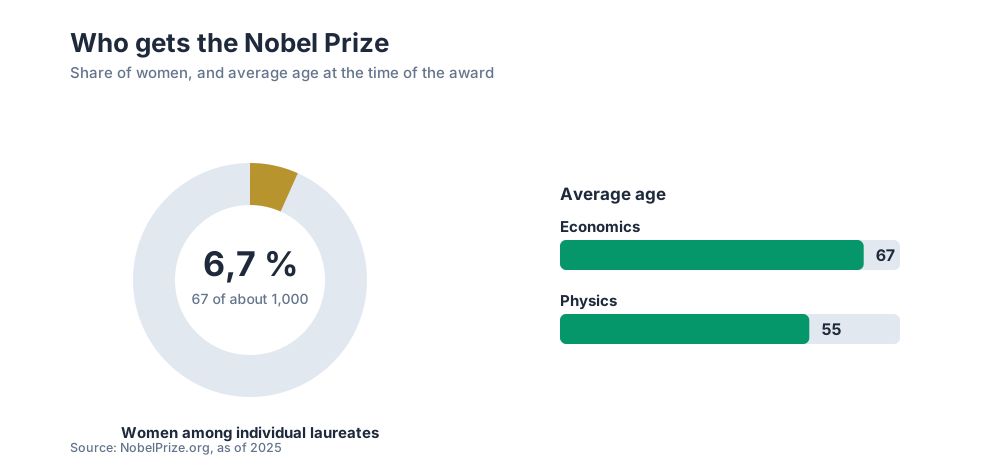
67 women have received a Nobel Prize, roughly one in fifteen individual laureates. The distribution is uneven: Peace and Literature account for a large share, while physics is still in single digits.
The direction of travel is clear even if the level is not. Of the 24 women who have won a science Nobel, 16 were recognised in the past 25 years. That is partly a change in who does the science and partly a change in what the committees are willing to see. It also runs into the structural problem described in Nobel Prize snubs and controversies: a prize that cannot be awarded posthumously and caps at three laureates will systematically miss people whose recognition arrives late, and recognition has historically arrived latest for women.
Marie Curie remains the only person of any gender to win in two different sciences.
Age: the prize keeps getting older
The average age at the time of the award differs by category:
- Economic sciences: around 67, the oldest field
- Physics: around 55, the youngest
- Chemistry and medicine: in between
More interesting than the level is the trend. Studies of the age at which laureates actually did the prize-winning work find averages in the mid-thirties for the 1901 to 1950 cohort, rising through the century. Two forces push the same way. Modern discoveries need longer verification, so committees wait. And the volume of prior work a researcher must absorb before contributing has grown, so the productive peak arrives later.
The extremes: Malala Yousafzai won the 2014 Peace Prize at 17. John B. Goodenough shared the 2019 chemistry prize at 97. Lawrence Bragg was 25 when he shared the 1915 physics prize with his father, still the youngest science laureate.
The 49 empty years
A Nobel Prize has gone unawarded 49 times. Most cluster in the two world wars: 1914 to 1918 and 1939 to 1945. The statutes permit the committees to withhold a prize when no candidate meets the standard, in which case the money returns to the fund.
The most quoted empty year is 1948, when the Peace Prize was not awarded. Mahatma Gandhi had been nominated and was assassinated in January of that year; the committee stated there was no suitable living candidate. In 2018 the literature prize was suspended entirely after a scandal in the Swedish Academy, and two were awarded in 2019 to close the gap.
The money, over time
The first prizes in 1901 were worth about 150,000 Swedish kronor each, an amount comparable to two decades of a professor's salary at the time. Conservative investment rules and twentieth-century inflation eroded the real value badly before the Nobel Foundation was allowed to invest more broadly.
Today a full prize is 12 million Swedish kronor, about 1.1 million euros. Shared between three laureates, that is a bit over 300,000 euros each, which is a career-defining honour and a fairly ordinary research grant.
What the numbers cannot tell you
Every statistic here describes the winners. The most interesting Nobel data set, the nominations, is sealed for 50 years. We know Gandhi was nominated five times and that Lise Meitner was nominated dozens of times only because those files are now open. Everything about the last half-century of shortlists is guesswork, including the annual predictions.
The rules that produce these patterns are covered in how the Nobel Prize works. The 2026 announcement schedule and four free courses are on our Nobel Prize week 2026 page.
Sources: NobelPrize.org prize facts and laureate lists, national laureate counts as compiled from the same lists. Figures current to the 2025 awards. Cite as: NerdSip, "Nobel Prize Statistics: 125 Years of Laureates in Numbers", nerdsip.com/blog/nobel-prize-statistics, updated July 2026.
Frequently Asked Questions
How many Nobel Prizes have been awarded?
Between 1901 and 2025, the Nobel Prizes and the Sveriges Riksbank Prize in Economic Sciences were awarded 633 times to 1,026 people and organisations. The gap between the two numbers is explained by shared prizes and by the handful of laureates who have won more than once.
Which country has the most Nobel Prizes?
The United States, with roughly 428 laureates, about a third of the total. The United Kingdom follows with around 143 and Germany with about 115. Those are the only three countries above a hundred.
How many women have won a Nobel Prize?
67 as of 2025, about 6.7 percent of individual laureates. The share is heavily weighted toward the Peace and Literature prizes; in physics the count is still in single digits. The trend is improving: 16 of the 24 women who have won a science Nobel were recognised in the last 25 years.
How often has the Nobel Prize not been awarded?
49 times between 1901 and 2025. The great majority fall in the two world wars, 1914 to 1918 and 1939 to 1945. The statutes allow a prize to be withheld if no work is judged to meet the standard, and the money is then rolled back into the fund.
What is the average age of a Nobel laureate?
It varies sharply by category. Economics laureates average around 67 at the time of the award, physics laureates around 55. The trend across all categories has risen steadily for a century, partly because committees increasingly wait for a discovery to be confirmed before recognising it.
Has anyone won two Nobel Prizes?
Five individuals: Marie Curie, Linus Pauling, John Bardeen, Frederick Sanger and K. Barry Sharpless, who won chemistry in 2001 and again in 2022. Among organisations, the International Committee of the Red Cross has won the Peace Prize three times, in 1917, 1944 and 1963, and the UN refugee agency twice.
How many Nobel Prize categories are there?
Six: physics, chemistry, physiology or medicine, literature, peace, and economic sciences. The first five come from Alfred Nobel's will and were first awarded in 1901. The economics prize was created by Sweden's central bank in 1968 and first awarded in 1969.
How many people win a Nobel Prize each year?
At most eighteen, since there are six prizes and each can be shared by up to three laureates. Usually it is between eleven and fifteen. In 2025 fourteen laureates were named.
Who is the youngest Nobel Prize winner?
Malala Yousafzai, who shared the 2014 Nobel Peace Prize at the age of 17. The oldest is John B. Goodenough, who shared the 2019 chemistry prize at 97.
Every NerdSip course clears a four-layer fact-checking pipeline before it reaches the app: grounded in live sources, scored nightly, gated on failure, and reviewable by a person at one tap. Articles on this blog are drafted with AI assistance, then researched, verified, and edited by our team.
Editorial responsibility: ai51 UG (haftungsbeschränkt). Responsible editor named in the imprint.
📚 Keep Learning
Explore the NerdSip learning hubs
The blog is our editorial layer. When you want to move from reading into doing, these hubs organize the rest of NerdSip by format, including the app itself and the press that has written about it.
Ready to Level Up?
Turn your screen time into knowledge. Download NerdSip and start learning in just 5 minutes a day.
4.7 stars from 510 reviews · 10,000+ learners