Quick answer
Nobel Prize week 2026 runs from Monday 5 October to Monday 12 October, with one prize announced per day: Physiology or Medicine, Physics, Chemistry, Literature, Peace, and finally Economic Sciences. Each full prize is worth 12 million Swedish kronor in 2026, up from 11 million, shared between at most three laureates. The awards were created by Alfred Nobel's 1895 will, first handed out in 1901, and are presented every 10 December, the anniversary of his death.
Nobel Prize 2026 winners
One prize a day from Monday 5 October, in the order Alfred Nobel wrote them into his will. This table is updated as each laureate is named. Until then, the 2026 column shows when each announcement is due, and the 2025 column shows who won last year.
| Prize | 2026 | 2025 |
|---|---|---|
| Physiology or Medicine | Mon 5 Oct, 11:30 CEST | Brunkow, Ramsdell, Sakaguchi |
| Physics | Tue 6 Oct, 11:45 CEST | Clarke, Devoret, Martinis |
| Chemistry | Wed 7 Oct, 11:45 CEST | Kitagawa, Robson, Yaghi |
| Literature | Thu 8 Oct, 13:00 CEST | Krasznahorkai |
| Peace | Fri 9 Oct, 11:00 CEST | Machado |
| Economic Sciences | Mon 12 Oct, 11:45 CEST | Mokyr, Aghion, Howitt |
Each 2026 laureate shares a full prize of 12 million Swedish kronor, one million more than last year. The Nobel Foundation raised it on 18 September to mark 125 years since the first prizes in 1901. The times are the earliest possible; committees often run a few minutes late.
How long science waits for its prize
See every award in the chart as a table
| The discovery | Awarded to | The work | Awarded | years |
|---|---|---|---|---|
| Black holes as a prediction of relativity | Roger Penrose | 1965 | 2020 | 55 |
| The Higgs mechanism | Higgs and Englert | 1964 | 2013 | 49 |
| Green fluorescent protein | Shimomura, Chalfie and Tsien | 1962 | 2008 | 46 |
| Artemisinin | Tu Youyou | 1972 | 2015 | 43 |
| The integrated circuit | Jack Kilby | 1958 | 2000 | 42 |
| Machine learning with neural networks | Hopfield and Hinton | 1982 | 2024 | 42 |
| Ivermectin | Ōmura and Campbell | 1975 | 2015 | 40 |
| Tests of quantum entanglement | Aspect, Clauser and Zeilinger | 1982 | 2022 | 40 |
| Quantum dots | Bawendi, Brus and Ekimov | 1983 | 2023 | 40 |
| Quantum behaviour in a circuit you can hold | Clarke, Devoret and Martinis | 1985 | 2025 | 40 |
| The lithium-ion battery | Goodenough, Whittingham and Yoshino | 1980 | 2019 | 39 |
| Metal-organic frameworks | Kitagawa, Robson and Yaghi | 1989 | 2025 | 36 |
Prize years from the official Nobel Prize records. Work years dated to the key publication or discovery. · Cite this: NerdSip Research, The Nobel Lag: how long science waits for its prize, nerdsip.com/events/nobel-prize/
Everything on this page
Free courses on this page
Hidden Secrets of the Nobel Prize
02 Free courseThe Nobel Prize: From Dynamite to Legacy
03 Free course3 Famous Nobel Laureates Who Made History
04 Free course3 Nobel Laureates Who Changed the World
Go deeper
 History
The history of the Nobel Prize
 Explainer
How the Nobel Prize works
 List
List
Famous Nobel Prize winners
 Debate
Nobel Prize snubs and controversies
 Quiz
Quiz
40 Nobel Prize trivia questions
 Daten
Daten
Nobel Prize statistics
Related courses in the app
When
5 to 12 October 2026 for the announcements. The ceremonies follow on 10 December in Stockholm and Oslo.
What it pays
12 million Swedish kronor per full prize in 2026, split evenly if it is shared. A maximum of three people may share one prize.
Who decides
Swedish institutions for five prizes, a Norwegian committee for Peace. Nominations and deliberations stay sealed for 50 years.
The 2026 announcement schedule
The order never changes, and it is not alphabetical or random. It follows the sequence Alfred Nobel used in his will, with the economics prize, added much later, tacked on at the end.
| Day | Prize | Announced from |
|---|---|---|
| Monday 5 October | Physiology or Medicine | 11:30 CEST at the earliest, Stockholm |
| Tuesday 6 October | Physics | 11:45 CEST at the earliest, Stockholm |
| Wednesday 7 October | Chemistry | 11:45 CEST at the earliest, Stockholm |
| Thursday 8 October | Literature | 13:00 CEST at the earliest, Stockholm |
| Friday 9 October | Peace | 11:00 CEST, Oslo |
| Monday 12 October | Economic Sciences | 11:45 CEST at the earliest, Stockholm |
Times are the earliest possible. Committees regularly run late, and the announcement happens when the vote is done, not when the clock says so. All six are streamed live by the Nobel Prize organisation. · Press enquiries and previous coverage: media page.
One detail catches people out every year: the Peace Prize is the only one announced in Oslo. Nobel's will gave that decision to a committee appointed by the Norwegian parliament, while the science and literature prizes stayed with Swedish institutions. Nobody has ever fully explained why, since Nobel left no note about it, and Norway and Sweden were in a union at the time.
The obituary that created the prize
In 1888, Alfred Nobel's brother Ludvig died in Cannes. A French newspaper confused the two and ran an obituary for Alfred instead, under a headline calling him a merchant of death, and crediting him with getting rich by finding ways to kill more people faster.
Nobel was alive to read it. He had invented dynamite in 1867 and held over 350 patents, and the obituary was not entirely unfair. Seven years later, in November 1895, he signed a will that left the overwhelming majority of his fortune to fund annual prizes for those who had conferred the greatest benefit to humankind.
His relatives contested it. The Swedish establishment disliked that the money would go to foreigners. It took years of legal work by his executors before the first prizes were awarded in 1901, five years after his death.

Take the free Nobel Prize courses
Four short courses from the NerdSip app. Two on the prize itself, two on the laureates whose work you use without thinking about it. Read the lesson, then tap an answer. They came out of the same engine as the rest of the library and went through the same checks, which the features page explains in full.
16 lessons, 4 courses, no signup needed. Tap an answer to check yourself as you read.
Hidden Secrets of the Nobel Prize
The strange bits: two gold medals dissolved in acid to hide them from the Nazis, the missing mathematics prize, the 50-year vault, and the prize that is not really a Nobel.
Lesson 1The Gold Medal Acid Escape
When Nazi forces invaded Denmark in 1940, German physicists Max von Laue and James Franck faced a terrifying predicament. Hitler's regime had banned Germans from accepting Nobel Prizes and declared owning gold contraband. To prevent the Gestapo from confiscating their solid gold Nobel medals, the scientists sent them to Niels Bohr’s laboratory in Copenhagen for safekeeping. But as soldiers neared, hiding solid gold became nearly impossible.
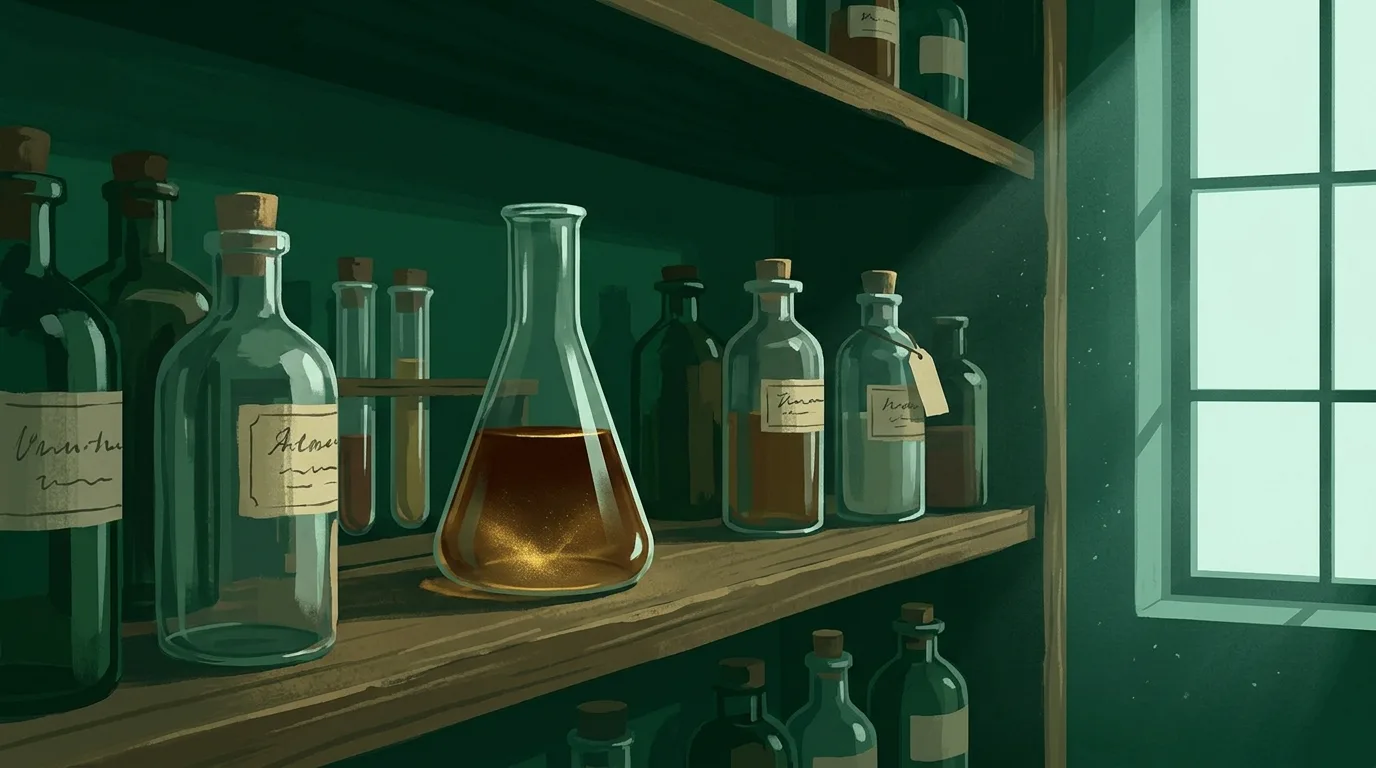
Hungarian chemist George de Hevesy devised an ingenious solution using basic chemistry. Instead of burying the gold medals, he dissolved them completely in aqua regia, a corrosive mixture of nitric acid and hydrochloric acid. The shiny gold transformed into a murky, orange liquid inside a simple glass jar. He placed the jar quietly on an ordinary laboratory shelf, right under the noses of Nazi soldiers searching the lab.
The plan worked perfectly. The soldiers overlooked the harmless-looking orange fluid entirely. After World War II ended, de Hevesy returned to the laboratory and reversed the chemical reaction. He precipitated the pure gold out of the acid solution and returned it to the Nobel Foundation. The original gold was melted down, recast into fresh Nobel medals, and presented back to the rightful owners.
Key takeaway
Chemists hid two solid gold Nobel medals from Nazis by dissolving them into plain acid liquid.
Test yourself
How did scientists protect two gold Nobel medals from Nazi confiscation in Copenhagen?
Lesson 2The Math Prize Mystery
Why is there no Nobel Prize for mathematics? A famous urban legend claims that Alfred Nobel caught his wife having an affair with a prominent Swedish mathematician named Gösta Mittag-Leffler. Furious and heartbroken, Nobel supposedly excluded mathematics from his will to ensure his rival could never win the prestigious prize or gain international glory.
While this scandalous story has circulated in university halls for generations, it is entirely false. The simplest proof is that Alfred Nobel never married. Although Nobel had romantic relationships, historical letters show no evidence of a bitter rivalry with Mittag-Leffler over a lover. Nobel simply prioritized practical, applied sciences like physics and chemistry that produced immediate, tangible benefits for humanity.
Furthermore, established mathematical prizes already existed in Scandinavia during Nobel's lifetime. Nobel believed pure mathematics was an abstract tool rather than an applied invention that directly improved daily human life. Today, mathematicians instead strive for top honors like the Fields Medal or the Abel Prize, which serve as the mathematical equivalents to Nobel's world-renowned awards.
Key takeaway
Alfred Nobel excluded math because he favored practical, applied sciences over pure theory.
Test yourself
Why is there no original Nobel Prize dedicated to mathematics?
Lesson 3The 50-Year Vault
Every autumn, world headlines erupt with rumors about who will win a Nobel Prize. Politicians, activists, and scientists frequently claim they have been nominated. However, the official Nobel Committee never confirms or denies any nominations. In fact, all official nomination records, committee deliberations, and voter comments are sealed inside a confidential vault for exactly 50 years.
This strict rule of secrecy was created to protect judges from external political pressure and ensure unbiased decisions. Nominators are formally asked to keep their submissions secret, meaning public claims of nomination are usually self-promotional leaks. Until the 50 year timer expires, no one outside the inner circle can verify who was actually considered or how close someone came to winning.
When these historical archives finally open, fascinating secrets come to light. For example, unsealed records revealed that Mahatma Gandhi was nominated five separate times for the Nobel Peace Prize but never won. The archives also exposed surprising past nominees, including historical figures like Adolf Hitler and Winston Churchill, offering unprecedented insight into shifting global politics.
Key takeaway
All Nobel nominations and committee secret votes stay locked away for exactly half a century.
Test yourself
What rule governs the release of official Nobel nomination records?
Lesson 4The Merchant of Death
In 1888, Alfred Nobel opened a French newspaper and was horrified to read his own obituary. His brother Ludvig had actually passed away in Cannes, but a confused reporter mistakenly thought Alfred died instead. The scathing headline reportedly declared, "The Merchant of Death is Dead," criticizing Nobel for building a massive personal fortune by inventing dynamite and military explosives.
Reading his own death notice gave Nobel a rare, unsettling glimpse into how history would remember him. Deeply disturbed by the thought of leaving behind a legacy of destruction, he determinedly sought a way to redeem his name. In 1895, he drafted his final will and testament, dedicating 94 percent of his immense wealth to establish international prizes honoring human progress.
When Nobel died in 1896, his family was shocked to discover they were largely disinherited. His estate faced years of legal battles, but his vision ultimately prevailed. Nobel effectively rewrote his legacy from a creator of weapons to the founder of humanity's most prestigious honors, proving that a single eye-opening moment can alter the course of history.
Key takeaway
Reading a mistaken obituary inspired Alfred Nobel to create awards that would redeem his legacy.
Test yourself
What motivated Alfred Nobel to dedicate his fortune to establishing prizes?
Lesson 5The Economics Imposter
When recipients collect their awards in Stockholm, one prize stands out from the rest. The Nobel Prize in Economics is not actually one of Alfred Nobel's original awards. Nobel's 1895 will created only five prizes: Physics, Chemistry, Medicine, Literature, and Peace. The economics award was introduced more than seven decades later in 1968 by Sweden's central bank.
To celebrate its 300th anniversary, the bank established and funded the award, officially named the Sveriges Riksbank Prize in Economic Sciences in Memory of Alfred Nobel. While it shares the same ceremony, prestige, and prize money, members of the Nobel family have occasionally criticized it, arguing that economics is a social science rather than a strict natural science like physics.
Despite the debate, the economics prize follows identical rigorous nomination procedures and evaluation standards. Winners receive their medals alongside natural scientists from the King of Sweden. Understanding this secret distinction reminds us how institutions evolve, blending modern economic theory into a century-old tradition originally designed for physical inventions and world peace.
Key takeaway
The economics prize was created in 1968 by Sweden's central bank, not by Alfred Nobel.
Test yourself
How does the Nobel Prize in Economics differ from the original prizes?
Want the XP, streaks, and progress tracking? Take this course in the NerdSip app.
Open in the appThe Nobel Prize: From Dynamite to Legacy
The full arc: the merchant of death obituary, the contested will, the five original categories, the economics prize added in 1968, and the controversies that never went away.
Lesson 1The Merchant of Death
In 1867, Swedish chemist Alfred Nobel revolutionized construction and warfare by inventing dynamite. Nobel believed his powerful explosive would end wars by making conflict too destructive to fight. Instead, dynamite made him immensely wealthy while transforming battlefield technology. His invention brought him massive financial success, but it also cemented his reputation as a creator of weapons of mass destruction across the globe.
The turning point came in 1888 when Alfred's brother Ludvig died. A French newspaper mistakenly printed Alfred's obituary instead, headline reading: "The Merchant of Death is Dead." Reading his own premature obituary shocked Nobel deeply. Horrified that history would remember him solely as a force for destruction, he became obsessed with reshaping his legacy to benefit humanity before his death in 1896.
Key takeaway
Alfred Nobel created the Nobel Prizes to reframe his legacy after reading a premature obituary calling him the merchant of death.
Test yourself
What prompted Alfred Nobel to establish the Nobel Prizes late in his life?
Lesson 2The Will That Shocked a Nation
When Alfred Nobel died in 1896, his final will sparked instant outrage. Having no direct heirs, Nobel left over 90 percent of his vast fortune to establish annual prizes for those who conferred the "greatest benefit on mankind." His family fought fiercely to overturn the document, while King Oscar II of Sweden strongly criticized leaving so much money to international candidates.
Despite heavy political pressure and legal challenges, Nobel's dedicated executors spent nearly five years defending his final wishes. They successfully established the Nobel Foundation in 1900 to manage the assets. Finally, on December 10, 1901—the fifth anniversary of Nobel's death—the very first Nobel Prizes were officially awarded in Stockholm and Oslo, cementing a new global tradition of excellence.
Key takeaway
Despite fierce opposition from relatives and royals, Nobel's executors spent years fulfilling his vision to launch the prizes in 1901.
Test yourself
Why did Alfred Nobel's will face major legal battles after his death?
Lesson 3The Original Five Categories
Alfred Nobel's will explicitly created five original categories: Physics, Chemistry, Physiology or Medicine, Literature, and Peace. Nobel personally selected the Swedish scientific institutions and the Swedish Academy to choose winners for science and literature. However, he made a surprising decision for the Nobel Peace Prize, designating a committee appointed by the Norwegian parliament to select its recipients.
At the time, Sweden and Norway were joined in a political union, though tensions between them were high. Historians speculate Nobel chose Norway for the Peace Prize because of its strong democratic traditions or to foster regional harmony. Today, while science and literature prizes are handed out in Stockholm, the Peace Prize remains uniquely presented in Oslo every December.
Key takeaway
Nobel established five original categories, split between Stockholm for academic fields and Oslo for the Peace Prize.
Test yourself
How does the Nobel Peace Prize differ from the other original awards?
Lesson 4The Sixth Prize and Modern Evolution
For decades, the original five categories remained untouched. That changed in 1968 when Sweden's central bank established the Sveriges Riksbank Prize in Economic Sciences in Memory of Alfred Nobel. First awarded in 1969, it is commonly called the Nobel Prize in Economics. Though administered alongside the original awards, it was not created by Alfred Nobel's original 1895 will.
Over time, the selection process has adapted to modern global challenges. Prizes can now be shared by up to three individuals per category, reflecting how science has shifted from lonely inventors to collaborative research teams. Furthermore, while posthumous awards were banned in 1974, the prizes continue to recognize groundbreaking discoveries that fundamentally shape human progress and global understanding.
Key takeaway
The Economics prize was added decades later in 1968, reflecting how the Nobel awards have evolved over time.
Test yourself
What is unique about the Nobel Prize in Economic Sciences?
Lesson 5Controversies and Unsung Heroes
Throughout its history, the Nobel Prize has faced significant scrutiny and criticism. Omissions are common: world-changing figures like Mahatma Gandhi never received the Peace Prize, and groundbreaking female scientists like Lise Meitner were historically overlooked. Additionally, strict rules limit each prize to three living people, often excluding crucial contributors in large modern scientific research teams.
Certain political awards have triggered intense global debates, while some laureates have even refused the honor entirely, such as Jean-Paul Sartre in 1964. Despite these flaws and ongoing debates over representation, the Nobel Prize remains the ultimate international benchmark of human achievement, driving public interest in scientific discovery, literature, and peace efforts worldwide.
Key takeaway
Nobel history includes notable omissions and debates, reflecting the complex challenges of evaluating human achievement.
Test yourself
Why do modern scientific Nobel Prizes sometimes draw criticism?
Want the XP, streaks, and progress tracking? Take this course in the NerdSip app.
Open in the app3 Famous Nobel Laureates Who Made History
Three laureates, three fields: Marie Curie's double, Einstein's prize for the photoelectric effect rather than relativity, and Martin Luther King Jr.'s Peace Prize at 35.
Lesson 1Marie Curie: The Trailblazer of Science
Marie Curie was a pioneering physicist and chemist who transformed our understanding of the physical world. Born in Poland, she moved to Paris to pursue science despite overwhelming barriers facing female researchers. Alongside her husband Pierre, she investigated mysterious rays emitted by uranium, leading to her discovery of radioactivity—a term she coined to describe the energetic rays released by decaying atomic nuclei.
In 1903, Curie became the first woman to win a Nobel Prize when she shared the Physics award for research on radiation. Eight years later, in 1911, she earned a second Nobel Prize in Chemistry for isolating pure radium and polonium. To this day, she remains the only person to win Nobel Prizes in two distinct scientific fields.
Curie’s ground-breaking research laid the groundwork for modern nuclear physics and modern cancer treatments, such as targeted radiation therapy. During World War I, she even developed mobile X-ray units to treat wounded soldiers on the front lines. Her relentless passion for discovery permanently altered medical science and inspired generations of future researchers worldwide.
Key takeaway
Marie Curie remains the only person to win Nobel Prizes in two different scientific fields.
Test yourself
What makes Marie Curie's Nobel Prize achievements unique in history?
Lesson 2Albert Einstein: Decoding Light and Energy
Albert Einstein is world-famous for his groundbreaking theories of relativity, yet his 1921 Nobel Prize in Physics was awarded for a completely different insight. The Nobel committee honored him primarily for discovering the law of the photoelectric effect. This breakthrough demonstrated that light can behave as both a continuous wave and a stream of discrete energy particles called photons.
Before Einstein's paper in 1905, classical physics could not explain why hitting metal with light caused it to emit electrons under specific conditions. Einstein proved that light transfers energy in tiny bundles. If a photon carries enough energy, it knocks an electron free from the atom. This realization sowed the seeds for quantum mechanics, revolutionizing modern physics forever.
The practical applications of Einstein's discovery surround us every single day. The photoelectric effect makes solar panels convert sunlight into electricity, enables modern digital cameras to capture light, and powers sensors in security systems. Einstein showed humanity that light is not just a gentle wave, but an active participant in atomic interactions across the universe.
Key takeaway
Albert Einstein won his Nobel Prize for explaining how light ejects electrons from metal.
Test yourself
Why did Albert Einstein receive the Nobel Prize in Physics in 1921?
Lesson 3Martin Luther King Jr.: The Power of Nonviolence
In 1964, civil rights leader Martin Luther King Jr. became the youngest recipient of the Nobel Peace Prize at that time. He was recognized for leading the nonviolent struggle against racial segregation in the United States. Inspired by Gandhi's philosophy, King proved that powerful social change could be achieved without resorting to physical violence or hatred.
King organized historic boycotts, peaceful marches, and voter registration drives across the American South. His famous 1963 "I Have a Dream" speech united millions of supporters and pushed the US government to pass landmark legislation, including the Civil Rights Act. King demonstrated to the world that brotherly love and moral courage could dismantle deeply entrenched institutional injustice.
When King accepted the award in Oslo, he donated the entire prize money to civil rights organizations. He emphasized that the honor belonged to the thousands of unsung marchers who stood for human dignity. His timeless message remains an international beacon for peaceful protest, human rights, and social equality across the globe today.
Key takeaway
Martin Luther King Jr. won the Nobel Peace Prize for leading nonviolent civil rights campaigns.
Test yourself
What principle guided Martin Luther King Jr.'s fight for civil rights?
Want the XP, streaks, and progress tracking? Take this course in the NerdSip app.
Open in the app3 Nobel Laureates Who Changed the World
Three more: Curie on radioactivity, Fleming and the accident that became penicillin, and Norman Borlaug, whose wheat is credited with saving a billion lives.
Lesson 1Marie Curie: Decoding Radioactivity
In 1903, Marie Curie made history by becoming the first woman to win a Nobel Prize. Alongside her husband Pierre and physicist Henri Becquerel, she received the award in Physics for researching invisible energy emitted by heavy elements like uranium. Curie coined the term radioactivity to describe this energy, opening an entirely new frontier in physics.
Eight years later, Curie achieved another historic milestone by winning the 1911 Nobel Prize in Chemistry. She successfully isolated two previously unknown radioactive elements: polonium and radium. Curie remains the only person in history to win Nobel Prizes in two different scientific fields, proving that persistent curiosity can shatter institutional barriers.
Curie's legacy extended far beyond laboratory research. During World War I, she developed mobile X-ray units to help battlefield surgeons treat wounded soldiers. Her pioneering discoveries laid the foundation for modern nuclear physics and medical radiation therapy, which continues to save millions of cancer patients around the globe today.
Key takeaway
Marie Curie pioneered radioactivity research and remains the only person to win Nobel Prizes in two distinct scientific fields.
Test yourself
What unique achievement distinguishes Marie Curie in Nobel Prize history?
Lesson 2Alexander Fleming: The Antibiotic Revolution
In 1928, Scottish scientist Alexander Fleming made a chance discovery that fundamentally altered medicine. Returning to his London laboratory after a short vacation, he noticed that mold had accidentally contaminated an uncleaned petri dish of bacteria. Crucially, the area immediately surrounding the mold was entirely free of bacterial growth.
Fleming identified the mold as Penicillium and named its bacteria-destroying compound penicillin. Before penicillin, minor cuts, infected wounds, or routine surgical procedures could easily turn fatal. Recognizing its incredible potential, scientists later developed methods for large-scale production, allowing penicillin to save thousands of lives during World War II.
For his discovery, Fleming shared the 1945 Nobel Prize in Physiology or Medicine. His work birthed the era of modern antibiotics, saving an estimated tens of millions of lives worldwide. Interestingly, in his Nobel acceptance speech, Fleming presciently warned that misusing antibiotics would eventually cause bacteria to develop resistance.
Key takeaway
Alexander Fleming discovered penicillin, launching the antibiotic era and transforming infectious disease treatment.
Test yourself
What led Alexander Fleming to discover the bacteria-killing properties of penicillin?
Lesson 3Norman Borlaug: Saving a Billion Lives
In the mid-20th century, prominent global experts predicted catastrophic widespread famines due to rapid population growth. American agronomist Norman Borlaug stepped forward to tackle this crisis. Working in Mexico, he spent decades cross-breeding wheat to create high-yielding, disease-resistant, and dwarf plant varieties capable of thriving in diverse environments.
Borlaug introduced these resilient crops to nations like India and Pakistan during critical food shortages in the 1960s. The results were dramatic: crop yields doubled and tripled within years, transforming vulnerable regions into self-sufficient producers. This massive worldwide agricultural expansion became known as the Green Revolution.
For his extraordinary humanitarian contributions, Borlaug was awarded the Nobel Peace Prize in 1970. Historians credit his agricultural innovations with saving more than one billion people from starvation. Borlaug demonstrated how applying practical science to real-world challenges can help overcome humanity's most overwhelming threats.
Key takeaway
Norman Borlaug spearheaded the Green Revolution, developing high-yield crops that saved over a billion people from famine.
Test yourself
Why was Norman Borlaug awarded the Nobel Peace Prize in 1970?
Want the XP, streaks, and progress tracking? Take this course in the NerdSip app.
Open in the appInteresting facts about the Nobel Prize
The prize is older than several of the countries that chase it, and the rules have some odd corners. These are the Nobel Prize facts that hold up.
One of the six is not a Nobel Prize
The economics award is the Sveriges Riksbank Prize in Economic Sciences in Memory of Alfred Nobel, created in 1968 and paid for by Sweden's central bank.
The medals are recycled gold
Since 1980 they have been 18-carat green gold plated with 24-carat gold. Earlier medals were 23-carat.
Nominations stay sealed for fifty years
You can look up who was nominated in 1975. You cannot look up last year.
It cannot be awarded after death
The rule was tightened in 1974. Ralph Steinman won in 2011 anyway, because the committee did not know he had died three days earlier.
Marie Curie is still unmatched
She is the only person with Nobel Prizes in two different sciences: physics in 1903 and chemistry in 1911.
The youngest laureate was seventeen
Malala Yousafzai in 2014. The oldest was John B. Goodenough, ninety-seven, in 2019.
Two people have refused it
Jean-Paul Sartre in 1964 on principle, and Le Duc Tho in 1973 because there was no peace in Vietnam to reward.
Two medals spent the war dissolved in acid
George de Hevesy dissolved two of them in aqua regia in Copenhagen so the Nazis would not find them. The gold was recovered and recast afterwards.
Peace is decided in another country
Five prizes are awarded in Stockholm. The Peace Prize is chosen and presented in Oslo by a Norwegian committee.
No prize may be split more than three ways
The rule strains harder every year against modern science, where discoveries come from teams of hundreds.
For the interesting things to learn behind the headlines, the four free courses above cover Alfred Nobel, the machinery of the committees, and the laureates who changed a century.
How the Nobel Prize actually works
Most of what people find surprising about the Nobel Prize comes down to four rules that have barely moved in a century.
You cannot apply
Nominations come only from invited nominators: past laureates, senior academics, members of specific institutions. Nominating yourself disqualifies you.
Three people maximum
A prize may be split between at most three laureates. Modern science is done by teams of hundreds, which is why the rule is the single most criticised part of the system.
No posthumous awards
Since 1974, a prize cannot be awarded to someone already dead, unless they die between the announcement and the ceremony. Delay in recognition can therefore be permanent.
The fourth rule is the one that makes Nobel history so hard to write: nominations, shortlists and committee deliberations are sealed for 50 years. We currently know who was nominated up to the mid-1970s and nothing after that. Every claim you read about who was on this year's shortlist is speculation.
The money comes from Nobel's original endowment, still managed by the Nobel Foundation. A full prize is 12 million Swedish kronor in 2026. If three laureates share it, they take a third each, and if two share it because one contribution was judged larger, the split can be uneven.
How much money is in the Nobel Prize, and who pays for it
A full Nobel Prize is worth 12 million Swedish kronor in 2026, roughly 1.1 million euros or 1.2 million dollars. That is one million more than in 2025: the Nobel Foundation announced the rise on 18 September 2026, to mark 125 years since the first prizes. No government funds it. No sponsor's name appears anywhere on it. Every krona traces back to one will, signed in a Paris club in November 1895, and to what 130 years of investing did to what it left behind.
Where the money came from
Alfred Nobel signed away 94 per cent of his fortune, about 31 million kronor, and instructed that it be invested in safe securities with the interest divided each year among those who had conferred the greatest benefit on humankind. His family contested the will. The estate took nearly four years to settle. The Nobel Foundation was formally created on 29 June 1900, and the first prizes went out in 1901 at 150,782 kronor each, enough at the time to keep a professor for about twenty years.
Then it very nearly died
Safe securities meant bonds, and the statutes made that binding. Bonds do not survive two world wars, Swedish taxation and half a century of inflation. Measured against what the 1901 prize could actually buy, the award shrank decade after decade, and the Foundation was quietly running short of the one thing it existed to hand out.
Two changes saved it, neither of them scientific. In 1946 the Swedish parliament exempted the Foundation from tax. In 1953 it was finally permitted to hold shares and property instead of bonds, and the American authorities exempted its investments as well. Only then could the capital compound.
The number that answers the question
The prize did not regain its 1901 purchasing power until 1991, when it was set at 6 million kronor, about 101 per cent of the original in real terms. Alfred Nobel's money took ninety years to catch up with Alfred Nobel's intention.
The prize, year by year
| Year | Prize per category | What happened |
|---|---|---|
| 1901 | 150,782 SEK | The first prizes are awarded |
| 1921 | 121,572 SEK | Einstein's physics prize, worth less than the first ones |
| 1980 | 1,000,000 SEK | A round number, still far below 1901 in real terms |
| 1991 | 6,000,000 SEK | The real value of 1901 is finally matched |
| 2001 | 10,000,000 SEK | The centenary |
| 2012 | 8,000,000 SEK | Cut by a fifth after the financial crisis |
| 2017 | 9,000,000 SEK | The first step back up |
| 2020 | 10,000,000 SEK | Back to the 2001 level |
| 2023 | 11,000,000 SEK | Unchanged through 2025 |
| 2026 | 12,000,000 SEK | Raised for the 125th anniversary |
Does anyone top it up?
Essentially nobody, and that is the whole point. The Foundation takes no state funding and no donations towards the prizes. It pays them out of returns on capital it has grown itself, which stood at about 6.8 billion kronor at the end of 2024 after an 11.6 per cent return that year. Six full prizes now cost 72 million kronor, a modest share of what the operation spends once the prize-awarding institutions, the ceremonies in Stockholm and Oslo and the Nobel Prize Museum are paid for.
There is one exception, and it happens to be the prize people argue about most. The economics prize is not in the will. Sveriges Riksbank, Sweden's central bank, created it in 1968 for its own three hundredth anniversary and pays the Foundation an annual sum covering both the prize and the cost of administering it. Five prizes come from a dead industrialist. One comes from a central bank.
So is Nobel's money still enough?
Strictly speaking, none of Nobel's money is being spent at all. The original 31 million kronor was never meant to be drawn down, and a fund that pays out its principal disappears. What a laureate receives today is investment return earned long after 1896. The endowment is worth far more in real terms than anything Nobel could have pictured, and it got that way by breaking the one investment instruction he actually wrote down.
The missing prize, the fake Nobel, and the people who never got one
There is no Nobel Prize for mathematics. The popular story, that Nobel's wife had an affair with a mathematician, fails on the basic fact that Nobel never married. The likelier explanation is duller: his will funded work of practical benefit to humanity, and pure mathematics did not fit that frame. The Fields Medal, established in 1936, filled the gap, though it is awarded every four years and only to mathematicians under 40.
The economics prize is not one of Nobel's. Its full name is the Sveriges Riksbank Prize in Economic Sciences in Memory of Alfred Nobel. Sweden's central bank created and funded it in 1968 to mark its 300th anniversary, and it was first awarded in 1969. It is announced with the others and presented at the same ceremony, which is why almost nobody outside Sweden makes the distinction.
And then the absences. Mahatma Gandhi was nominated five times and never received the Peace Prize; in 1948, the year of his assassination, the committee declined to award it at all. Lise Meitner, who co-discovered nuclear fission, was nominated dozens of times and never won. Rosalind Franklin died in 1958, four years before the DNA prize her data made possible, and the rules bar posthumous awards.
Two people have refused the prize outright: Jean-Paul Sartre turned down the 1964 literature prize on principle, and Le Duc Tho declined the 1973 Peace Prize because there was no peace in Vietnam yet.
Frequently asked questions
What are some interesting facts about the Nobel Prize?
The economics prize is not one of Alfred Nobel's. It was created in 1968 and funded by Sweden's central bank. Nominations are sealed for fifty years, no prize may be shared by more than three people, and since 1974 it cannot be awarded posthumously. Marie Curie remains the only person to win in two different sciences. The Peace Prize is the only one decided and presented in Oslo rather than Stockholm.
When are the 2026 Nobel Prizes announced?
From 5 to 12 October 2026. Medicine on Monday 5 October, Physics on Tuesday 6 October, Chemistry on Wednesday 7 October, Literature on Thursday 8 October, Peace on Friday 9 October in Oslo, and Economic Sciences on Monday 12 October.
How much money is a Nobel Prize?
12 million Swedish kronor for a full prize in 2026, roughly 1.1 million euros depending on the exchange rate. If the prize is shared, the amount is divided between the laureates. Recipients also get a gold medal and a diploma.
Why is there no Nobel Prize for mathematics?
Alfred Nobel's will funded work of concrete benefit to humanity, and pure mathematics did not fit that description in his mind. The often-repeated story about a love rival is false, since Nobel never married. The Fields Medal, awarded every four years to mathematicians under 40, is the closest equivalent.
Is the economics Nobel a real Nobel Prize?
Not in the strict sense. It was created in 1968 by Sweden's central bank, not by Alfred Nobel's will, and its formal name is the Sveriges Riksbank Prize in Economic Sciences in Memory of Alfred Nobel. It is administered by the Nobel Foundation and awarded at the same ceremony, so it functions like a Nobel Prize in practice.
Who is the youngest Nobel Prize winner?
Malala Yousafzai, who received the 2014 Peace Prize at 17 for her campaigning on girls' education after being shot by the Taliban. The youngest science laureate is Lawrence Bragg, who won the physics prize in 1915 at 25.
Who is the oldest Nobel Prize winner?
John B. Goodenough, who shared the 2019 chemistry prize at 97 for his work on lithium-ion batteries. He died in 2023 at 100.
Can a Nobel Prize be awarded after death?
Not since 1974, unless the laureate dies between the announcement and the December ceremony. That happened in 2011, when Ralph Steinman died three days before his medicine prize was announced and the Foundation let the award stand.
Did Einstein win the Nobel Prize for relativity?
No. Einstein received the 1921 physics prize, awarded in 1922, for his explanation of the photoelectric effect. Relativity was still considered too contested at the time, which is why the citation avoids it.
Who has won the most Nobel Prizes?
Among individuals, five people have won twice: Marie Curie, Linus Pauling, John Bardeen, Frederick Sanger and K. Barry Sharpless. Curie is the only person to win in two different sciences, and Pauling the only one to win two unshared prizes. Among organisations, the International Committee of the Red Cross has won the Peace Prize three times.
Can you nominate yourself for a Nobel Prize?
No. Self-nomination disqualifies a candidate. Nominations may only be submitted by qualified nominators invited by the awarding institutions, and the list of nominees stays secret for 50 years.
Who decides who wins the Nobel Prize?
Four separate bodies. The Royal Swedish Academy of Sciences chooses physics, chemistry and economics. The Nobel Assembly at the Karolinska Institute chooses medicine. The Swedish Academy chooses literature. The Peace Prize is decided by a committee of five appointed by the Norwegian parliament, which is why it is the one prize not decided in Sweden.
How many women have won a Nobel Prize?
Sixty-seven, out of roughly a thousand individual laureates, which is about one in fifteen. Marie Curie counts once as a person but won twice. The share is rising, but the ban on posthumous awards works against anyone recognised late, and women have historically been recognised later.
Can a Nobel Prize be taken away?
No. The statutes contain no mechanism for revoking a prize and none has ever been withdrawn, including in cases the committee has publicly regretted. A laureate may decline it, and two have: Jean-Paul Sartre in 1964 and Le Duc Tho in 1973.
Where is the Nobel Prize ceremony held?
Five of the six are presented by the King of Sweden at the Stockholm Concert Hall. The Peace Prize is presented the same day at Oslo City Hall. Both fall on 10 December, the anniversary of Alfred Nobel's death in 1896.
How much money do Nobel Prize winners get?
A full prize is 12 million Swedish kronor in 2026, up from 11 million in 2025, about 1.1 million euros or 1.2 million dollars. The Nobel Foundation sets the amount each year and announced the 2026 rise on 18 September. If a prize is shared between two or three laureates they divide that sum, and the split does not have to be equal: the committee can award one half and two quarters when it judges one contribution larger.
Who pays for the Nobel Prize?
The Nobel Foundation pays it out of investment returns on Alfred Nobel's endowment, which was about 31 million kronor when he died in 1896 and stood at roughly 6.8 billion kronor at the end of 2024. No government and no sponsor contributes. The one exception is the economics prize, which Sweden's central bank created in 1968 and funds annually.
Has the Nobel Prize money ever been reduced?
Yes, once and recently. In 2012 the Foundation cut the prize from 10 million to 8 million kronor after investment returns failed to keep pace with what it was paying out. It was raised back in stages: 9 million in 2017, 10 million in 2020, 11 million in 2023, and 12 million in 2026 for the prize's 125th anniversary.
Is the Nobel Prize money taxed?
Not in Sweden, where the prize is exempt. Laureates are taxed by their own countries instead, so an American laureate owes United States federal income tax on it unless the money is assigned directly to charity before it is received.
Read next
The history of the Nobel Prize
Dynamite, a mistaken obituary, a contested will, and the first prizes in 1901.
ExplainerHow the Nobel Prize works
Nomination, the rule of three, the 50-year seal, and where the money comes from.
ListFamous Nobel Prize winners
Curie, Einstein, King, Mandela, Malala, Feynman, and what they actually won for.
DebateNobel Prize snubs and controversies
Gandhi, Franklin, Meitner, and the awards the committee would probably take back.
Quiz40 Nobel Prize trivia questions
Youngest, oldest, refusals, and the medals dissolved in acid.
DatenNobel Prize statistics
633 prizes, 1,026 laureates, 67 women, and 49 years with no award.
CourseEinstein for everyone
The theory he did not win the prize for, explained in five minutes.
EventTotal solar eclipse, 12 August 2026
The 1919 eclipse proved Einstein right. This one crosses Iceland and Spain.
EventOktoberfest 2026
19 September to 4 October. The rules, the numbers, the global spin-offs.
Learn something new in 5 minutes a day
NerdSip turns any topic into a short course with quizzes, XP, and streaks. Free to start, no doomscrolling required.
4.7 stars from 510 reviews · 10,000+ learners