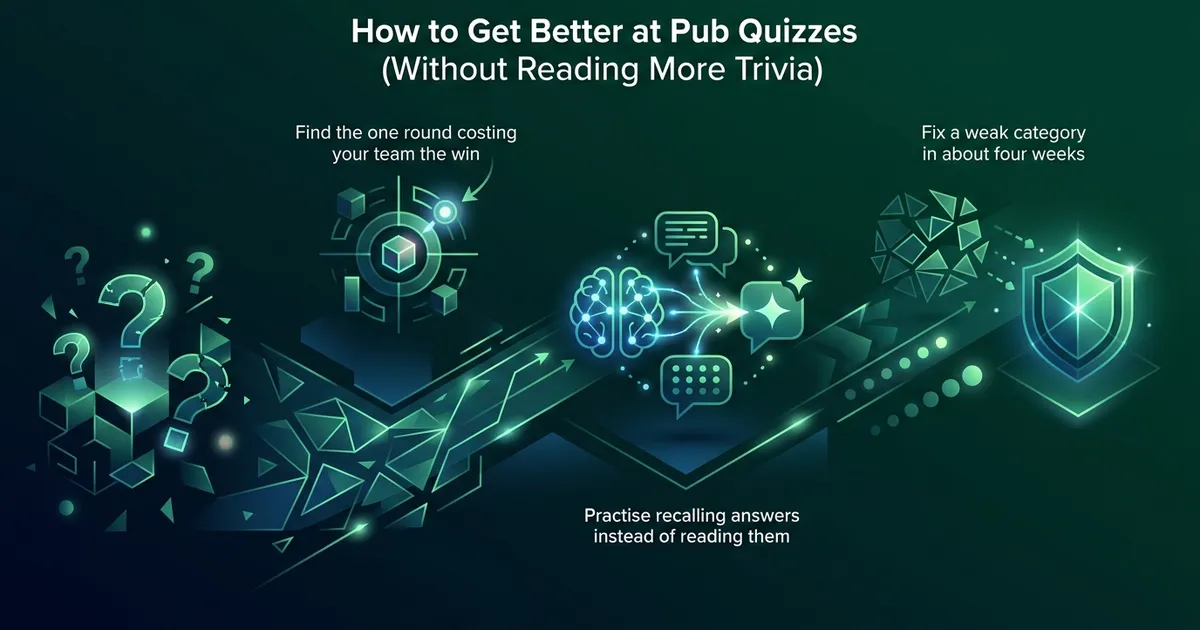
It happens to everyone. The question is read out, you know that you know this, and nothing comes. Then twenty minutes later, walking to the car, it arrives unprompted and complete. That sequence is not a memory failure. It is a retrieval failure, and understanding the difference is the single most useful thing you can know about quizzing.
The fix is being asked rather than told. Our trivia questions page does both on purpose: sixty printed with their answers, and a ten-question round per category that hides the options until you commit.
You Did Not Forget It
If you have ever thought why do I blank on answers I know, start with the evidence of your own experience. If you had genuinely forgotten the name of the actor, it would not have surfaced in the car park. The memory was there the whole time. What failed was the path to it.
Memory researchers separate these two things carefully, and once you see the separation you cannot unsee it. Storage is whether the information is in there. Retrieval is whether you can get it out on demand. Almost every frustrating quiz moment is a retrieval problem being misread as a storage problem.
This matters because the two have different fixes. If you think you forgot it, you will go and read more facts. If you understand that retrieval failed, you will practise retrieving. Only the second one changes anything.
Recognition Is Not Recall
Here is the trap that catches nearly everyone who tries to get better at quizzes.
You read a list of pub quiz questions with the answers printed underneath. Capital of Australia: Canberra. Chemical symbol for gold: Au. Each one lands with a small click of confirmation. Yes. Knew that. This feels like studying and it feels like it is working.
What you are exercising is recognition: the ability to confirm that a supplied answer is correct. It is a low effort operation, it is fast, and it is almost entirely useless at quiz night, because at quiz night nobody supplies the answer.
What you need is recall: producing the answer from nothing but the question. That is a harder operation running on a different route, and reading lists does very little to build it. This is the reason people can read trivia for months and score exactly the same as before.
The One Test That Tells You If It Is Working
Cover the answer. If you cannot produce it with the answer hidden, you do not know it yet, no matter how familiar it looks the moment it is revealed.
The Tip of the Tongue State
The most maddening version of this is when you can feel the answer without reaching it. You know it starts with a B. You know it is two words. You could pick it instantly from a list. But you cannot say it.
This is a partial retrieval. Memories are not stored as single lumps but as bundles of features, and retrieval can succeed on some features while failing on others. Getting the first letter and the rhythm but not the word is exactly what you would expect from a partly successful search.
It is also proof that the memory is intact, which is oddly reassuring. Nothing is missing. The lookup failed.
Four Things Working Against You at the Table
1. Time pressure
Retrieval takes longer than recognition, and quizzes give you seconds. The pathway that would have delivered the answer in fifteen seconds is no help when the host has already moved to question seven.
2. Noise and divided attention
Retrieval is effortful and it needs working memory. A loud room, a teammate arguing about question three, and music over the top all consume exactly the resource you are trying to spend on remembering.
3. The wrong answer blocking the right one
When a plausible but incorrect candidate arrives first, it tends to stay, and it actively crowds out the correct one. This is why the harder you chase a blocked answer, the more stuck it becomes, and why it releases the moment you stop trying. The wrong candidate fades and the path clears.
4. Alcohol, mildly
Alcohol impairs retrieval more than it impairs recognition, which is precisely the wrong trade for a quiz. The bigger effect is social rather than cognitive: it makes people more willing to overrule a quiet teammate who happens to be right.
The Fix Is Retrieval Practice
The remedy is not more input. It is more output.
Retrieval practice means testing yourself with the answer hidden, producing it from memory, and only then checking. It is well established as one of the most effective things you can do for durable memory, and it has an unfortunate property: it feels worse than reading. It is slower, it involves sitting in uncertainty, and you get things wrong. Rereading feels smooth and productive. That smoothness is the illusion.
The effort is the mechanism. Every time you drag an answer out of memory, you widen the path you dragged it down, which makes the next retrieval easier. Reading the answer does not do this, because nothing was dragged.
How to Train It in Ten Minutes a Day
- Always hide the answer first. If you can see it, you are practising recognition. Cover it, commit to an answer, then reveal.
- Say it out loud. Producing a word is a stronger retrieval than thinking it vaguely, and it removes the self deception of "I basically had that".
- Practise at speed. Give yourself ten seconds, because that is what quiz night gives you. Comfortable, unhurried recall trains the wrong conditions.
- Return to what you got wrong. The questions you missed have the most to give. The ones you got right have already paid out.
- Space it out. Ten minutes on five days beats fifty minutes on one. Coming back to material after a gap forces a real retrieval rather than an echo of the last session.
A scored round on our interactive pub quiz does most of this by construction: the answer is hidden until you commit, you are working against the clock of your own impatience, and the end screen shows you what you missed so you know what to come back to. If you want a baseline first, our free general knowledge test runs the same drill across broader ground: hidden answers, mild time pressure, and a score to beat.
What to Do in the Moment
So how do I stop blanking under pressure in the moment? When it happens at the table, the instinct is to chase the answer harder. Do the opposite.
Move on to the next question. Let the blocked answer sit. The competing wrong candidate that is jamming the path will fade in a minute or two on its own, and the right answer often arrives while you are thinking about something else entirely. Teams that park a question and return at the end of the round recover noticeably more answers than teams that sit and grind.
If you must chase it, chase sideways rather than head on. Think about where you encountered it, who else was involved, what else was around it. Retrieval works by association, so approaching from a neighbouring memory works better than assaulting the same blocked door repeatedly.
What Changes After a Month
Not much in the first fortnight, which is where most people quit. The change shows up as a shift in the kind of failure you have. Blanks become tip of the tongue moments. Tip of the tongue moments become slow correct answers. Slow correct answers become fast ones.
You will also notice something less expected: you get better at knowing whether you know. That metacognitive accuracy is worth real points, because most wrong answers in a pub quiz are not written by people who had no idea. They are written by people who were confident and wrong, and who talked a hesitant teammate out of the right answer.
If you want the practical version of all this, the four week plan is here, and the round by round breakdown tells you where to point it. For the underlying daily habit, the general knowledge hub covers the ten minute system. And if you have ever wondered whether the problem is deeper than quizzing, this piece on feeling like you lack basic knowledge makes the case that you almost certainly do not.
If you want somewhere low-stakes to practise retrieval rather than recognition, the free Halloween quiz is twenty questions with the reason behind every answer, which is exactly the format that makes things stick. The Christmas quiz works the same way in December.
On the other side of the microphone? Here is how to host a pub quiz so the room keeps answering instead of going quiet.
Frequently Asked Questions
Why do I blank on answers I know at quiz night?
Because recognising a fact and retrieving it are different skills. Reading trivia builds recognition, which feels like knowing but depends on the answer being in front of you. Under time pressure, noise and a drink or two, the retrieval pathway is what you need, and it only gets built by practising recall with the answer hidden.
Why do I remember the answer right after the quiz ends?
Because the block was never about storage. Once the time pressure lifts and you stop actively searching, the competing wrong answer that was crowding out the right one fades, and retrieval succeeds. This is why the answer famously arrives in the car park.
What is the tip of the tongue state?
A partial retrieval, where you can access some features of a memory, such as the first letter or how long the word is, but not the whole thing. It is evidence that the memory is intact and that only the path to it has failed, which is why it feels so maddeningly close.
What is retrieval practice?
Testing yourself with the answer hidden, rather than re-reading material. You produce the answer from memory, then check. It feels harder and less productive than reading, which is exactly why it works: the effort of retrieving is what strengthens the path back to the memory.
Does alcohol make you worse at pub quizzes?
It narrows attention and impairs retrieval more than it impairs recognition, which is a bad trade for a quiz. It also reduces the willingness to be overruled, so teams make more confident wrong answers. The first drink rarely hurts. The pattern of overruling correct teammates tends to start after it.
How can I stop blanking under pressure?
Train under conditions closer to the real thing: with the answer hidden, at speed, and ideally out loud. Then, in the moment, stop searching. Move to the next question and come back. Actively hunting a blocked answer keeps the wrong candidate active and blocks the right one.
Every NerdSip course clears a four-layer fact-checking pipeline before it reaches the app: grounded in live sources, scored nightly, gated on failure, and reviewable by a person at one tap. Articles on this blog are drafted with AI assistance, then researched, verified, and edited by our team.
Editorial responsibility: ai51 UG (haftungsbeschränkt). Responsible editor named in the imprint.
📚 Keep Learning
- Best Quiz App in 2026: 4 Tested (And What Happens When You Get One Wrong)
- How to Get Better at Pub Quizzes (Without Reading More Trivia)
- Every Pub Quiz Round, Explained (And How to Prepare for Each)
- Why Do I Lack Basic Knowledge? (And Why It Is Not Your Fault)
- How to Retain 90% of What You Learn (And Why That Number Is Fake)
- How to Improve Your General Knowledge: A Daily System That Works
- 50 Easy Trivia Questions and Answers (Everyone Should Get These)
Explore the NerdSip learning hubs
The blog is our editorial layer. When you want to move from reading into doing, these hubs organize the rest of NerdSip by format, including the app itself and the press that has written about it.
Practise Being Asked, Not Just Reading
Every NerdSip lesson ends in a question, so you spend your time retrieving what you learned instead of re-reading it. Five minutes, 3, 5 or 10 lessons, one topic at a time.
4.7 stars from 510 reviews · 10,000+ learners