Germany has a reputation for being predictable, which does not survive contact with a country that has a 31-centimetre-wide street, a 40,000-year-old flute, and a legal position that escaping from prison is understandable. Fifty checked facts follow, grouped by subject. The rest of the collection is in the fun facts library.
Geography and the Shape of the Country
- Germany borders nine countries, more than any other state in the European Union: Denmark, Poland, Czechia, Austria, Switzerland, France, Luxembourg, Belgium and the Netherlands.
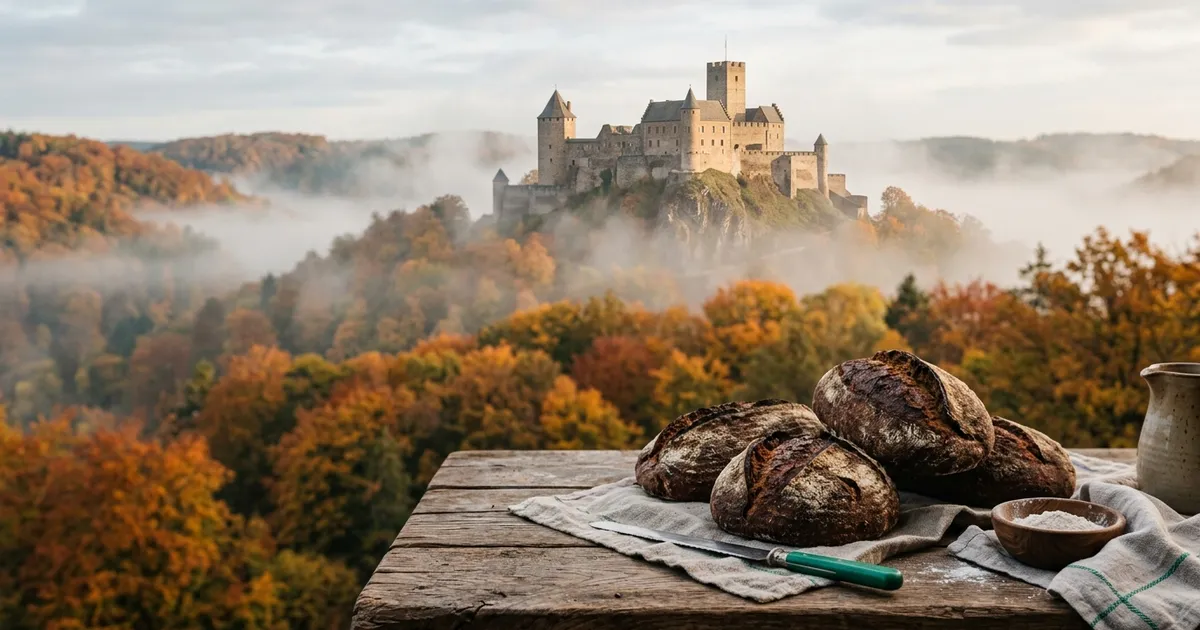
- There are roughly 20,000 castles. Germany was hundreds of separate territories until 1871, and every ruler needed a fortified seat.
- Berlin is nine times the size of Paris. The city covers about 891 square kilometres against Paris at 105, which is why Berlin feels empty and Paris does not.
- Berlin has more bridges than Venice. Around 1,700 against roughly 400, thanks to the Spree, the Havel and a dense canal network.
- The narrowest street in the world is in Reutlingen. Spreuerhofstraße measures 31 centimetres at its tightest point and holds the Guinness record.
- About a third of Germany is forest. The country has more tree cover now than it did a century ago, the result of deliberate reforestation.
- Germany's highest mountain is not very high. The Zugspitze reaches 2,962 metres, lower than dozens of Alpine peaks in neighbouring countries.
- Tempelhof airport is now a public park. Berliners cycle, skate and fly kites on the runways, and the terminal was for decades one of the largest buildings on Earth by floor area.
- Around 2,000 tonnes of unexploded wartime bombs are found every year. Evacuations for bomb disposal are routine enough that most large German cities have a standard procedure.
- Germany has 16 federal states, three of which are cities: Berlin, Hamburg and Bremen.
The Language
- German is the most widely spoken native language in the European Union, ahead of French and Italian.
- The longest official German word was 63 letters. Rindfleischetikettierungsüberwachungsaufgabenübertragungsgesetz was a real law about beef labelling supervision. It was repealed in 2013, taking the word with it.
- German builds words rather than borrowing them. Handschuh is a hand shoe. Glühbirne is a glow pear. Krankenhaus is a sick house.
- It has words other languages simply lack. Kummerspeck is the weight gained from emotional eating, literally grief bacon. Backpfeifengesicht is a face badly in need of a slap.
- Fernweh is the opposite of homesickness, a longing for places you have never been. English has no single word for it.
- Kindergarten is a German invention, both the word and the concept, created by Friedrich Fröbel in 1840.
- Germany has around 35 distinct dialects, some mutually unintelligible. Speakers of Bavarian and Plattdeutsch often cannot follow each other.
- All German nouns are capitalised, a rule almost every other language using the Latin alphabet abandoned centuries ago.
- The word Autobahn does not mean motorway generally. It refers to the specific German network, which is why English kept the German word instead of translating it.
- The umlaut has an official workaround. Where the character is unavailable, ä becomes ae, ö becomes oe and ü becomes ue, which is why German URLs look the way they do.
Food and Drink
- Germany has more than 3,000 registered bread varieties, and German bread culture is on the UNESCO intangible cultural heritage list.
- There are around 1,500 breweries, more than half of them in Bavaria alone.
- The Reinheitsgebot of 1516 is one of the oldest food regulations still cited today. It limited beer to water, barley and hops. Yeast was not mentioned, because nobody knew it existed.
- Germany has roughly 1,500 types of sausage, and regional variants are protected with the seriousness normally reserved for wine.
- Gummy bears were invented in Bonn. Haribo is an acronym: Hans Riegel, Bonn. The original 1922 version was called the dancing bear.
- Fanta was created because of a trade embargo. Coca-Cola's German operation could not get syrup during the war, so its head improvised a drink from whey and apple pomace.
- Oktoberfest starts in September. It commemorates an October royal wedding from 1810, but was moved earlier for better weather.
- The oldest brewery still operating is German. Weihenstephan in Bavaria traces its brewing licence to 1040.
- Germans drink less beer than they used to. Per-head consumption has fallen by roughly a third since the 1970s, and Czechia now drinks more.
- The coffee filter was invented by a German housewife. Melitta Bentz punched holes in a brass pot, lined it with blotting paper from her son's schoolbook, and patented it in 1908.
Invention and Science
- Movable-type printing in Europe started in Mainz. Gutenberg's press around 1440 did more to reshape Europe than any single machine before the steam engine.
- The car is German. Carl Benz patented the first practical petrol automobile in 1886. His wife Bertha then drove it 106 kilometres without telling him, which is how it got publicity.
- The MP3 was developed in Erlangen. Fraunhofer researchers spent years tuning it, partly by testing compression against Suzanne Vega's Tom's Diner.
- X-rays were discovered by Wilhelm Röntgen, who won the first ever Nobel Prize in Physics and refused to patent the discovery so anyone could use it.
- Aspirin was developed at Bayer in the 1890s and remains one of the most widely used medicines on Earth.
- Continental drift was a German idea. Alfred Wegener proposed it in 1912 and was ridiculed for fifty years before being proved right.
- The diesel engine is named after a person. Rudolf Diesel patented it in 1892 and disappeared from a ferry in the English Channel in 1913.
- Germany ranks third in the world for Nobel laureates, behind only the United States and the United Kingdom.
- The oldest musical instrument ever found is German. A flute carved from a vulture's wing bone, roughly 40,000 years old, was excavated from Hohle Fels cave in Baden-Württemberg.
- So is the oldest known figurative sculpture. The Venus of Hohle Fels, carved from mammoth ivory, came out of the same cave system.
Law, Custom and the Genuinely Odd
- Escaping from prison is not a crime. German law treats the desire for freedom as a basic human impulse. Damaging property or harming anyone during the escape is prosecuted normally.
- Running out of fuel on the Autobahn is an offence. Stopping without a genuine emergency is prohibited, and an empty tank counts as avoidable.
- Registry offices can reject your baby's name. It must be recognisable as a first name and must not expose the child to ridicule. Rejected applications have included Osama bin Laden and Borussia.
- Sunday is legally quiet. Ruhezeit rules restrict mowing, drilling and loud work, and most shops are closed by law rather than by choice.
- University is free, including for foreigners. Most German states charge no tuition at public universities regardless of nationality.
- The bottle deposit is aggressive and it works. Pfand runs up to 25 cents per container, and return rates for deposit bottles sit around 98 percent.
- Germany has more zoos than any other country, several hundred of them, including the world's most species-rich zoo in Berlin.
- Only the third verse of the national anthem is sung. The melody is by Haydn and was originally written for an Austrian emperor.
- Pieces of the Berlin Wall stand in more than 140 places worldwide, including a Las Vegas casino bathroom and the grounds of the CIA.
- Germany is younger than it looks. As a unified nation state it dates only to 1871, which makes it younger than the United States, Brazil and Belgium.
Its neighbour across the North Sea has a set of its own in fun facts about the UK, and if Oktoberfest is what brought you here, there is a whole round of Oktoberfest trivia questions. For one checked fact a day, use the fun fact of the day.
Frequently Asked Questions
What is Germany's strangest law?
Escaping from prison is not itself a criminal offence. German law treats the urge for freedom as fundamental, so the escape alone is not punished. Anything done to achieve it, such as damaging property or hurting a guard, absolutely is.
How many castles does Germany have?
Around 20,000, more than any other country. The number is that high because Germany did not exist as a unified state until 1871. Before that it was hundreds of separate territories, and each of them needed somewhere fortified to sit.
Why does Oktoberfest start in September?
The original festival in 1810 celebrated a royal wedding held in October. It was later moved earlier for warmer weather and longer evenings, so the modern festival begins in September and ends in the first days of October.
Is there really no speed limit on the Autobahn?
On roughly 70 percent of the network there is no general limit, only an advisory speed of 130 km/h. The other 30 percent is limited, and the limits are enforced. Driving at 200 km/h past a sign saying 100 is treated exactly as you would expect.
What food is Germany actually famous for?
Bread, not beer. Germany has more than 3,000 registered bread varieties and German bread culture is on the UNESCO intangible heritage list. It also has around 1,500 breweries, more than half of them in Bavaria, so the beer reputation is not exactly unearned.
Every NerdSip course clears a four-layer fact-checking pipeline before it reaches the app: grounded in live sources, scored nightly, gated on failure, and reviewable by a person at one tap. Articles on this blog are drafted with AI assistance, then researched, verified, and edited by our team.
Editorial responsibility: ai51 UG (haftungsbeschränkt). Responsible editor named in the imprint.
📚 Keep Learning
- 50 Fun Facts About the UK, From Unicorns to a 38-Minute War
- 50 Fun Facts About America (Including Ones Americans Get Wrong)
- 50 Fun Facts About Canada That Sound Made Up
- 42 Facts That Will Blow Your Mind (2026)
- 40 Oktoberfest Trivia Questions (With Answers)
- 100 Interesting Facts, Sorted by What Kind of Conversation You Want to Start
Explore the NerdSip learning hubs
The blog is our editorial layer. When you want to move from reading into doing, these hubs organize the rest of NerdSip by format, including the app itself and the press that has written about it.
Learn the Story Behind the Fact
NerdSip turns German history, language and everything else into five-minute lessons, fact-checked before they reach you. Free to start.
Courses on this topic
4.7 stars from 380 reviews · 10,000+ learners