Quick answer: Forty Oktoberfest questions with answers below, grouped into origins, rules, numbers and the global spin-offs. Short version: it started as a wedding horse race in 1810, only six breweries may pour, and the biggest Oktoberfest outside Germany happens in Brazil.
Once the tents come down, trivia questions by category keeps sixty questions across ten categories going all year, with eight packs of fifty underneath it.
Good for a pub quiz, a team event in September, or the queue outside a tent. If you want a general round rather than a themed one, the 500-question pub quiz covers ten categories.
Origins
1. What event was the first Oktoberfest?
The wedding of Crown Prince Ludwig of Bavaria and Princess Therese of Saxe-Hildburghausen, on 12 October 1810.
2. What closed the original celebration?
A horse race, held on 17 October 1810 on the meadow outside Munich's gates.
3. Who is the Theresienwiese named after?
Therese, the bride. Wiese means meadow, so the name means Therese's Meadow.
4. What do locals call the festival?
The Wiesn, short for Theresienwiese.
5. Why was the festival repeated in 1811?
It was tied to a new agricultural show intended to promote Bavarian farming, which gave organisers a reason to hold the races again.
6. When was the last Oktoberfest horse race?
1938. The event that started the whole festival is the one part that did not survive.
7. When did the large beer tents appear?
From 1896, when innkeepers began building them in partnership with the Munich breweries.
8. What statue overlooks the grounds?
The Bavaria, a bronze figure unveiled in 1850 above the western edge of the meadow.
9. Why did the festival move into September?
Warmer nights and longer evenings. The end date stayed in early October.
10. Which parade dates back to 1835?
The costume parade, first held for the silver wedding anniversary of Ludwig and Therese, now the Trachten- und Schützenzug on the first Sunday.
Rules and rituals
11. What must the Mayor of Munich do before any beer is served?
Tap the first keg in the Schottenhamel tent at noon and shout O'zapft is.
12. What does O'zapft is mean?
"It's tapped" in Bavarian dialect.
13. Who receives the first Maß?
The Minister-President of Bavaria.
14. What follows the tapping?
A twelve-gun salute fired from the steps below the Bavaria statue.
15. How many breweries may serve?
Six: Augustiner, Hacker-Pschorr, Hofbräu, Löwenbräu, Paulaner and Spaten.
16. What law governs the beer?
The Bavarian purity law of 1516, plus a festival standard requiring stronger beer brewed inside Munich city limits.
17. How strong is Wiesnbier?
Around 6 percent alcohol, roughly a fifth stronger than standard Helles.
18. What is a Maß?
A one-litre mug, and the only beer size served in the large tents. Full, it weighs about 2.25 kg.
19. What happens in the tents before 18:00?
Only traditional brass band music at limited volume, which keeps afternoons family-friendly.
20. Can you stand on the tables?
No. Benches yes, tables never.
21. What song triggers a tent-wide toast?
Ein Prosit der Gemütlichkeit, played every 15 to 20 minutes.
22. Where should you clink your mug?
On the thick base, not the rim, and with eye contact.
23. Does entry cost anything?
No. The grounds and tents are free. Only table reservations are scarce.
24. What is the Oide Wiesn?
The historical section introduced for the 200th anniversary in 2010, with vintage rides and traditional music.
Numbers
25. How many people came in 2025?
About 6.5 million over 16 days.
26. How much beer did they drink?
About 6.5 million litres, which works out at roughly one litre per visitor.
27. How many mugs did security intercept?
116,000 in 2025, up from 98,000 in 2024.
28. How many items reached lost property?
4,500 in 2025, including the usual phones and wallets and the occasional set of dentures.
29. How much does a Maß cost in 2026?
Between €14.80 and €15.90 depending on the tent.
30. How much did it cost in 2010?
About €8.95 on average, so roughly 70 percent less than today.
31. How big is the site?
About 42 hectares, or roughly 60 football pitches.
32. How much waste does it produce?
764 tonnes in 2025.
33. Which edition is the 2026 festival?
The 191st, running 19 September to 4 October 2026.
Oddities and the wider world
34. Which future physicist may have helped light the tents?
Albert Einstein, as a teenager, through his family's electrical company in 1896. Munich lore treats it as fact, and the paperwork is thin.
35. How does beer reach some of the big tents?
Through underground pipelines from tanks outside, which is faster than moving barrels through crowds.
36. How many times has the festival been cancelled?
More than two dozen, for wars, cholera, hyperinflation and the COVID-19 pandemic.
37. Which queen died in a year the festival was cancelled?
Therese herself, of cholera, in 1854, the same outbreak that stopped the festival named after her.
38. Where is the largest Oktoberfest outside Germany?
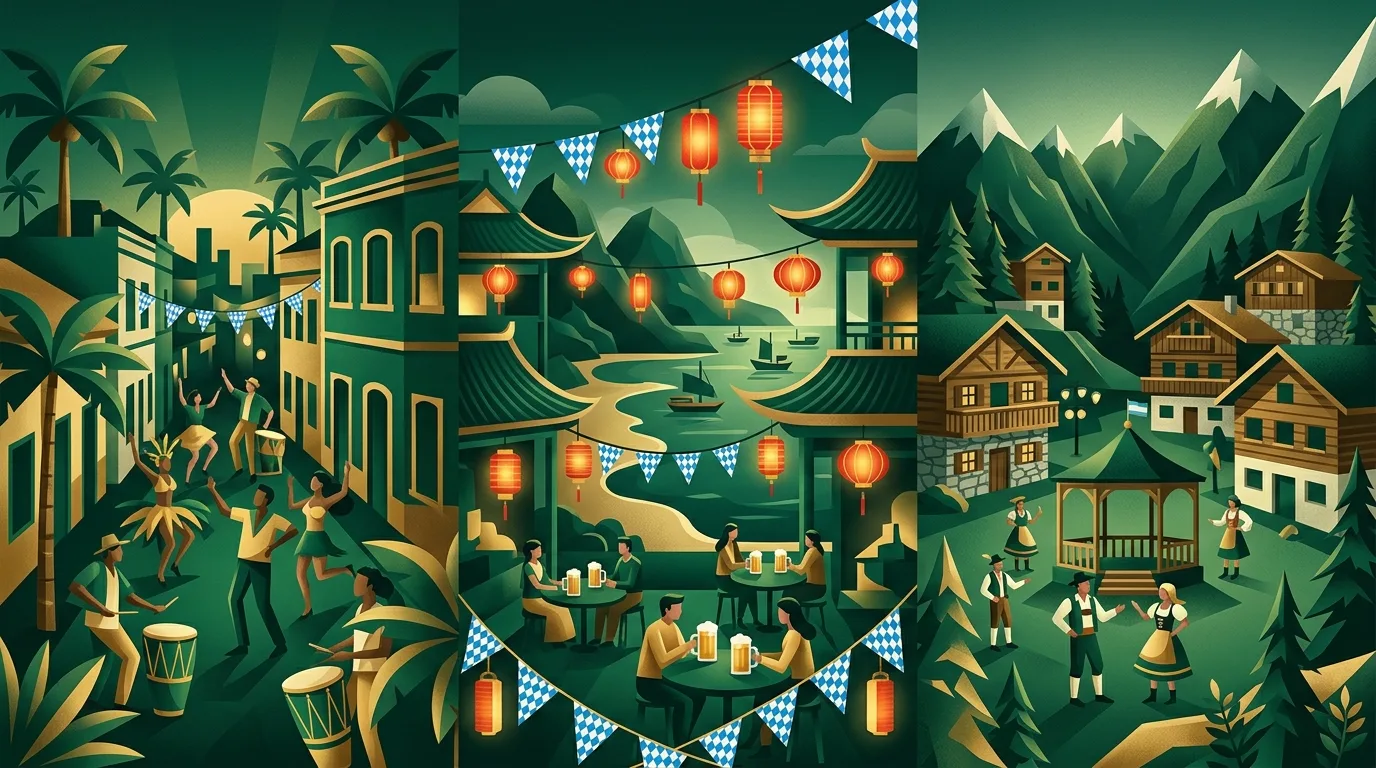
Blumenau, Brazil, founded by German settlers and now home to the biggest version in the Americas.
39. Which Chinese city hosts Asia's largest beer festival, with German brewing roots?
Qingdao, where a German brewery was founded in 1903.
40. Which Argentine village celebrates with its own barrel-tapping ritual?
Villa General Belgrano, an Alpine-styled town in Córdoba province that hosts the country's national beer festival.
Go deeper
Questions 34 to 40 are covered properly in two free courses on our Oktoberfest 2026 page: Untold Mysteries of Oktoberfest and Global Oktoberfest: The Most Unexpected Spin-Offs. Both run in the browser with a quiz after each lesson.
For the full story behind questions 1 to 10, read the history of Oktoberfest. For the statistics, see Oktoberfest by the numbers. And if you want to know what to actually do inside a tent, Oktoberfest traditions explained covers the etiquette.
If you need a themed round for October rather than September, the 100 Halloween trivia questions work the same way, and there is a free interactive version on the Halloween 2026 page. After that comes Christmas, with 100 Christmas trivia questions.
Frequently Asked Questions
Why is Oktoberfest called Oktoberfest if it is in September?
Because the original celebration took place in October 1810, tied to a royal wedding on 12 October. The festival was gradually moved earlier for warmer weather and longer evenings, but the name stayed. It still ends in early October.
How many breweries are allowed to serve beer at Oktoberfest?
Six: Augustiner, Hacker-Pschorr, Hofbräu, Löwenbräu, Paulaner and Spaten. Each must brew its festival beer within Munich city limits, in line with the Bavarian purity law, and to a stronger specification than everyday lager.
What is the largest Oktoberfest outside Germany?
Blumenau in Brazil, a city founded by German settlers, which hosts the biggest Oktoberfest in the Americas. Its modern festival grew out of community efforts to recover from catastrophic flooding in the 1980s.
How strong is Oktoberfest beer?
Around 6 percent alcohol by volume, noticeably stronger than standard Munich Helles, and it is served in one-litre mugs. That combination, rather than any special ingredient, is what makes the Wiesn hit harder than expected.
Did Einstein work at Oktoberfest?
According to long-standing Munich lore, yes. His family's electrical firm, Einstein & Cie, is said to have installed lighting in a festival tent in 1896, when Albert was a teenager. It is repeated by the festival's own historians, though the documentary record is thin.
What is a Maß?
The one-litre mug that Oktoberfest beer is served in, and the only measure available in the large tents. Full, it weighs about two and a quarter kilograms, which is why servers carrying ten at once are a spectacle in their own right.
Every NerdSip course clears a four-layer fact-checking pipeline before it reaches the app: grounded in live sources, scored nightly, gated on failure, and reviewable by a person at one tap. Articles on this blog are drafted with AI assistance, then researched, verified, and edited by our team.
Editorial responsibility: ai51 UG (haftungsbeschränkt). Responsible editor named in the imprint.
📚 Keep Learning
- The History of Oktoberfest: From a Royal Wedding to 6 Million Visitors
- Every Pub Quiz Round, Explained (And How to Prepare for Each)
- Oktoberfest by the Numbers: Beer, Visitors and the Price of a Maß
- Oktoberfest Traditions Explained: Tapping, Tracht and Table Rules
- 100 Interesting Facts, Sorted by What Kind of Conversation You Want to Start
- Oktoberfest Beer Price History: Every Maß Price From 1950 to 2026
- 50 Hard Trivia Questions That Stump Almost Everyone
Explore the NerdSip learning hubs
The blog is our editorial layer. When you want to move from reading into doing, these hubs organize the rest of NerdSip by format, including the app itself and the press that has written about it.
Ready to Level Up?
Turn your screen time into knowledge. Download NerdSip and start learning in just 5 minutes a day.
4.7 stars from 510 reviews · 10,000+ learners