Every comparison between the brain and a computer breaks down at the same place, and it is worth knowing where.
Step one: an electrical signal, travelling
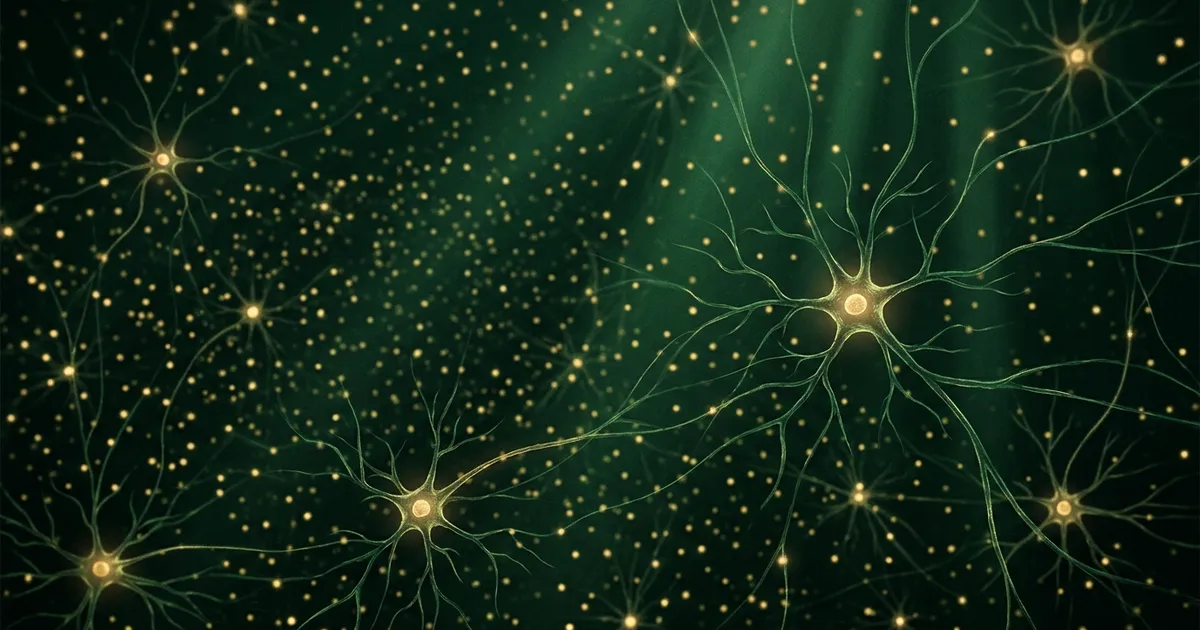
Information moves through a neuron as a change in voltage racing down its axon. How fast depends entirely on insulation. Fibres wrapped in myelin, the fatty sheath produced by glial cells, carry a signal at up to 120 metres per second, roughly 430 kilometres per hour. Uninsulated fibres manage closer to half a metre per second.
You have felt the difference. Stub your toe and the sharp pain arrives almost immediately, along fast myelinated fibres. The dull ache follows a second or two later on slow unmyelinated ones. Two separate messages about the same event, arriving at different times because they travelled on different grades of cable.
Step two: the gap
Then the signal stops, because neurons do not touch.
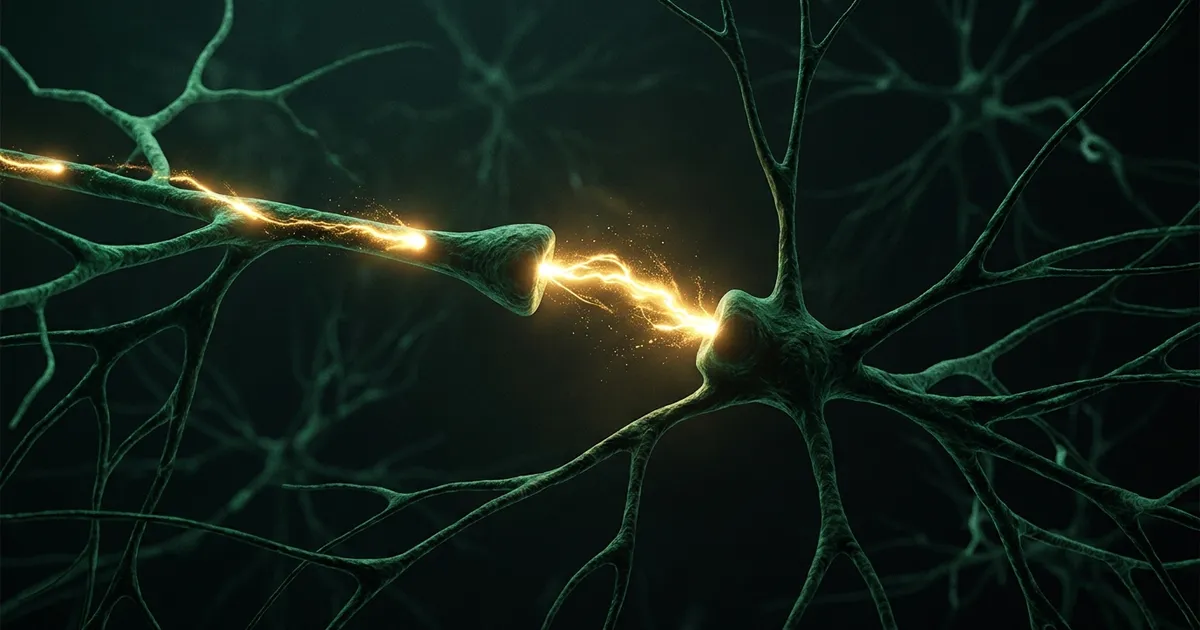
Between one neuron and the next lies a gap of roughly 20 to 40 nanometres called the synaptic cleft. The electrical signal cannot jump it. Instead it triggers the release of chemical messengers, neurotransmitters, which drift across and bind to receptors on the far side. There the message becomes electrical again.
Every thought you have ever had crossed that gap chemically. It is slower than a wire, and it is also the reason the system can learn, because a chemical junction can be adjusted in ways a soldered connection cannot.
Step three: adding up
A single neuron may be listening to thousands of others simultaneously. Some inputs push it toward firing, others push it away. It fires only when the running total crosses a threshold, and then it fires completely. There is no half signal.
What matters is not any individual input but the pattern across thousands, arriving with particular timing. Meaning lives in the pattern.
Step four: the connections change
Here is where the computer comparison finally fails.
When two neurons fire together repeatedly, the connection between them strengthens. Fire apart, and it weakens. This is not a metaphor for learning. It is what learning physically is, and it means the hardware doing the processing is also the storage, and it rewrites itself as it runs.
A computer keeps memory and processing in separate places connected by a bus. The brain has no such separation, which is why you cannot copy a memory out of one brain and into another, and why practising something changes the tissue that does it.
The prediction loop on top
All of that is the mechanics. The strategy sitting above it is what makes the whole thing affordable.
The brain does not wait for sensory data and then work out what it means. It continuously generates predictions about what it expects to sense, and compares them against what arrives. What gets processed in depth is mostly the mismatch, the part the prediction got wrong.
This is why you stop noticing the hum of a fridge until it switches off. The prediction was correct, so there was nothing to report. The silence is the surprise.
How little reaches you
Your sensory receptors take in an enormous volume of raw data every second. Estimates of how much information reaches conscious awareness range from around 50 bits per second in older calculations to as low as about 10 bits per second in a 2024 analysis. Either way the ratio is brutal: millions of bits arriving, a handful getting through.
Treat those specific numbers as rough. They depend heavily on how you define a bit of experience, and researchers do not agree. The order of magnitude is the point.
That gap is not a failure of the system. It is compression, and it is what makes acting in real time possible. A brain that processed everything would still be interpreting the first frame while the situation changed around it.
Where the processing happens
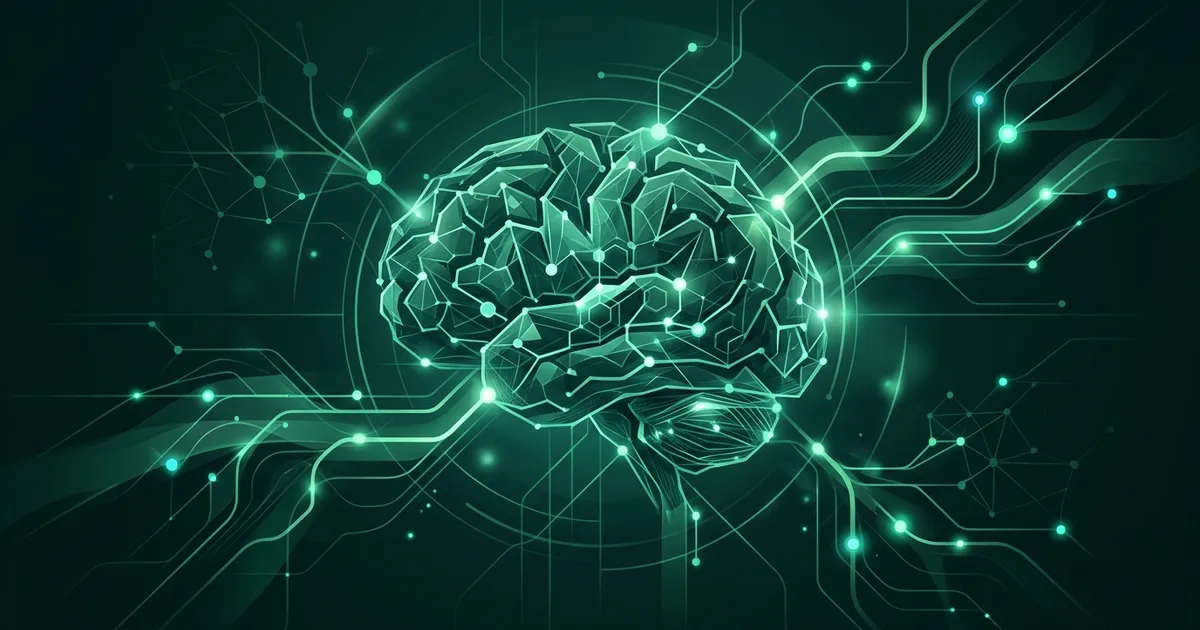
Different regions specialise. The occipital lobe pulls edges and motion out of visual signal. The temporal lobe turns sound into meaning. The parietal lobe places things in space. The frontal lobe works out what to do about it.
But almost nothing interesting happens inside one region. Reading this sentence recruits occipital, temporal, parietal and frontal areas within a few hundred milliseconds, coordinated by white matter tracts running across the whole organ. Our interactive map of the human brain shows where each of those regions sits.
Why this matters for learning
Two consequences fall out of the mechanics, and both are practical.
First, repetition spaced over time beats repetition crammed together, because strengthening a connection is a physical process that needs time between sessions. Second, retrieving information does more for retention than rereading it, because retrieval fires the pathway and rereading mostly fires the visual system.
Neither of those is a trick. They are what you would predict from a system where the connections doing the work are the same connections holding the memory.
Frequently Asked Questions
How does the brain process information?
Electrical signals travel down neurons, cross synaptic gaps as chemical messengers, and either push the next neuron closer to firing or further from it. A neuron fires only when the summed input crosses a threshold. Learning happens because connections strengthen with repeated joint activity.
How fast do signals travel in the brain?
Up to about 120 metres per second, roughly 430 kilometres per hour, in the thickest myelinated fibres. Uninsulated fibres carry signals at closer to half a metre per second, which is why sharp pain arrives before dull pain.
Do neurons touch each other?
No. There is a gap of roughly 20 to 40 nanometres, the synaptic cleft, between one neuron and the next. Signals cross it chemically, as neurotransmitters released by one cell and received by the next.
Is the brain like a computer?
Only loosely. A computer separates memory from processing and runs on fixed hardware. In the brain, the connections that do the processing are also where the memory lives, and they physically change with use.
How much information reaches conscious awareness?
Very little. Estimates for the rate of conscious information processing range from around 10 to 50 bits per second, against millions of bits arriving at the sensory receptors. The gap is compression, not failure.
Every NerdSip course clears a four-layer fact-checking pipeline before it reaches the app: grounded in live sources, scored nightly, gated on failure, and reviewable by a person at one tap. Articles on this blog are drafted with AI assistance, then researched, verified, and edited by our team.
Editorial responsibility: ai51 UG (haftungsbeschränkt). Responsible editor named in the imprint.
📚 Keep Learning
- How Many Brain Cells Does a Human Have?
- What Is the Primary Function of the Human Brain?
- The Main Regions of the Human Brain, Explained
- When Does the Human Brain Fully Develop?
- 27 Mind-Blowing Brain Facts That Will Change How You Think About Thinking
- Neuroplasticity: How Your Brain Rewires Itself (At Any Age)
Explore the NerdSip learning hubs
The blog is our editorial layer. When you want to move from reading into doing, these hubs organize the rest of NerdSip by format, including the app itself and the press that has written about it.
Learn one real thing today
NerdSip turns any topic you type into a fact-checked five-minute course, brain science included. Free to start.
4.7 stars from 380 reviews · 8,900+ learners