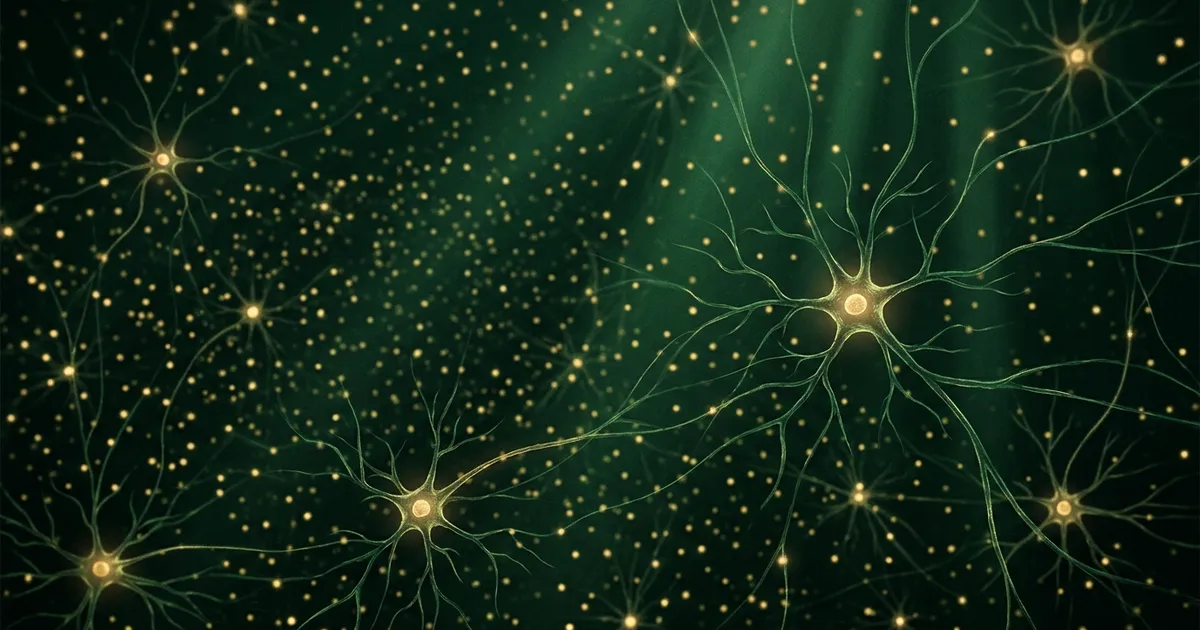
Ask the internet how many brain cells you have and you will get one number back, over and over: 86 billion. It is a good number. It is also, as an answer to that specific question, wrong by about half.
86 billion is the count of neurons. Your brain contains roughly the same number again of another cell type entirely. Add them together and the real answer is closer to 170 billion cells.
The short answer
A typical adult human brain contains approximately 86.1 billion neurons and approximately 84.6 billion non-neuronal cells, for a total of around 171 billion cells. Those figures come from a 2009 study led by Suzana Herculano-Houzel and Frederico Azevedo, published in the Journal of Comparative Neurology, and they remain the reference numbers today.
Where the old 100 billion came from
For most of the twentieth century, textbooks said 100 billion neurons. Ask where that came from and the trail goes cold fast. There was no landmark paper, no careful census. It was a round number that entered the literature, got repeated, and hardened into fact through nothing but repetition.
The problem was practical. Brain tissue is not uniform. Neurons are packed at wildly different densities in different structures, so counting cells in a small sample and multiplying up gives you an answer that depends almost entirely on which small sample you took. Nobody had a method that got around this.
How they finally counted
Herculano-Houzel's team solved it with a technique that sounds almost crude. They took whole human brains, dissolved the tissue while leaving the cell nuclei intact, and stirred the result until it was a completely uniform suspension. Because every nucleus was now evenly distributed through the liquid, counting nuclei in a small measured sample and scaling up became valid. A stain that binds only to neuronal nuclei let them separate neurons from everything else.
The method is called the isotropic fractionator. Applied to four adult male brains, it returned 86.1 billion neurons. The old estimate had been about 16 percent too high, which for a number quoted that confidently is a lot.
The other half: glial cells
The 84.6 billion non-neuronal cells are mostly glia, and calling them support cells undersells them badly. Oligodendrocytes wrap axons in the fatty myelin that lets signals travel at up to 120 metres per second instead of crawling. Astrocytes regulate blood flow, manage the chemical environment around synapses, and actively influence signalling. Microglia are the brain's immune system and prune unused connections.
You will still see the claim that glia outnumber neurons ten to one. That was another unmeasured estimate, and the same 2009 study killed it. The real ratio in the whole brain is close to one to one.
The distribution is the surprising part
Here is the fact that should be famous instead. Of your 86 billion neurons, roughly 69 billion sit in the cerebellum, the structure tucked under the back of your brain that handles balance, coordination and timing. The cerebral cortex, the folded outer sheet responsible for language, planning, reasoning and everything else we call thinking, holds about 16 billion.
Four out of every five of your neurons are working on movement. The cerebellum manages this while taking up only about a tenth of the brain's volume, because its neurons, the granule cells, are the smallest and most densely packed in the entire nervous system.
If you want to see where these structures actually sit, we built an interactive map of the human brain where you can click any region and read what it does.
Cells are not the interesting number anyway
Cell count is a poor proxy for capability, and the comparisons make that obvious. African elephants have around 257 billion neurons, three times the human count. Long-finned pilot whales have more neocortical neurons than we do. Neither writes symphonies.
What matters far more is the connections. Estimates put the number of synapses in the human brain somewhere around 100 trillion, and unlike the cell counts these are extrapolations from tissue samples rather than direct measurements, so treat any specific figure as an order of magnitude. Those connections change constantly. The cells you have at 40 are largely the cells you had at 20; what differs is how they are wired, and that difference is the whole of what you have learned.
What about losing brain cells?
The claim that you lose 10,000 neurons a day, or that a night of drinking kills thousands, is another unsourced number in wide circulation. Careful stereological counts find that cortical neuron numbers stay fairly stable through healthy ageing. Volume declines, and connectivity changes, but wholesale neuron death is a feature of disease rather than of ordinary years passing.
Whether adults grow new neurons is a live scientific argument rather than a settled fact. In 2018, one paper in Nature reported that hippocampal neurogenesis becomes undetectable in adults, and another in Cell Stem Cell reported that it persists into the eighth decade. Both used careful methods. The disagreement has not been resolved, so when you next see a confident headline about growing new brain cells, that is the context it is missing.
What the number is actually good for
Almost nothing, if you were hoping it says something about you.
Cell counts do not vary in any way that predicts what a person can do, and across species they predict less than you would expect. What does change, constantly and measurably, is the wiring between the cells you already have. That is where everything you know is stored, and it is the only part of this that responds to anything you do.
Which flips the useful question. Not how many cells do I have, but what are they currently connected to. Learning a subject does not add hardware. It rearranges what is already there, and the rearrangement follows use. That is why the same brain that could not hold a language at the start of a year can hold one by the end of it, with no change in the census.
Frequently Asked Questions
How many brain cells does a human have in total?
Roughly 170 billion. That breaks down into about 86.1 billion neurons and about 84.6 billion non-neuronal cells, mostly glia, based on the 2009 count by Azevedo and colleagues.
Is it 86 billion or 100 billion neurons?
86 billion. The 100 billion figure circulated for decades as an unverified estimate. When researchers finally counted directly in 2009 using the isotropic fractionator method, the answer came back at 86.1 billion.
Where are most of the brain's neurons?
In the cerebellum, which holds about 69 billion of them despite occupying only around a tenth of the brain's volume. The cerebral cortex, which handles reasoning and language, holds about 16 billion.
Do we lose brain cells every day?
Some neurons are lost over a lifetime, but the popular idea of tens of thousands dying daily has no solid support. Cortical neuron numbers stay relatively stable in healthy ageing, and what changes most is connectivity rather than raw cell count.
Can you grow new brain cells as an adult?
It is genuinely unresolved for humans. Two major papers published in 2018 reached opposite conclusions about whether the adult hippocampus produces new neurons. What is well established is that existing neurons keep rewiring throughout life.
Every NerdSip course clears a four-layer fact-checking pipeline before it reaches the app: grounded in live sources, scored nightly, gated on failure, and reviewable by a person at one tap. Articles on this blog are drafted with AI assistance, then researched, verified, and edited by our team.
Editorial responsibility: ai51 UG (haftungsbeschränkt). Responsible editor named in the imprint.
📚 Keep Learning
- What Is the Primary Function of the Human Brain?
- The Main Regions of the Human Brain, Explained
- When Does the Human Brain Fully Develop?
- How the Human Brain Processes Information
- 27 Mind-Blowing Brain Facts That Will Change How You Think About Thinking
- Neuroplasticity: How Your Brain Rewires Itself (At Any Age)
Explore the NerdSip learning hubs
The blog is our editorial layer. When you want to move from reading into doing, these hubs organize the rest of NerdSip by format, including the app itself and the press that has written about it.
Learn one real thing today
NerdSip turns any topic you type into a fact-checked five-minute course, brain science included. Free to start.
4.7 stars from 380 reviews · 8,900+ learners