Quick answer: Oktoberfest runs on rituals: the mayor taps the first keg at noon, beer comes only in one-litre mugs, the band starts a toast every twenty minutes, and the tents stay quiet until 18:00. Entry is free, tables are the thing people fight over, and the dirndl bow tells a story before anyone speaks.
Oktoberfest looks like chaos with a brass band. It is actually one of the most rule-bound events in Europe, and knowing the rules is the difference between visiting and taking part.
O'zapft is: the tapping
Nothing pours until the Mayor of Munich hammers a tap into the first keg in the Schottenhamel tent at noon on the opening Saturday and shouts O'zapft is, Bavarian for "It's tapped." A twelve-gun salute follows from the steps below the Bavaria statue, and only then may the other tents serve.
The number of blows it takes is counted and reported by every Munich newspaper. Two strokes is a triumph. Anything past four gets remembered for years. The first Maß goes to the Minister-President of Bavaria, which is the only guaranteed perk of that office.
Two parades bracket the opening. On the Saturday morning, the Wirtseinzug brings the tent landlords, their families and the brewery horse teams onto the grounds in decorated carriages. On the first Sunday, the Trachten- und Schützenzug sends thousands of people in traditional costume, along with marching bands and riflemen's clubs, on a long route through central Munich. That parade traces back to 1835, when it marked the silver wedding anniversary of the royal couple whose marriage started the festival.
What people wear, and what it signals
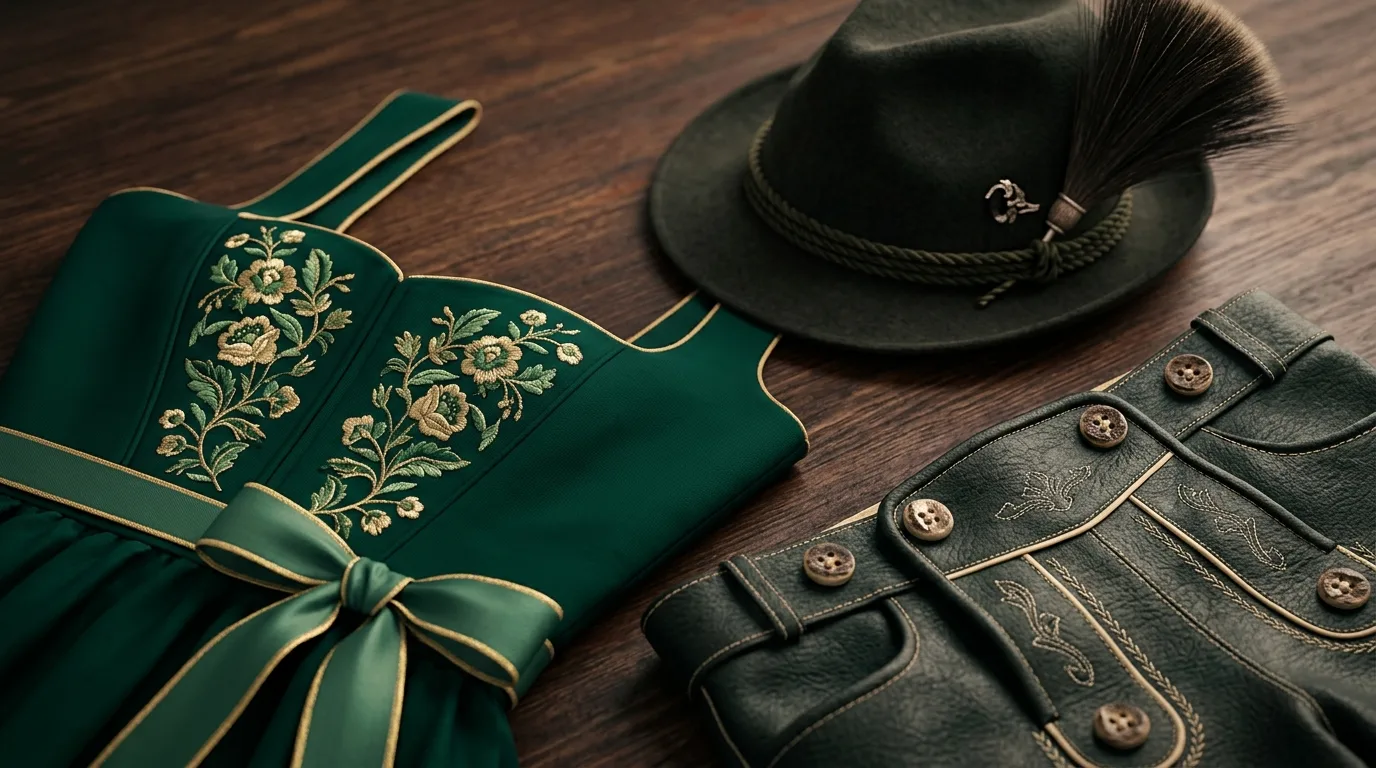
Tracht, the regional traditional dress, is worn by most visitors now, including a majority of locals. Lederhosen for men, dirndl for women, and a level of seriousness that surprises first-timers. Good Tracht is expensive, kept for years, and treated as clothing rather than costume.
The one piece of coded information is the dirndl bow:
- Left: single
- Right: taken or married
- Front centre: traditionally a girl, or someone declining to say
- Back: widowed, or working as a server
It is folklore, not law, and plenty of people tie it wherever it looks best. But enough people know the convention that it still functions as a signal.
What locals notice, and quietly judge: novelty lederhosen made of felt, dirndls worn as fancy dress, and anything with a beer-branded logo bought at the airport.
Inside the tent
Entry is free. There is no ticket for Oktoberfest. What is scarce is a seat, and beer is only served to people sitting at a table. Reservations are made months ahead, usually by companies and large groups, and they typically come as a package with food and beer vouchers.
If you have no reservation, the workable strategy is a weekday, before noon or in the early afternoon, and a willingness to sit with strangers. Sharing a table is normal and is where most of the social part of Oktoberfest actually happens.
The table rules, in order of how quickly you will be corrected:
- Stand on the bench, never on the table. Benches are for singing. Tables carry ten-kilogram trays of glass.
- Beer comes by the litre only in the large tents. There is no small measure to order.
- Pay in cash where you can and tip roughly a euro a Maß directly to the server.
- Do not take the mug. 116,000 were confiscated at the exits in 2025. Souvenir mugs are sold legitimately at stalls outside.
Ein Prosit, and the toast that resets the room
Every 15 to 20 minutes the band plays Ein Prosit der Gemütlichkeit. The whole tent stands, raises mugs, and toasts together. Clink the thick base of the mug rather than the rim, because rims chip and the base is where the glass is strongest, then make eye contact with each person you touch glasses with. Skipping the eye contact is the single most commented-on mistake foreigners make.
Gemütlichkeit itself has no clean English translation. It is roughly the warmth of a room where nobody is in a hurry and nobody is being difficult. The entire festival is an argument that it can be manufactured at scale.
The quiet hours, and why they exist
Until 18:00, tents play traditional brass band music at limited volume. After six, the party bands take over and the volume goes up. This is not an accident of programming. It is what keeps the afternoon usable for families, older visitors and anyone who wants a conversation, and it is why locals treat the afternoon and the evening as two separate festivals.
Tuesdays are traditionally family days, with reduced prices on the funfair rides.
What to eat
- Hendl: half a roast chicken, the defining Oktoberfest dish and the safest order in any tent.
- Brezn: pretzels the size of a steering wheel, carried through the tents in baskets.
- Steckerlfisch: whole mackerel grilled on a stick, sold from outdoor stands.
- Ochsenbraterei: a tent that roasts whole oxen on a spit and posts the name and weight of each animal on a board.
- Obatzda: a Bavarian cheese spread that exists mainly to make you order more beer.
The beer itself
Only six breweries may serve at Oktoberfest: Augustiner, Hacker-Pschorr, Hofbräu, Löwenbräu, Paulaner and Spaten. Each must brew inside Munich city limits, in line with the Bavarian purity law of 1516, and to a stronger specification than everyday Helles. Wiesnbier lands around 6 percent alcohol, which is roughly a fifth stronger than the lager most visitors are used to, served in a vessel five times the size of a standard glass. That combination is the entire explanation for the stories you have heard.
The last night
On the closing Sunday, a gun salute is fired at the Bavaria statue, and in the evening the tents dim their lights while guests hold up sparklers or candles. It is the one moment when six million litres of beer resolve into something genuinely quiet.
Before you go
The dates, the 2026 prices and the origin story are on our Oktoberfest 2026 event page, along with three free courses that run in the browser. Untold Mysteries of Oktoberfest covers the details even regulars get wrong, and the history of Oktoberfest explains why any of these rituals exist in the first place.
Frequently Asked Questions
What does O'zapft is mean?
It is Bavarian dialect for "It's tapped." The Mayor of Munich drives the tap into the first keg in the Schottenhamel tent at noon on the opening Saturday and shouts the phrase, followed by a twelve-gun salute. Beer may not be served anywhere on the grounds before that.
What does the dirndl bow mean?
By tradition, a bow tied on the wearer's left means single, on the right means taken or married, at the front centre means a girl or someone who prefers not to say, and at the back means widowed or working as a server. It is folklore rather than a rule, and plenty of people tie it wherever they like.
Do you need a reservation for Oktoberfest?
Not to enter. The grounds and the tents are free to walk into. Reservations only exist for tables and are usually booked months ahead by groups. Individuals and pairs can still find seats on weekday afternoons if they arrive early.
Can you stand on the tables at Oktoberfest?
No. Standing on the benches is normal and expected during the music. Standing on the table is banned and staff will remove you, mainly because a table covered in full litre mugs is a genuine hazard.
What do you say when toasting at Oktoberfest?
Prost. Clink the thick bases of the mugs rather than the rims, make eye contact, and drink. The band plays "Ein Prosit der Gemütlichkeit" every 15 to 20 minutes, and the entire tent toasts together.
How much should you tip at Oktoberfest?
Roughly one euro per Maß is normal, handed over as you pay rather than left on the table. Servers carry ten or more full litre mugs at a time and work for tips, and a good relationship with yours is the difference between one beer and three.
Every NerdSip course clears a four-layer fact-checking pipeline before it reaches the app: grounded in live sources, scored nightly, gated on failure, and reviewable by a person at one tap. Articles on this blog are drafted with AI assistance, then researched, verified, and edited by our team.
Editorial responsibility: ai51 UG (haftungsbeschränkt). Responsible editor named in the imprint.
📚 Keep Learning
- The History of Oktoberfest: From a Royal Wedding to 6 Million Visitors
- Oktoberfest by the Numbers: Beer, Visitors and the Price of a Maß
- 40 Oktoberfest Trivia Questions (With Answers)
- Why You Run Out of Things to Say: 5 Reasons and Fixes (2026)
- Oktoberfest Beer Price History: Every Maß Price From 1950 to 2026
Explore the NerdSip learning hubs
The blog is our editorial layer. When you want to move from reading into doing, these hubs organize the rest of NerdSip by format, including the app itself and the press that has written about it.
Ready to Level Up?
Turn your screen time into knowledge. Download NerdSip and start learning in just 5 minutes a day.
4.7 stars from 510 reviews · 10,000+ learners