Quick answer: Oktoberfest began on 12 October 1810 as a royal wedding party, ended with a horse race, and was repeated the following year because Munich enjoyed it. The beer tents, the brass bands and the September dates all came later. The 2026 festival is the 191st edition and runs from 19 September to 4 October.
The largest beer festival in the world started as a wedding for which beer was not the point.
1810: the wedding
On 12 October 1810, Crown Prince Ludwig of Bavaria married Princess Therese of Saxe-Hildburghausen. Bavaria had been a kingdom for barely four years, elevated by Napoleon, and the new royal house needed public legitimacy more than it needed a private party. So the citizens of Munich were invited.
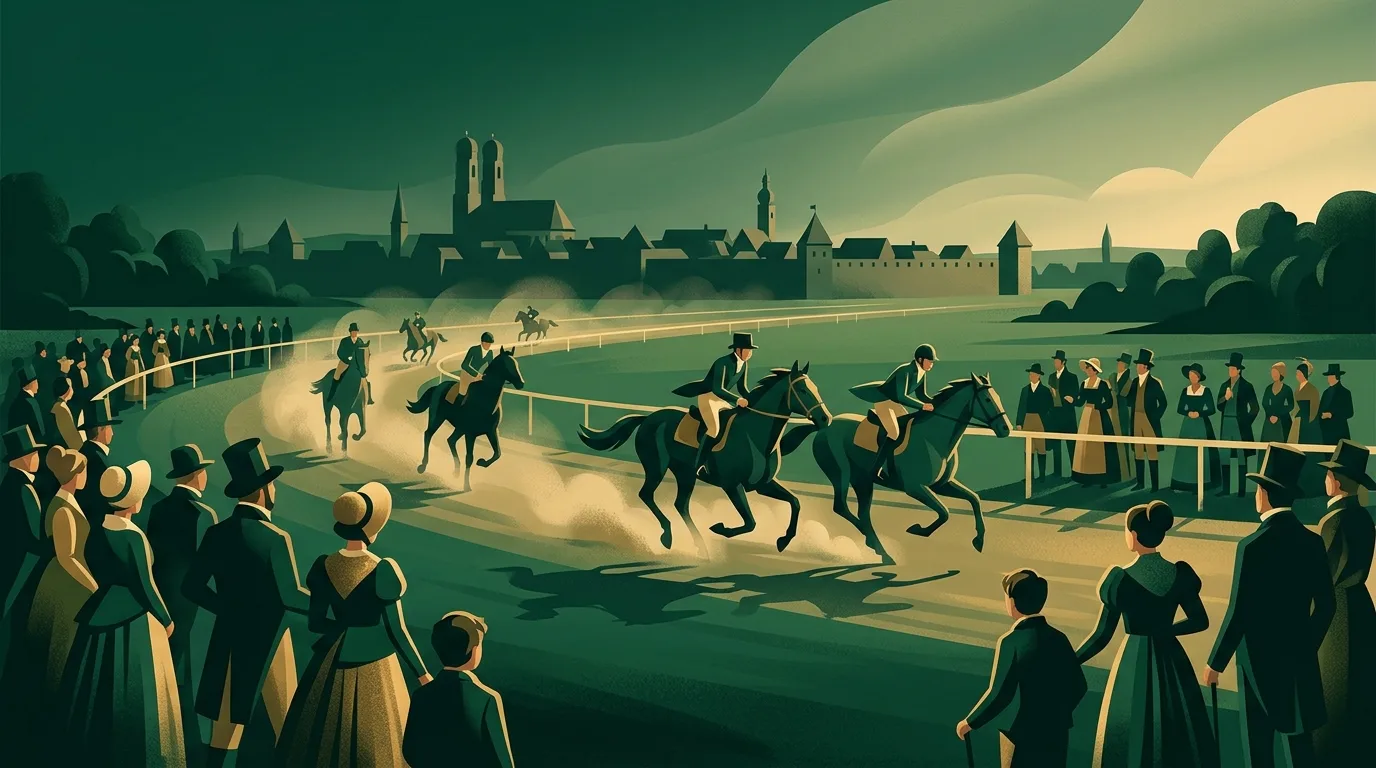
The celebrations ran for days and closed on 17 October with a horse race on a large meadow outside the city gates. Estimates put the crowd at around 40,000, which was a substantial share of Munich's entire population at the time.
Two decisions turned that party into an institution. The race was held again the following year, tied to a new agricultural show meant to promote Bavarian farming. And the meadow was named Theresienwiese, Therese's Meadow, after the bride. Munich locals shortened it to the Wiesn, which is still what they call the festival.
The nineteenth century: from race to festival
For decades, Oktoberfest was an agricultural fair with entertainment attached. The horse race was the centrepiece. The farming show, held every few years, brought livestock and machinery. Beer was sold, but from small stands rather than the cathedral-sized tents of today.
The shift happened gradually across the century:
- 1818: the first carousel and swings appear, the beginning of the funfair half of the festival.
- 1835: a costume parade marks the silver wedding anniversary of Ludwig and Therese, the ancestor of today's parade on the first Sunday.
- 1850: the Bavaria statue is unveiled above the meadow, where she still watches the whole thing.
- 1880: electric light arrives on the grounds and the number of beer stands multiplies.
- 1896: innkeepers and breweries begin building the large tents, replacing the scattered stands with the format we know.
The horse race, the original reason for the whole event, was held for the last time in 1938.
Why a festival called Oktoberfest happens in September
The original party was in October because the wedding was in October. As the festival grew, organisers kept moving the start earlier, and the reason was practical. September nights in Munich are warmer, the evenings are longer, and the entire event happens outdoors on an exposed meadow.
By the late nineteenth century most of the festival sat in September while the finish stayed in early October. The modern rule holds it in place: Oktoberfest ends on the first Sunday in October, extended to 3 October if that Sunday falls on the first or second, so the festival always covers German Unity Day. That is why some years run 16 days and others 17 or 18.
Every time Oktoberfest did not happen
The festival has been cancelled more than two dozen times, and the list reads like a summary of German history.
| Years | Reason |
|---|---|
| 1813 | Napoleonic wars |
| 1854 and 1873 | Cholera epidemics in Munich |
| 1866 | Austro-Prussian war |
| 1870 | Franco-Prussian war |
| 1914 to 1918 | First World War |
| 1923 and 1924 | Hyperinflation |
| 1939 to 1945 | Second World War |
| 2020 and 2021 | COVID-19 pandemic |
The 1854 cancellation is the bleakest entry. A cholera outbreak killed thousands of Munich residents that year, including Queen Therese herself, who died of the disease in 1854. The meadow named after her stayed empty.
In the years after the world wars, smaller autumn festivals were held in place of the full Oktoberfest, partly because Munich had no beer to spare and no barley to brew with.
1980: the part that is not a celebration
On 26 September 1980, a bomb exploded at the main entrance of the festival, killing 13 people including the perpetrator and injuring more than 200. It remains one of the deadliest attacks in postwar German history. A memorial stands near the entrance, and the case was reopened decades later. Any honest history of Oktoberfest includes it.
The modern Wiesn
Today's festival covers about 42 hectares and draws roughly six and a half million visitors over 16 days. Only six Munich breweries may serve beer there: Augustiner, Hacker-Pschorr, Hofbräu, Löwenbräu, Paulaner and Spaten. The beer must be brewed within city limits and to a stronger specification than everyday Helles.
Nothing is served until the Mayor of Munich taps the first keg in the Schottenhamel tent at noon on the opening Saturday and shouts O'zapft is. In 2010, for the 200th anniversary, the city added the Oide Wiesn, a historical section with old rides and traditional music, which has returned in most years since.
The exact figures behind the modern festival, from litres poured to items lost, are in Oktoberfest by the numbers. The rituals, the dress codes and the etiquette are in Oktoberfest traditions explained.
Learn the whole story in five minutes
Our Oktoberfest 2026 event page carries the dates, the 2026 beer prices and three free courses that run in your browser. From Royal Wedding to Global Party covers this history in five short lessons with a quiz after each one, and Global Oktoberfest follows the festival to Brazil, China and Argentina.
If the beer itself is the interesting part, Brewing Basics: From Grain to Glass explains what actually happens between barley and stein, and The 1873 Frankfurt Beer Riots covers what happens when Germans decide beer has become too expensive.
Oktoberfest is not the only autumn festival whose origin story got tidied up after the fact. The history of Halloween is a stronger case still: much of its confident Celtic backstory was assembled by Victorian antiquarians rather than recorded at the time.
Frequently Asked Questions
When did Oktoberfest start?
On 12 October 1810, as the public celebration of the wedding of Crown Prince Ludwig of Bavaria and Princess Therese of Saxe-Hildburghausen. The festivities closed with a horse race on 17 October on the meadow outside Munich's city gates.
Why is Oktoberfest held in September?
For weather and daylight. September evenings in Munich are warmer and longer than October ones, so the festival was gradually shifted earlier during the nineteenth century. The closing date stayed anchored in early October, and the name never changed.
Why is the Oktoberfest site called Theresienwiese?
It is named after Princess Therese, the bride at the 1810 wedding. Wiese means meadow, so the name translates as Therese's Meadow. Locals shorten it to the Wiesn, which is now a synonym for the festival itself.
How many times has Oktoberfest been cancelled?
More than two dozen times since 1810. The causes were the Napoleonic wars, cholera epidemics in 1854 and 1873, the Franco-Prussian war, both world wars, hyperinflation in 1923 and 1924, and the COVID-19 pandemic in 2020 and 2021.
When were beer tents introduced at Oktoberfest?
Small beer stands appeared through the nineteenth century and grew steadily. By 1896 innkeepers had begun erecting the large tents in partnership with Munich breweries, which is the format visitors recognise today.
What is the Oide Wiesn?
A historical section of the festival introduced for the 200th anniversary in 2010, with traditional rides, brass bands and older-style beer tents. It has returned in most years since, on a separate ticketed area of the grounds.
Every NerdSip course clears a four-layer fact-checking pipeline before it reaches the app: grounded in live sources, scored nightly, gated on failure, and reviewable by a person at one tap. Articles on this blog are drafted with AI assistance, then researched, verified, and edited by our team.
Editorial responsibility: ai51 UG (haftungsbeschränkt). Responsible editor named in the imprint.
📚 Keep Learning
- Oktoberfest by the Numbers: Beer, Visitors and the Price of a Maß
- Oktoberfest Traditions Explained: Tapping, Tracht and Table Rules
- 40 Oktoberfest Trivia Questions (With Answers)
- 100 Interesting Facts, Sorted by What Kind of Conversation You Want to Start
- Oktoberfest Beer Price History: Every Maß Price From 1950 to 2026
Explore the NerdSip learning hubs
The blog is our editorial layer. When you want to move from reading into doing, these hubs organize the rest of NerdSip by format, including the app itself and the press that has written about it.
Ready to Level Up?
Turn your screen time into knowledge. Download NerdSip and start learning in just 5 minutes a day.
4.7 stars from 510 reviews · 10,000+ learners