Quick answer: Europe gets totality twice in thirteen months, in August 2026 and August 2027, and then, apart from a brief 2053 brush with Gibraltar and southern Spain, nothing until 2081. Germany's next total solar eclipse is 3 September 2081. The UK's is 23 September 2090.
Anyone in Europe deciding whether the 2026 eclipse is worth the trip should see this list first. The honest summary is that the next two years contain both of Europe's realistic chances in a normal lifetime.
The European list
| Date | Where totality falls in Europe | Max totality |
|---|---|---|
| 11 August 1999 | Cornwall, northern France, southern Germany, Austria, Hungary, Romania | about 2 min 23 s |
| 29 March 2006 | Turkey only, on the European edge | about 4 min 7 s |
| 20 March 2015 | Faroe Islands and Svalbard only | about 2 min 47 s |
| 12 August 2026 | Eastern Greenland, western Iceland, northern Spain, Balearics | about 2 min 18 s |
| 2 August 2027 | Southern Spain and Gibraltar, then North Africa | about 6 min 23 s |
| 3 September 2081 | France, Switzerland, southern Germany, Austria, northern Italy, Slovenia, Croatia | about 5 min 33 s |
| 23 September 2090 | Southern Ireland, Cornwall, Devon, southern England, northern France, Belgium | about 3 min 36 s |
Compiled from NASA and timeanddate eclipse catalogues. Durations are the maximum along each path, usually reached outside Europe. Peripheral events touching only Arctic islands or the Caucasus are noted where relevant but do not count as continental European totalities.
The 54-year gap
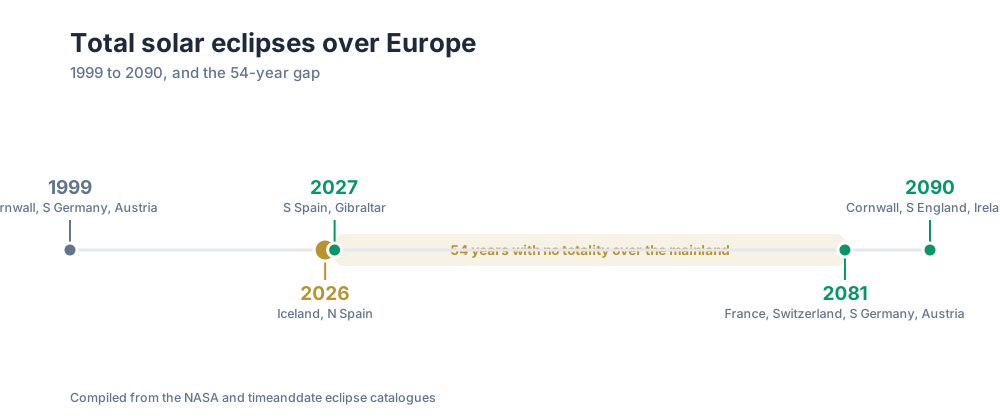
Look at the middle of that table. Between the 2027 eclipse and the 2081 eclipse, mainland Europe gets almost nothing: the 12 September 2053 path only clips Gibraltar and the southern tip of Spain, with under two minutes of totality, on its way to North Africa. That is 54 years without a proper totality over the continent, a span that covers most of a working life.
This is not unusual, it is the norm. Eclipse paths are a few hundred kilometres wide on a planet 40,000 km around, and most of them land on ocean. Any fixed point on Earth averages one total eclipse every 375 years or so, and the spacing is irregular: long droughts, occasional clusters.
Europe is currently in a cluster. Spain in particular has drawn an extraordinary hand, with totality in the north in August 2026 and totality in the south in August 2027. Nowhere else on the continent gets two chances in one calendar's memory.
By country
Spain
Twice, thirteen months apart. On 12 August 2026 the path crosses the north, including Zaragoza, with the Sun low near sunset. On 2 August 2027 it crosses the south, including areas near Cádiz and Málaga, with the Sun high and totality several times longer. If you can only travel once, 2027 is the better eclipse; if you want the atmospheric one, 2026's near-sunset corona is unrepeatable.
Germany
Last totality: 11 August 1999, when the path crossed the south including Stuttgart, Augsburg and Munich, and much of the country was rained on. Next totality: 3 September 2081, with the path again crossing the south. That is a gap of 82 years. Everyone who remembers 1999 as an adult will need to be well past a hundred to see the next one from home.
United Kingdom and Ireland
Last totality: 11 August 1999, seen from Cornwall, again mostly under cloud. Next: 23 September 2090, when the path covers Cornwall, Devon and much of the south coast of England, with southern Ireland catching only the fringe. Ninety-one years between the two.
Iceland
The unexpected winner of 2026. The path crosses the west of the island including the Reykjavik area, with the Sun about 25 degrees above the horizon, the best geometry anywhere in Europe that day. Iceland's weather in August is the only real caveat, and it is a large one.
France, Austria, Italy, Switzerland
Nothing in 2026 or 2027 beyond partial phases. All of them are on the 2081 path, which is why that date deserves a place in the family calendar of anyone currently under twenty.
What this means for August 2026
If you live in Europe and you have ever wondered whether a total solar eclipse is worth travelling for, the calendar has made the decision unusually simple. The realistic options are Iceland or northern Spain in 2026, southern Spain in 2027, and then a wait measured in generations.
Details of the 2026 path, city by city, are on our solar eclipse event page, along with three free courses on the science. The worldwide calendar through 2045 is in where to see the next total solar eclipse, and before you go, read how to watch a solar eclipse safely, because the rules around filters are less obvious than they look.
Cite as: NerdSip, "Total Solar Eclipses in Europe, 1999 to 2090", nerdsip.com/blog/total-solar-eclipses-in-europe, updated July 2026.
Frequently Asked Questions
When is the next total solar eclipse in Europe?
12 August 2026, with the path of totality crossing eastern Greenland, western Iceland, northern Spain and the Balearics. A second follows on 2 August 2027 across southern Spain, Gibraltar and North Africa.
When is the next total solar eclipse in Germany?
3 September 2081. The path crosses France, Switzerland, southern Germany, Austria and northern Italy. Germany's last totality was 11 August 1999, so the gap is 82 years.
When is the next total solar eclipse in the UK?
23 September 2090. The path of totality covers Cornwall, Devon and much of the south coast of England, with southern Ireland on the fringe. The UK's last was 11 August 1999, seen from Cornwall.
Why does Europe get two total eclipses within a year and then none for decades?
Eclipse paths are narrow, roughly a few hundred kilometres wide, and where they land depends on the geometry of each individual alignment. Clustering is coincidence rather than pattern. Over long spans any given region averages one totality every few hundred years, but the spacing is wildly irregular.
Will Germany see the 2026 eclipse?
Only as a partial eclipse. The path of totality stays well to the north and west, touching Iceland and northern Spain. A deep partial eclipse still leaves the sky bright, because even a thin sliver of the Sun is thousands of times brighter than the full Moon.
How long does totality last in Europe in 2026 and 2027?
Up to about 2 minutes 18 seconds in 2026, and up to about 6 minutes 23 seconds in 2027, though the 2027 maximum falls in Egypt. Southern Spain sees several minutes of the 2027 eclipse, more than double what the 2026 path delivers on land.
Every NerdSip course clears a four-layer fact-checking pipeline before it reaches the app: grounded in live sources, scored nightly, gated on failure, and reviewable by a person at one tap. Articles on this blog are drafted with AI assistance, then researched, verified, and edited by our team.
Editorial responsibility: ai51 UG (haftungsbeschränkt). Responsible editor named in the imprint.
📚 Keep Learning
Explore the NerdSip learning hubs
The blog is our editorial layer. When you want to move from reading into doing, these hubs organize the rest of NerdSip by format, including the app itself and the press that has written about it.
Keep going: five-minute courses on this
Pick one and finish it before your coffee cools. Every lesson ends with a quick question, so it sticks instead of scrolling past.
Courses on this topic
4.7 stars from 510 reviews · 10,000+ learners