Quick answer: The next total solar eclipse is 12 August 2026 over Greenland, Iceland and northern Spain. The best one in a generation follows on 2 August 2027, with more than six minutes of totality over Egypt. Australia gets 2028 and 2037, southern Africa 2030, and the United States 2044 and 2045.
Total solar eclipses are not rare on a planetary scale. One happens roughly every 18 months. They are rare where you happen to live, which is why the useful question is not when the next eclipse is, but where you would have to stand.
Every total solar eclipse to 2045
| Date | Path of totality | Max totality | Worth travelling for? |
|---|---|---|---|
| 12 Aug 2026 | Arctic, east Greenland, west Iceland, north Spain, Balearics | About 2 min 18 s | Yes, first in mainland Europe since 1999 |
| 2 Aug 2027 | South Spain, Gibraltar, Morocco, Algeria, Libya, Egypt, Saudi Arabia, Yemen, Somalia | About 6 min 23 s | The one to plan your life around |
| 22 Jul 2028 | Australia (including Sydney) and New Zealand | About 5 min 10 s | Yes, a major city sits on the path |
| 25 Nov 2030 | Botswana, South Africa, southern Australia | About 3 min 44 s | Good, and easy to combine with a trip |
| 20 Mar 2034 | Nigeria, Chad, Sudan, Egypt, Saudi Arabia, Iran, Pakistan, India, China | About 4 min 9 s | Yes, long and broadly accessible |
| 2 Sep 2035 | China, North and South Korea, Japan | Close to 3 min | Yes, Tokyo sits near the path |
| 13 Jul 2037 | Australia and New Zealand | About 3 min 58 s | Good, winter conditions in the south |
| 26 Dec 2038 | Australia and New Zealand | About 2 min 18 s | Only if you are nearby |
| 30 Apr 2041 | Angola, Democratic Republic of the Congo, Uganda, Kenya, Somalia | About 4 min 51 s | Long, but logistically demanding |
| 23 Aug 2044 | Greenland, Canada, Montana, North Dakota | About 2 min | North America's first since 2024 |
| 12 Aug 2045 | United States coast to coast, California to Florida, then the Caribbean and Brazil | Over 6 min | The American great eclipse |
Durations are maximums along each path, usually reached at sea or in remote terrain. Your local duration will be shorter. Check exact circumstances for your location with NASA or timeanddate before booking anything.
12 August 2026: Iceland and Spain
This is the one weeks away as we publish. The shadow crosses the Arctic, clips eastern Greenland, sweeps over western Iceland including the Reykjavik area, then makes landfall in northern Spain in the last minutes before sunset.
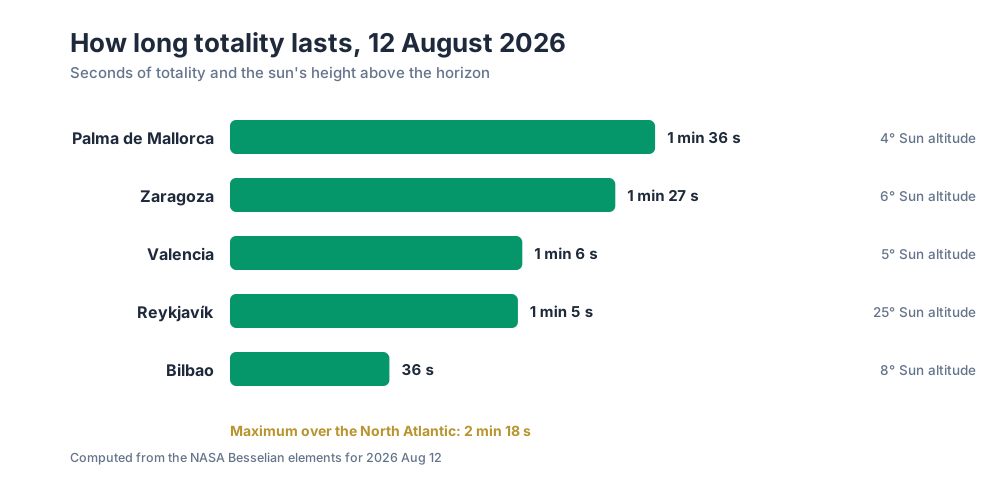
Iceland gets the better geometry, with the Sun about 25 degrees above the horizon and roughly a minute of totality. August weather there is a coin flip.
Northern Spain gets more time, up to about a minute and a half around Zaragoza, and much better cloud odds inland. The catch is the Sun sits only a few degrees up, so a flat western horizon matters more than anything else. Palma de Mallorca gets about a minute and a half with the Sun barely 4 degrees high, which will either be the most photogenic eclipse of your life or a hill in the way.
Full detail, city by city, is on our solar eclipse event page.
2 August 2027: the six-minute eclipse
If you only ever chase one, this is it. Totality lasts about 6 minutes 23 seconds near Luxor in Egypt, the longest stretch of totality over land this century, and nothing longer is due until 2114.
The path runs across southern Spain and Gibraltar, then Morocco, Algeria, Libya, Egypt, Saudi Arabia and Yemen. Two things make it exceptional beyond the duration. The Sun sits high in the sky, unlike 2026, and the path crosses some of the most reliably cloudless land on Earth in August. Luxor in early August is brutally hot and almost guaranteed clear.
Spain gets an unusual gift here: totality in the north in 2026 and totality in the south a year later. Andalusia, including areas near Cádiz and Málaga, sits on the 2027 path.
The ones after that, by region
Europe
After 2027, mainland Europe's next total solar eclipse is not until 2081. That is not a typo. Anyone in Europe who wants to see totality without a long-haul flight has two chances in the next 55 years, and both are within 13 months of each other.
Australia and New Zealand
An extraordinary run: 2028, 2030, 2037 and 2038. The 2028 eclipse passes directly over Sydney, which is rare enough that it is worth stating plainly. Major cities are almost never on a path of totality.
Africa and Asia
2030 crosses southern Africa, 2034 runs from Nigeria to China, 2035 reaches Japan and both Koreas, and 2041 crosses central Africa. The 2034 and 2041 eclipses are long, over four minutes, and both cross regions where clear August or April skies are likely.
North America
After the 2024 eclipse, the continent waits. 2044 clips Montana and North Dakota at the end of a path over Greenland and Canada. Then 12 August 2045 delivers a coast-to-coast crossing from California to Florida with over six minutes of totality, the longest American eclipse in modern history.
How to choose a spot on a path
- Cloud climatology beats duration. Four minutes behind cloud is worse than 90 seconds in clear sky. Look up historical August or April cloud cover for the region before comparing durations.
- Get to the centre line. Totality is longest along the middle of the path and shrinks to zero at the edges. Twenty kilometres of driving can add 30 seconds.
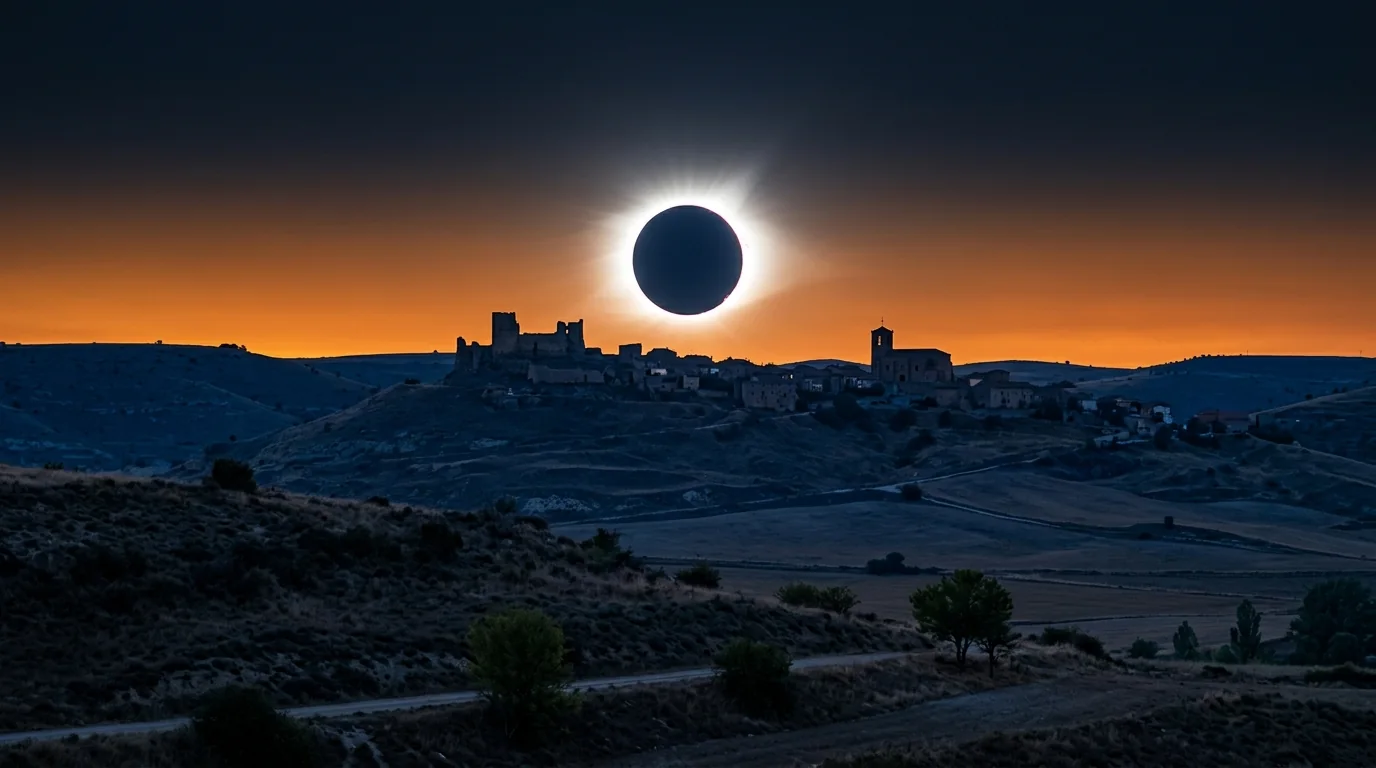
- Sun altitude matters for what you see. A high Sun gives you a classic corona overhead. A low Sun, as in Spain in 2026, gives you a horizon-hugging corona and a genuine risk of terrain blocking the view. When the Sun sits under ten degrees, a terrain check from your exact coordinates, such as Total Eclipse 2026, is worth more than any obscuration map.
- Stay mobile. Experienced eclipse chasers book accommodation near the path, not on it, and drive on the morning based on the satellite picture.
- Book early, cancel late. Rooms in small towns on a path sell out a year ahead and prices climb hard in the final months.
Before you go
Read how to watch a solar eclipse safely first, because the rules around filters and optics are not intuitive. If you want the underlying mechanics, why do solar eclipses happen covers the geometry in about eight minutes.
And if you want it to stick, the free course 3 Eclipses That Changed Human History runs directly in your browser on our event page: the eclipse that ended a war in 585 BCE, the one that revealed helium, and the one that proved Einstein right.
Frequently Asked Questions
When is the next total solar eclipse?
12 August 2026. The path of totality crosses the Arctic, eastern Greenland, western Iceland and northern Spain, including the Balearics, with a maximum totality of about 2 minutes 18 seconds over the North Atlantic.
Which upcoming eclipse has the longest totality?
2 August 2027, with about 6 minutes 23 seconds near Luxor in Egypt. That is the longest totality over land anywhere this century, and roughly three times the duration of the 2026 eclipse.
When is the next total solar eclipse in the United States?
23 August 2044 clips Montana and North Dakota after crossing Greenland and Canada. The coast-to-coast event is 12 August 2045, running from California to Florida with more than six minutes of totality.
When is the next total solar eclipse in Europe?
12 August 2026 over Iceland and northern Spain, followed by 2 August 2027 over southern Spain and Gibraltar. After that, mainland Europe waits until 2081.
When is the next total solar eclipse in Australia?
22 July 2028, passing over Sydney with about 5 minutes 10 seconds of maximum totality. Australia gets another on 25 November 2030 and again on 13 July 2037.
How far in advance should you book eclipse travel?
For a well-served destination, a year is comfortable. Hotels along the 2027 path in Egypt and southern Spain began filling years ahead, and prices in small towns on a path typically rise sharply in the final six months. Book refundable where possible, since the deciding factor on the day is cloud cover.
Every NerdSip course clears a four-layer fact-checking pipeline before it reaches the app: grounded in live sources, scored nightly, gated on failure, and reviewable by a person at one tap. Articles on this blog are drafted with AI assistance, then researched, verified, and edited by our team.
Editorial responsibility: ai51 UG (haftungsbeschränkt). Responsible editor named in the imprint.
📚 Keep Learning
- Why Do Solar Eclipses Happen? The Simple Answer and the Cosmic Fluke
- How to Watch a Solar Eclipse Safely (Without Ruining Your Eyes)
- 40 Solar Eclipse Trivia Questions (With Answers)
- 47 Mind-Blowing Science Facts That Sound Fake But Are 100% Real
- Total Solar Eclipses in Europe: Every One From 1999 to 2090
Explore the NerdSip learning hubs
The blog is our editorial layer. When you want to move from reading into doing, these hubs organize the rest of NerdSip by format, including the app itself and the press that has written about it.
Keep going: five-minute courses on this
Pick one and finish it before your coffee cools. Every lesson ends with a quick question, so it sticks instead of scrolling past.
Courses on this topic
4.7 stars from 510 reviews · 10,000+ learners