Quick answer: We celebrate Halloween because six different eras each found a use for the same night. It began as Samhain, the Gaelic marker for the end of the harvest. The Church made 31 October the vigil of All Saints' Day. The medieval poor went door to door selling prayers for cake. Victorians used the evening to ask who they would marry. Post-war American suburbs turned it into a children's holiday to curb vandalism, and retailers turned that into the second-largest commercial holiday in the United States. Underneath all of it sits one durable human appetite: being frightened on purpose, in company, with the exit clearly marked.
Ask why we celebrate Halloween and you usually get an origin story. Origins explain how something started. They do not explain why it is still here, and Halloween is a strange survivor: a festival with no fixed religion, no national ownership and no official status, which nonetheless outgrew nearly every feast day around it.
The better question is not where it came from. It is why every generation kept it.
The six answers, one per era
1. Because the harvest ended
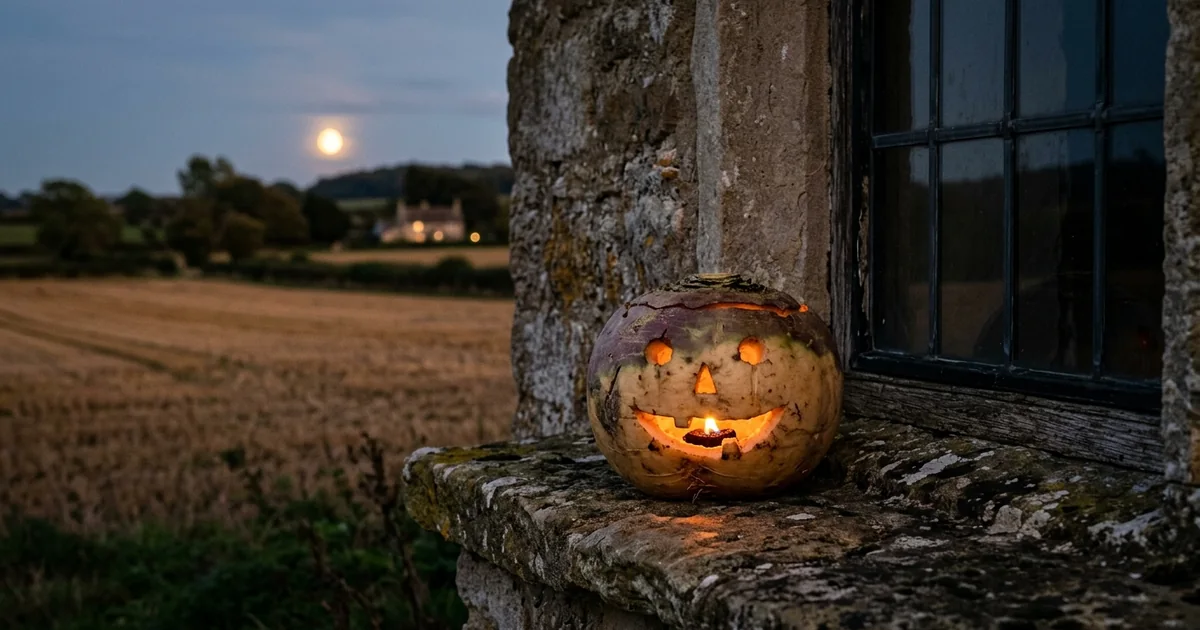
Samhain marked the end of the harvest and the start of the dark half of the year in the Gaelic calendar. This was not symbolism. Herds came down from summer pasture, animals were killed and salted for winter, and the community moved indoors for months. A break that sharp gets marked, and any culture marking it will attach stories about thresholds and the dead to the night it falls on.
2. Because the Church needed a vigil
Pope Gregory IV had 1 November adopted as All Saints' Day across the Frankish empire in 835. In the medieval calendar a feast begins the evening before, so 31 October became All Hallows' Even, which is where the word Halloween comes from. That gave the night an official place in the year, which is precisely what a folk custom needs in order to survive several centuries.
3. Because the poor could sell prayers
Souling was an economy. On All Saints' and All Souls', poor people and children went house to house asking for soul cakes and prayed for the household's dead in return. Both sides got something real. The household bought intercession for its dead, and the poor got food at the start of winter. In Scotland this became guising, where a costumed child had to perform before receiving anything, which is the direct ancestor of trick or treating.
4. Because people wanted to know who they would marry
This is the forgotten Halloween, and it lasted for centuries. Most traditional Halloween games were marriage divination. Bobbing for apples decided who would wed first. Apple peel thrown over a shoulder was read for the initial of a future spouse. Robert Burns wrote a whole poem about it in 1785 and footnoted the rules. In a world where marriage was the single largest determinant of a life, one licensed evening for asking the question was genuinely useful.
5. Because American suburbs had a vandalism problem
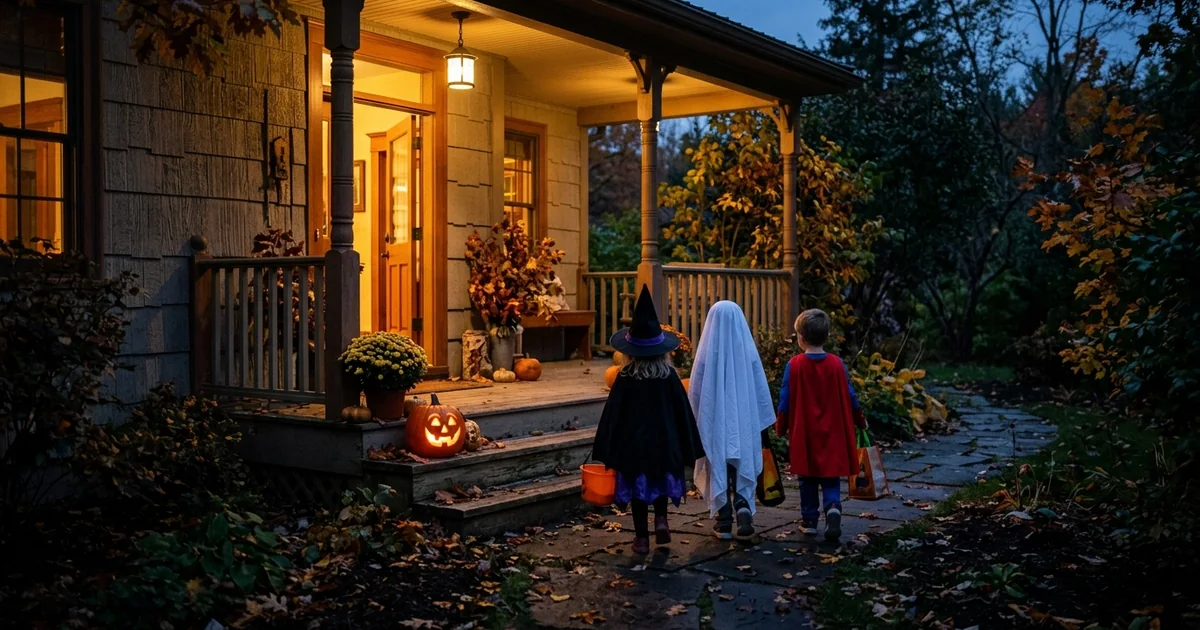
By the 1920s and 1930s the mischief half of the American Halloween had overtaken the treat half, and cities were losing property every year. Communities responded with organised parties, parades and a push for supervised house-to-house treating aimed at children. It worked, and the new suburbs of the 1950s, full of identical streets and young families, made it effortless. The modern children's Halloween is a public safety measure that succeeded.
6. Because being scared on purpose feels good
The final answer is the one that keeps working when the others have expired. Nobody today needs to salt a pig or ask an apple about their spouse, and yet the night keeps growing.
Researchers who study what they call recreational fear have found something useful here. In a field study run in a commercial haunted house, published in Psychological Science, enjoyment did not rise with fear indefinitely. It followed an inverted U: too little fear was boring, too much was unpleasant, and the sweet spot sat in the middle. People sought out an amount of fright, not the maximum available.
That is what Halloween provides better than any other night in the calendar. Fear with the exit marked. A rehearsal of dread in a setting where nothing is actually at stake, taken in company, on a fixed date, with sweets afterwards.
Why it spread to countries with no connection to it
If Halloween were only a folk survival, it would have stayed where the folklore was. Instead it went to Germany in the 1990s and Japan after that, neither of which has any Samhain to survive.
Three things carry it. It is participatory, so it gives people something to do rather than something to watch. It is secular enough to be adopted without conflict in most places, which Christmas and Easter are not. And it is commercially generous, offering costumes, sweets, decorations and parties to sell, which guarantees it a marketing budget every autumn.
Germany is the instructive case, because the fit is not clean. The 31st of October is Reformation Day, a public holiday in nine federal states, and 1 November is All Saints', a silent holiday with dancing restrictions in five more. Halloween there is genuinely contested rather than simply adopted, which is a useful reminder that the night is not universal, it is imported.
So why do you celebrate it?
Probably for the sixth reason, plus one the older lists do not have: it is one of the few remaining evenings when adults are allowed to be silly in public, and when knocking on a neighbour's door is normal rather than alarming.
That is not a small thing to have kept. The harvest reason is gone, the divination reason is gone, and most people celebrating tonight could not name the pope who fixed the date. The night survived all of that because each era found something new to do with it, which is exactly what a living tradition looks like.
For the full chronology, with sources and the parts that are genuinely uncertain, read the history of Halloween. For the details worth repeating out loud, there are 50 Halloween facts, and the Halloween 2026 page has a free quiz that will tell you quickly how much of this you actually knew.
Frequently Asked Questions
Why do we celebrate Halloween?
Because six different eras each found a use for the same night. It began as Samhain, the Gaelic marker for the end of the harvest, then became All Hallows' Even, the vigil of the Christian feast of All Saints. The medieval poor went door to door selling prayers for soul cakes. Victorians used the evening for marriage divination. Post-war American suburbs turned it into a supervised children's holiday to reduce vandalism, and retailers made it the second-largest commercial holiday in the United States. The one reason that still applies to everyone is the pleasure of being frightened on purpose, in company, with the exit clearly marked.
What is the point of Halloween today?
For most people it is a licensed evening of harmless fear and public silliness. Research on recreational fear, including a field study in a commercial haunted house published in Psychological Science, found that enjoyment peaks at a moderate level of fright rather than a maximum, which is exactly what Halloween is designed to deliver. It is also one of the few nights when knocking on a neighbour's door is normal rather than alarming.
What does Halloween actually mean?
The word is a contraction of All Hallows' Even. Hallows means saints and even is an old word for evening, so Halloween is simply the evening before All Saints' Day on 1 November. The contraction is Scottish.
Is Halloween religious?
It has religious roots on both sides and is largely secular in practice. The date comes from the Christian feast of All Saints, and the season comes from the Gaelic festival of Samhain. What people actually do on the night, costumes, sweets, parties and decorations, carries no religious content, which is a large part of why it travels so easily to countries with no connection to either tradition.
Why do we wear costumes on Halloween?
Disguise served two purposes that later merged. In folk belief it made you unrecognisable to whatever was abroad on a night when the boundary between worlds was thin. In the Scottish custom of guising it made you anonymous while demanding food at a neighbour's door, and you had to perform a song, joke or poem to earn it.
Why do we celebrate Halloween on 31 October?
Because it is the eve of All Saints' Day, which was fixed on 1 November for the whole Church in 835 under Pope Gregory IV. In the medieval calendar a feast begins on the evening before, so the vigil fell on 31 October and stayed there. The date has not moved since.
Every NerdSip course clears a four-layer fact-checking pipeline before it reaches the app: grounded in live sources, scored nightly, gated on failure, and reviewable by a person at one tap. Articles on this blog are drafted with AI assistance, then researched, verified, and edited by our team.
Editorial responsibility: ai51 UG (haftungsbeschränkt). Responsible editor named in the imprint.
📚 Keep Learning
- The History of Halloween: From Samhain to Trick or Treat
- 50 Halloween Facts That Are Actually True
- 100 Halloween Trivia Questions (With Answers)
- 50 Fun Facts About Mexico You Were Never Taught
- 42 Facts That Will Blow Your Mind (2026)
- 100 Interesting Facts, Sorted by What Kind of Conversation You Want to Start
Explore the NerdSip learning hubs
The blog is our editorial layer. When you want to move from reading into doing, these hubs organize the rest of NerdSip by format, including the app itself and the press that has written about it.
Ready to Level Up?
Turn your screen time into knowledge. Download NerdSip and start learning in just 5 minutes a day.
4.7 stars from 510 reviews · 10,000+ learners