Mexico gets flattened in the retelling: beaches, tequila, one misunderstood holiday. The actual country invented colour television, holds the largest pyramid on Earth by volume, and contains a cave of crystals so large that people can only enter wearing ice-cooled suits. Fifty checked facts follow, grouped by subject. More of everything is in the fun facts library.
The Land Itself
- A volcano grew out of a cornfield while a farmer watched. In February 1943 Dionisio Pulido saw the ground crack in his field in Michoacán. Within a week Paricutín was five storeys tall. Within a year it had buried two villages, and it stopped nine years later at 424 metres.
- Mexico City is sinking. Parts of it drop by up to 50 centimetres a year, because it sits on the drained bed of Lake Texcoco and the soft sediment compacts as groundwater is pumped out.
- The asteroid that ended the dinosaurs hit Mexico. The Chicxulub crater under the Yucatán Peninsula is about 180 kilometres across, and the ring of sinkholes above it is still visible from the air.
- Those sinkholes are the cenotes. Thousands of them dot the Yucatán, forming a freshwater network the Maya treated as sacred and used as their main water supply.
- The world's longest underwater cave system is in Mexico. Sac Actun in Quintana Roo runs for more than 370 kilometres of mapped passage.
- The largest natural crystals ever found are in Chihuahua. The Cave of the Crystals at Naica holds selenite beams up to 12 metres long. It sits above magma, so the air reaches around 58 degrees at near total humidity and visitors need ice-cooled suits.
- Copper Canyon is bigger than the Grand Canyon. The Chihuahua network of six canyons is larger overall and deeper in places.
- Mexico is one of the world's 17 megadiverse countries, holding somewhere between 10 and 12 percent of all known species despite covering 1 percent of the land surface.
- It has more species of pine and oak than anywhere else on Earth, and ranks second globally for reptile species.
- Monarch butterflies fly up to 4,800 kilometres to get there. They arrive in the Michoacán fir forests each autumn, several generations removed from the butterflies that left the year before.
History Before and After 1519
- Tenochtitlan was bigger than any city in Spain. The Aztec capital held around 200,000 people when the Spanish arrived, roughly four times the population of London at the time.
- The Maya invented zero independently. They were using it as a placeholder in their calendar centuries before the concept reached Europe.
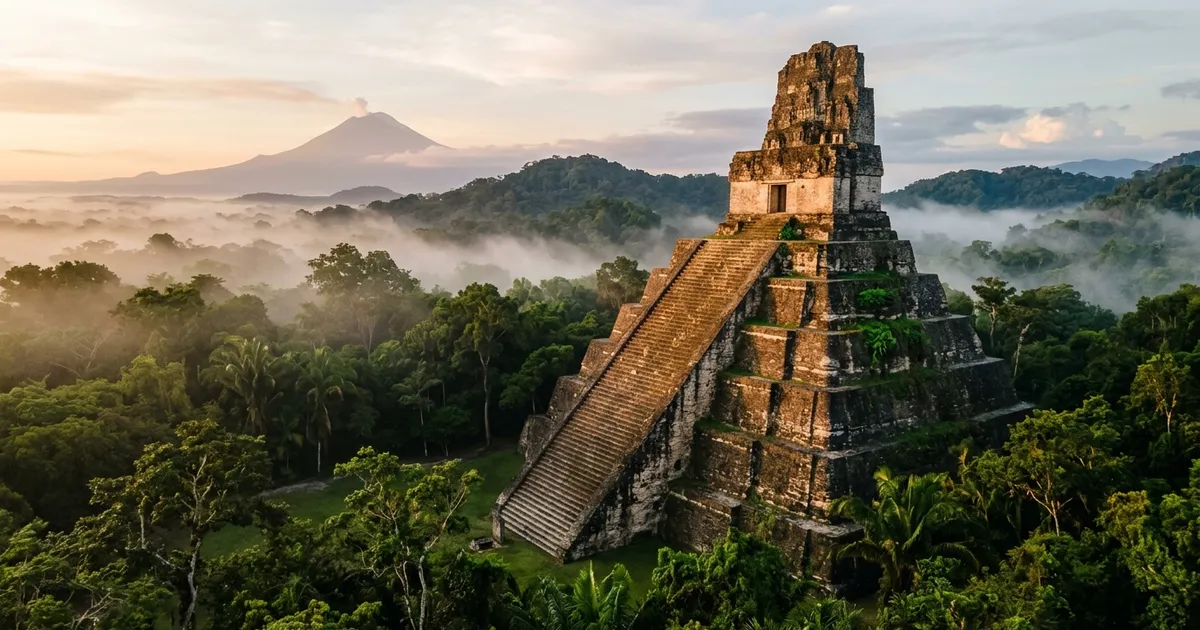
- The Great Pyramid of Cholula is the largest pyramid on Earth by volume, roughly twice that of Giza. There is a church on top, because the Spanish mistook the overgrown structure for a hill.
- The first printing press in the Americas arrived in Mexico City in 1539, nearly a century before one reached the English colonies.
- Mexico's national university was founded in 1551, making it one of the oldest in the Americas.
- Mexico abolished slavery in 1829, more than three decades before the United States.
- Mexico once had an Austrian emperor. Maximilian of Habsburg was installed by France in 1864 and executed by firing squad three years later.
- The official name is the United Mexican States. Estados Unidos Mexicanos, 32 federal entities, deliberately modelled on the American federal structure.
- Cinco de Mayo is not independence day. It marks the 1862 Battle of Puebla, where a smaller Mexican force beat the French army. Independence day is 16 September, and Cinco de Mayo is a far bigger event in the United States than in most of Mexico.
- The eagle on the flag comes from a founding legend. The Mexica were told to build their city where they saw an eagle on a cactus eating a snake. They found it on an island in a lake, which is why the capital is where it is.
Food the Rest of the World Took
- Chocolate is Mexican. Cacao was cultivated in Mesoamerica for millennia, drunk bitter and spiced. The word comes from Nahuatl, and so does tomato, avocado, chilli and coyote.
- So are tomatoes, chillies, vanilla, avocados, maize, beans and turkey. Italian food without tomatoes and Indian food without chillies are both possible; they are just not the food anyone alive remembers.
- Vanilla comes from a Mexican orchid that was for centuries pollinated by a single genus of local bee. Growing it anywhere else required inventing hand pollination.
- Mexican cuisine is on the UNESCO intangible heritage list, one of the first national cuisines to be recognised.
- Caesar salad was invented in Mexico. Cesare Cardini put it together in Tijuana in 1924, reportedly improvising from what was left in the kitchen on a busy Fourth of July.
- Chewing gum started with chicle, sap from the Mexican sapodilla tree. The exiled general Antonio López de Santa Anna brought it to New York, where it was turned into a product.
- Tequila is legally geographic. It can only be made in designated regions, mostly in Jalisco, and the agave landscape around the town of Tequila is a UNESCO World Heritage site.
- Mexico grows around 64 native varieties of chilli, and dried versions get entirely different names from their fresh forms. A jalapeño smoked and dried becomes a chipotle.
- Insects are food, not a stunt. Chapulines are toasted grasshoppers, and escamoles are ant larvae, sometimes called insect caviar, eaten since Aztec times.
- Mexico is the world's largest avocado producer, and most of the global supply comes from a single state, Michoacán.
Invention and Culture
- Colour television is partly Mexican. Guillermo González Camarena patented an early colour transmission system in 1940, aged 23.
- The contraceptive pill needed a Mexican yam. Chemists in Mexico City worked out how to synthesise hormones cheaply from barbasco root, which is what made oral contraception affordable.
- Mexico is the most populous Spanish-speaking country in the world, with more Spanish speakers than Spain and Argentina combined.
- It has 68 recognised indigenous languages and hundreds of variants. Spanish is not legally the official language; it holds equal status with all of them.
- Mexico City has one of the highest museum counts of any city on Earth, consistently listed in the global top three.
- The Day of the Dead is UNESCO heritage, and it is not Mexican Halloween. It is a family reunion where the dead are the guests.
- So is mariachi. The style was added to the intangible heritage list in 2011.
- The Mexican wave got its name in Mexico. It existed before, but the 1986 World Cup broadcast it worldwide, and the name stuck everywhere except Mexico, where it is simply la ola.
- The Xoloitzcuintli is over 3,000 years old. The hairless Mexican dog appears in Aztec art and was believed to guide souls through the underworld.
- Mexico has more UNESCO World Heritage sites than any other country in the Americas, a list that runs from Maya cities to a whale sanctuary to a 16th century aqueduct.
Strange and Specific
- There is an island covered in dolls. Isla de las Muñecas in the Xochimilco canals is hung with hundreds of weathered dolls, put there over decades by one man as an offering.
- Cuexcomate in Puebla is often called the world's smallest volcano, at 13 metres tall. It is technically a geyser cone, which has not stopped anyone.
- Popocatépetl means smoking mountain in Nahuatl, and it has been living up to the name almost continuously since 1994.
- At Chichén Itzá the pyramid produces a snake. On the spring and autumn equinoxes, the stepped edge casts a shadow along the staircase that resembles a serpent descending.
- Clap in front of that pyramid and it chirps back. The staircase produces an echo whose pitch resembles the call of the quetzal, a bird sacred to the Maya.
- Mexico has a hairless dog, a hairless cave fish, and a salamander that never grows up. The axolotl keeps its larval form for life and can regrow limbs, spinal cord and parts of its heart.
- Axolotls are critically endangered in the wild, surviving in the remnants of the same Xochimilco canal system, while millions live in aquariums worldwide.
- The world's smallest cetacean lives only in Mexican waters. The vaquita porpoise is down to a population in the low tens, all in the northern Gulf of California.
- Mexico's national palace stands on the Aztec ruler's palace. Cortés built on the site of Moctezuma's residence, and the modern seat of government has never moved off it.
- The word Mexico comes from Mexica, the people the world usually calls the Aztecs. They did not call themselves that.
The neighbours to the north are covered in fun facts about America and fun facts about Canada. If you would rather get one checked fact a day than fifty in a sitting, that is the fun fact of the day.
Day of the Dead is often mistaken for a Mexican Halloween, which it is not: the altars and marigold paths exist to welcome the dead home rather than to frighten anything away. The difference is set out on our Halloween 2026 page, alongside the history of Halloween itself.
Frequently Asked Questions
What is Mexico famous for that most people do not know?
Colour television. The Mexican engineer Guillermo González Camarena patented an early colour transmission system in 1940, while still in his twenties. Mexico also gave the world chocolate, vanilla, chewing gum, and the ingredient that made the contraceptive pill possible.
Is Cinco de Mayo Mexico's independence day?
No, and this is the single most common mistake made about the country. Cinco de Mayo marks the Battle of Puebla in 1862. Mexican independence is celebrated on 16 September. Cinco de Mayo is a far bigger occasion in the United States than in most of Mexico.
What is the largest pyramid in the world?
The Great Pyramid of Cholula in Mexico, by volume. It is roughly twice the volume of the Great Pyramid of Giza, and it has a Catholic church built on top of it, because the Spanish assumed the overgrown structure was a hill.
Why is Mexico City sinking?
It was built on a drained lake bed. The Aztec capital Tenochtitlan sat on an island in Lake Texcoco, which the Spanish drained. Groundwater extraction from the soft lake sediment now sinks parts of the city by up to 50 centimetres a year.
How many languages are spoken in Mexico?
Sixty-eight recognised indigenous languages, with hundreds of regional variants, alongside Spanish. Mexico has no official language at the federal level; Spanish and all 68 indigenous languages hold equal national status.
Every NerdSip course clears a four-layer fact-checking pipeline before it reaches the app: grounded in live sources, scored nightly, gated on failure, and reviewable by a person at one tap. Articles on this blog are drafted with AI assistance, then researched, verified, and edited by our team.
Editorial responsibility: ai51 UG (haftungsbeschränkt). Responsible editor named in the imprint.
📚 Keep Learning
- 50 Fun Facts About America (Including Ones Americans Get Wrong)
- 50 Fun Facts About Canada That Sound Made Up
- 50 Fun Facts About the UK, From Unicorns to a 38-Minute War
- 42 Facts That Will Blow Your Mind (2026)
- 100 Interesting Facts, Sorted by What Kind of Conversation You Want to Start
- How to Improve Your General Knowledge: A Daily System That Works
Explore the NerdSip learning hubs
The blog is our editorial layer. When you want to move from reading into doing, these hubs organize the rest of NerdSip by format, including the app itself and the press that has written about it.
Learn the Story Behind the Fact
NerdSip turns history, geography and everything else into five-minute lessons, fact-checked before they reach you. Free to start.
4.7 stars from 380 reviews · 10,000+ learners