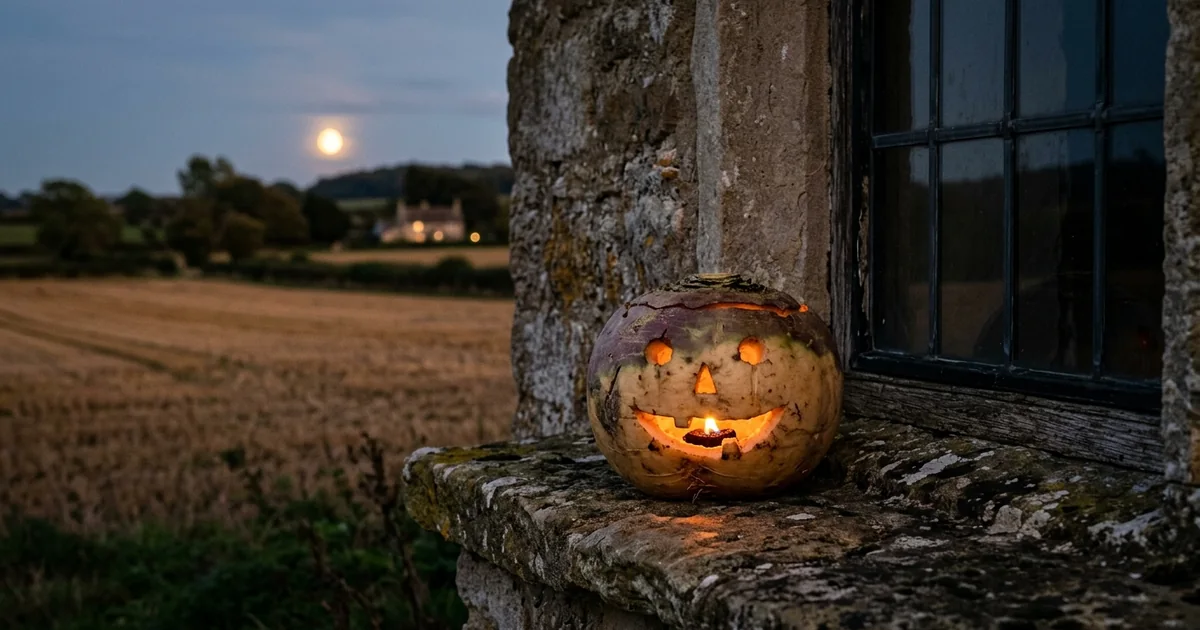
Quick answer: Halloween is the eve of All Saints' Day, 1 November, and it grew out of two traditions rather than one. Samhain, the Gaelic festival marking the end of the harvest, gave it the date and the mood. Medieval Christian Europe gave it the name, the vigil and the custom of going door to door for food in exchange for prayers. Irish and Scottish emigrants carried those customs to North America in the 19th century, where the turnip lantern became a pumpkin and the door-to-door performance became trick or treat, first recorded in print in 1927.
Every October the same history circulates: the Celts held a festival of the dead, the Church painted over it, and the Irish shipped it to America. It is not wrong so much as flattened. The parts that got smoothed away are the interesting ones, and several of the confident details in that version were invented by people who wanted the story to be tidier than the evidence allowed.
Here is the version that survives a look at the sources.
Where Halloween came from, in six steps
- Samhain, the Gaelic festival marking the end of the harvest and the beginning of the dark half of the year, fixed the season.
- All Saints' Day was set on 1 November for the whole Church in 835, which made 31 October its vigil: All Hallows' Even, shortened to Halloween.
- Souling sent the poor from door to door for cakes, in exchange for prayers for the household's dead.
- Guising in Scotland added the disguise and demanded a performance before the treat.
- Irish emigration carried all of this to North America, where the turnip lantern met the pumpkin.
- Twentieth-century America turned a night of mischief into a children's holiday, then into an industry, and exported it back to Europe.
Samhain: what the evidence actually says
Samhain is real, old and well attested. The word survives in modern Irish as the name of the month of November, which tells you how central it was. The festival did not merely fall in that month, it gave the month its name. Medieval Irish literature places major assemblies and pivotal events at Samhain, and the sense of a threshold, a night when the boundary between worlds runs thin, is genuinely present in the texts.
What the evidence does not support is the picture painted in most Halloween articles: a pan-Celtic festival of the dead, run by druids, with mass sacrifice and a formal cult of ancestors. The historian Ronald Hutton worked through the sources for The Stations of the Sun and found that much of that picture was assembled in the 18th and 19th centuries by antiquarians who wanted a pagan pedigree and were willing to fill the gaps with imagination. Nicholas Rogers reached a similar conclusion in Halloween: From Pagan Ritual to Party Night.
The honest summary is narrower and more interesting. Samhain marked a real agricultural break. Herds came down from summer pasture, the killing and salting of animals began, and the year turned towards the dark. A culture that marks that turn will attach stories about spirits and thresholds to it without needing to be told. That is enough to explain what we can actually see, without inventing a druid liturgy nobody wrote down.
All Hallows' Even: the half everybody forgets
The name Halloween is Christian, and it is not subtle about it. Hallows means saints. Even is an old word for evening. All Hallows' Even is the evening before All Saints' Day, and the contraction to Hallowe'en is Scottish.
The date matters. Pope Gregory III dedicated a chapel in St Peter's to all saints in the 8th century. A century later, in 835, Gregory IV had 1 November adopted across the Frankish empire, which made it general. The evening before became the vigil, and a vigil in the medieval calendar is not a small thing. It is when a feast begins, with its own fasting, bell ringing and processions.
This is where the popular story goes wrong in a specific way. It describes the Church pasting a feast over a pagan festival in order to suppress it. The chronology does not really support a deliberate takeover, and the customs that make up a modern Halloween are documented in Christian Europe rather than in pre-Christian sources. The night is a hybrid, but the Christian half did most of the visible work.
Souling, guising, and the door that had to be answered
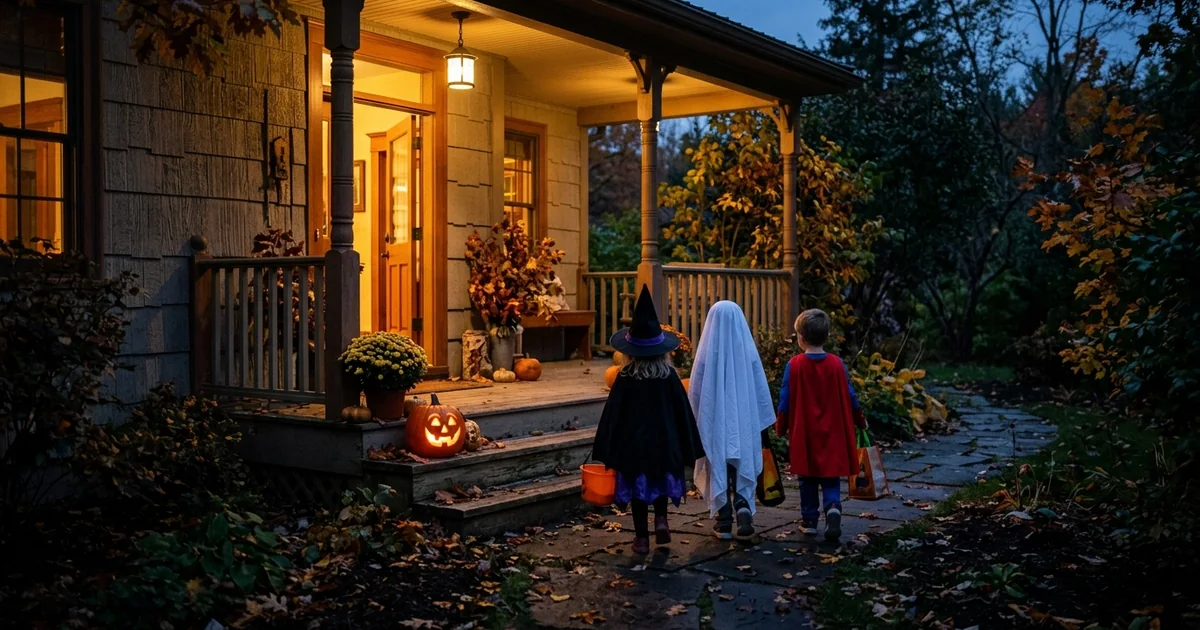
Trick or treating did not appear from nowhere in twentieth-century America. Two older customs feed straight into it.
Souling is the older one. On All Saints' and All Souls', poor people and children went from house to house asking for soul cakes, small spiced buns, and in return prayed for the household's dead. It was a transaction and everyone understood it as one: bread for prayer, a service rendered by the living poor to the dead of a wealthier house. It is recorded across Britain and Ireland from the late medieval period onwards.
Guising is the Scottish descendant, and it added the costume. A child in disguise came to the door and had to earn the treat with a performance: a song, a poem, a joke, a party trick. No performance, no reward. Anyone who has ever been mildly irritated that modern trick or treating asks nothing of the child is, historically speaking, on very solid ground. America kept the transaction, dropped the performance, and put a threat in its place.
Stingy Jack and the turnip that came before the pumpkin
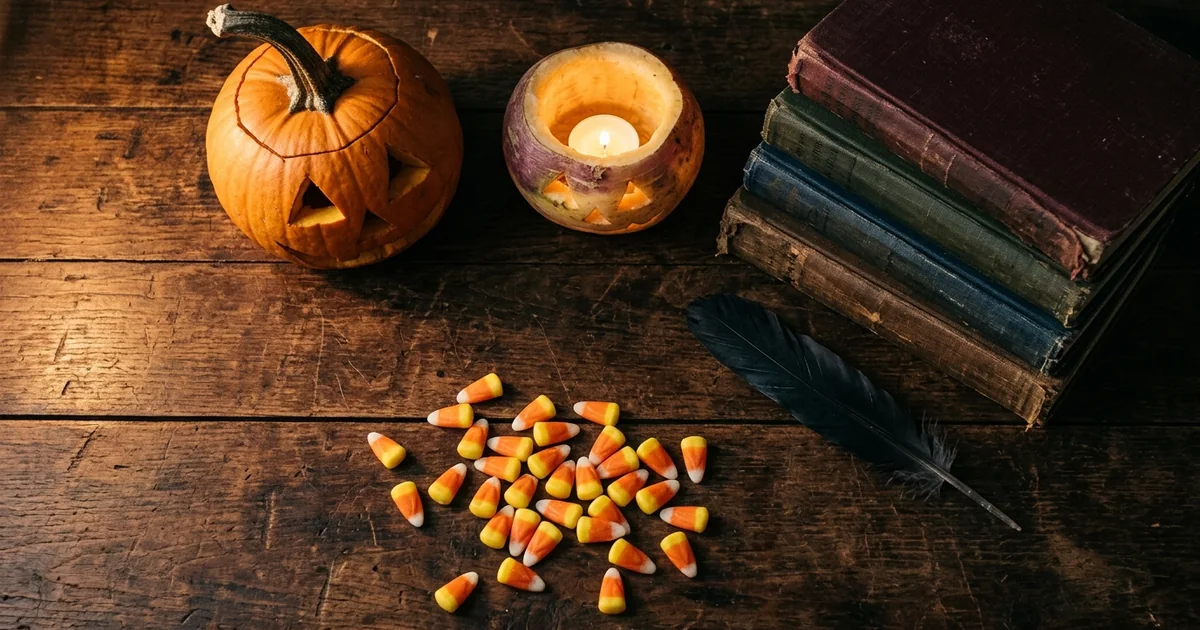
The lantern has its own line of descent. Before it meant a carved vegetable, the term jack-o'-lantern meant a night watchman, and before that the flickering marsh light that leads travellers astray, the will-o'-the-wisp. The Irish story attached to it involves a man called Stingy Jack who tricked the Devil, was refused by heaven for his life and by hell because of the bargain, and was sent off with an ember to light his wandering. He carried it in a hollowed turnip.
So the first jack-o'-lanterns were turnips, sometimes beets or mangelwurzels, carved with a face and lit with a coal. German-speaking regions did the same and called the results Rübengeister, turnip spirits, and the Swiss still hold Räbeliechtli lantern processions in November. The pumpkin is an American substitution and a purely practical one: bigger, softer, hollow already, and growing in every field.
Crossing the Atlantic
Halloween did not so much spread to America as emigrate there. Irish and Scottish emigration, hugely accelerated by the famine years of 1845 to 1852, moved millions of people who carried their calendar with them. In the new country the customs met three things they had never had: cheap sugar, mass-produced costumes, and newspapers that printed the same ideas from coast to coast.
The result was standardisation. Customs that had varied from valley to valley in Ireland were flattened into a single national American Halloween, then printed on postcards. In the early 1900s Halloween postcards were produced in enormous quantities, and collectors still trade them today. They are one of the better records of what the night looked like before it settled into its modern form.
How twentieth-century America built the Halloween we know
By the 1920s and 1930s the American Halloween had a problem. The mischief half had outgrown the treat half, and cities were losing property to vandalism every 31 October. The response was deliberate: community parties, organised parades, and the promotion of house-to-house treating as a supervised alternative aimed at children. It worked. Trick or treating spread through the 1930s and 1940s and became close to universal in the post-war suburbs, where identical streets full of young families made it easy.
From there the commercial layer built quickly. Sweets came pre-wrapped in single portions, which suits a custom that hands out hundreds of small items. Costumes moved from home-made to licensed. Halloween became the second-largest commercial holiday in the United States after Christmas, and it did so within living memory.
Two later additions are worth naming because they are so often assumed to be ancient. Charity collecting on Halloween, the UNICEF box, began in 1950. And the fear of poisoned sweets and razor blades in apples, which reshaped how an entire generation was allowed to trick or treat, has been studied closely by the sociologist Joel Best. He traced decades of reports and found no confirmed case of a child killed by contaminated sweets handed out by a stranger. The panic was real. The threat was not.
The reimport: how Halloween came back to Europe
The last stage is the strangest. A custom that left Ireland in the 19th century returned to Europe in the late 20th as an American product. British Halloween grew from the 1980s, having long been overshadowed by Guy Fawkes Night on 5 November, which had already absorbed the autumn bonfire tradition. Ireland kept its own version throughout, which is why Irish Halloween still has barmbrack and games that the American version lost.
Germany is the clearest case of a genuinely new arrival. Halloween only became widely celebrated there in the 1990s, spread by retailers, by American forces stationed in the country and by imported films. It also landed on an occupied date. The 31st of October is Reformation Day, a public holiday in nine federal states, and 1 November is All Saints', a silent holiday with dancing bans in five more.
Four things the popular history gets wrong
1. Nobody was burned at Salem. Nineteen people were hanged in 1692 and Giles Corey was pressed to death under stones. Burning witches was a continental European practice, not a colonial American one.
2. The Church did not simply overwrite Samhain. The date of All Saints moved for reasons internal to the Church calendar, and the evidence for a deliberate suppression strategy is much thinner than the retellings suggest.
3. Trick or treating is not a survival of an ancient rite. It is a twentieth-century American formalisation of souling and guising, both of them customs of the Christian era.
4. Halloween is not ancient in most places that celebrate it. In Britain it is a recent revival, in Germany it is barely older than the commercial internet, and in Japan it arrived later still.
A short timeline
| When | What happened |
|---|---|
| Early medieval | Samhain marks the end of harvest in the Gaelic calendar and gives November its Irish name. |
| 731 to 741 | Gregory III dedicates a chapel in St Peter's to all saints. |
| 835 | Gregory IV has 1 November adopted as All Saints' Day across the Frankish empire. Its vigil is All Hallows' Even. |
| Late medieval | Souling, the door-to-door request for soul cakes in exchange for prayers, is recorded across Britain and Ireland. |
| 1785 | Robert Burns publishes his poem "Halloween", whose footnotes record Scottish divination games in detail. |
| 1845 to 1852 | The Great Famine drives mass Irish emigration to North America. |
| 1900 to 1915 | The Halloween postcard boom standardises the imagery. |
| 1927 | "Trick or treat" appears in print in Blackie, Alberta. |
| 1930s to 1950s | Trick or treating is promoted as an alternative to vandalism and becomes near-universal in American suburbs. |
| 1950 | The UNICEF Halloween collection box begins. |
| 1980s to 1990s | Halloween is reimported into Britain and, for the first time at scale, into Germany. |
Why the real version is better
The invented history makes Halloween a survival, a piece of paganism that slipped through the net. The documented history makes it something more interesting: a night that has been repurposed by every era that touched it. Farmers marked a threshold. The Church needed a vigil. The medieval poor sold prayers for cake. Victorians used it to ask who they would marry. American suburbs used it to keep teenagers from setting fires. Retailers used it to sell more sweets than in any month except December.
None of those groups was preserving a tradition. Each of them was using one. That is what a living festival looks like, and it is why Halloween is still here while so many older feast days are not.
If you want the shorter version of why the night survived, read why we celebrate Halloween. For the details that make good conversation, there are 50 Halloween facts with sources attached, and if you want to test what stuck, the Halloween 2026 page carries a free twenty-question quiz.
Sources and further reading
- Ronald Hutton, The Stations of the Sun: A History of the Ritual Year in Britain (Oxford University Press, 1996), the standard scholarly account of what can and cannot be claimed about Samhain.
- Nicholas Rogers, Halloween: From Pagan Ritual to Party Night (Oxford University Press, 2002).
- Robert Burns, "Halloween" (1785), together with the author's own footnotes on Scottish divination customs.
- Joel Best's long-running research on Halloween sadism legends, which found no confirmed death from contaminated sweets given out by a stranger.
- Encyclopaedia Britannica on Halloween, for a concise reference summary of the same chronology.
Frequently Asked Questions
What is the origin of Halloween?
Halloween has two origins that merged. Samhain, the Gaelic festival marking the end of the harvest and the start of the dark half of the year, and All Hallows' Even, the vigil before the Christian feast of All Saints on 1 November, which Pope Gregory IV had adopted across the Frankish empire in 835. The customs that make up a modern Halloween, souling, guising and lantern carving, are documented in Christian-era Europe, and Irish and Scottish emigrants carried them to North America in the 19th century.
Is Halloween a pagan holiday?
Partly, and less directly than most accounts claim. Samhain is a genuine pre-Christian festival and it set the date and the mood. But the detailed picture of a druid-run festival of the dead was largely assembled by 18th and 19th century antiquarians rather than drawn from contemporary evidence, and the actual customs of a modern Halloween are Christian-era in origin. The historian Ronald Hutton's work is the standard reference on where that line falls.
Where did trick or treating come from?
From two older door-to-door customs. Souling, in which the poor asked for soul cakes and prayed for the household's dead in return, and Scottish guising, in which a child in disguise had to perform a song, poem or joke before receiving anything. Twentieth-century America kept the exchange, dropped the performance, and added the threat. The phrase itself first appears in print in Blackie, Alberta, in 1927.
Why were the first jack-o'-lanterns made from turnips?
Because that is what grew in Ireland and Britain. Turnips, and sometimes beets or mangelwurzels, were hollowed out, carved with a face and lit with a burning ember, tied to the story of Stingy Jack who tricked the Devil and was left to wander with a coal for light. German-speaking regions carved the same thing and called them Rübengeister. Pumpkins were an American substitution: larger, softer and abundant.
Did the Church invent Halloween to replace Samhain?
Not in the deliberate way the story is usually told. All Saints' Day moved to 1 November for reasons internal to the Church calendar, and it was fixed for the whole Church in 835 under Gregory IV. The evening before became its vigil. There was certainly overlap with existing seasonal custom, but the evidence for a planned campaign to overwrite Samhain is much thinner than most retellings imply.
When did Halloween arrive in Europe as we know it today?
It returned as an American import in the late 20th century. Britain's modern Halloween grew from the 1980s, having long been overshadowed by Guy Fawkes Night on 5 November. Germany only adopted it widely in the 1990s. Ireland is the exception: it never lost its own version, which is why Irish Halloween still keeps customs such as barmbrack that the American version dropped.
Every NerdSip course clears a four-layer fact-checking pipeline before it reaches the app: grounded in live sources, scored nightly, gated on failure, and reviewable by a person at one tap. Articles on this blog are drafted with AI assistance, then researched, verified, and edited by our team.
Editorial responsibility: ai51 UG (haftungsbeschränkt). Responsible editor named in the imprint.
📚 Keep Learning
- Why Do We Celebrate Halloween? Six Answers, One Per Era
- 50 Halloween Facts That Are Actually True
- 100 Halloween Trivia Questions (With Answers)
- The History of Oktoberfest: From a Royal Wedding to 6 Million Visitors
- 50 Fun Facts About Mexico You Were Never Taught
- 100 Interesting Facts, Sorted by What Kind of Conversation You Want to Start
Explore the NerdSip learning hubs
The blog is our editorial layer. When you want to move from reading into doing, these hubs organize the rest of NerdSip by format, including the app itself and the press that has written about it.
Ready to Level Up?
Turn your screen time into knowledge. Download NerdSip and start learning in just 5 minutes a day.
4.7 stars from 510 reviews · 10,000+ learners