A standard pub quiz runs six to eight rounds of ten questions. Six of them show up almost every time, and knowing what each round is really testing tells you how to prepare for it. Some rounds reward memorising closed sets, some reward structure, and one of them rewards nothing except paying attention early. Here is the anatomy of a quiz night, round by round.
Each round below has a page of its own now. Trivia questions by category collects them, with fifty questions apiece on geography, history, music, movies and science.
The Standard Shape of a Quiz Night
Most quizzes follow the same skeleton, whether they are run in a Yorkshire pub or a bar in Chicago. Six to eight rounds of ten questions, a picture sheet handed out at the start, a break somewhere in the middle, and a tiebreaker held back in case of a draw.
Hosts vary the categories, but far less than you would expect. If you prepared only for the six rounds below, you would be ready for most of what gets asked on most nights of the year.
The Six Rounds Almost Every Quiz Has
1. General Knowledge
What it tests: breadth, and whether anyone on your team reads outside their own interests.
This is the opener, and it is deliberately fair. Capital cities, chemical symbols, collective nouns, how many of something there are. It is the round least likely to have a specialist and most likely to be won on general reading.
How to prepare: this is the only round where broad daily habit genuinely beats targeted study. Ten minutes a day across rotating topics compounds here. Our 150 general knowledge questions covers the ones that come up most often.
2. Music
What it tests: which decade you were nineteen in.
Music rounds are written by a host with their own taste, for a crowd with a predictable age range. That makes them more learnable than they look. Questions cluster around defining acts, one hit wonders, band lineups, and which artist released what.
How to prepare: work by decade rather than by artist. Know two or three defining acts per decade from the 1960s onward, plus the classical staples that turn up in mixed rounds: Beethoven's Ninth, Vivaldi's Four Seasons, Tchaikovsky's Nutcracker.
3. Film and TV
What it tests: quotes, casts, directors, and the shows everyone claims not to watch.
The most reliably answerable round in the quiz, because film knowledge spreads culturally whether you seek it out or not. Questions lean heavily on the canon: the ones that get quoted, the ones that won Best Picture, the ones with a famous line.
How to prepare: learn directors attached to famous films rather than plots. "Who directed it" is asked far more often than "what happened in it".
4. Sport
What it tests: records, rules and tournament formats, not whether you watch matches.
This is the round that decides more quizzes than any other, because it is the one where non fans score zero and give up. That surrender is a mistake. Quiz sport questions are overwhelmingly about how many players are in a team, what a score is called, who won a famous final, and how often a tournament happens. Almost none of it requires having watched anything.
How to prepare: memorise team sizes, scoring terms and the big four-yearly tournaments. That alone converts a zero into a five.
5. Geography
What it tests: capitals, rivers, borders, and superlatives.
The single most learnable round in a pub quiz, and the one to study first if you want your score to move. Everything in it belongs to a closed set. There are a fixed number of countries, capitals, oceans and continents, and unlike music or film, the material is not growing.
How to prepare: capitals first, then the extremes: largest, longest, highest, deepest, smallest. Hosts love a superlative because it has exactly one defensible answer.
6. History
What it tests: the twentieth century, mostly, with a few classical anchors.
Despite covering all of human history in theory, quiz history rounds are concentrated in a narrow band: the two world wars, the Cold War, a handful of revolutions, and the greatest hits of Rome, Egypt and Greece.
How to prepare: learn the spine before the details. If you can place the major events of 1900 to 1991 in order, you can reason your way to answers you never memorised.
The Common Extras
Food and Drink
Origins of dishes, key ingredients, which country makes what, and spirits. Deceptively winnable if anyone on your team cooks. Worth knowing which dish comes from where, because that is most of the round.
Science and Nature
Elements and symbols, animal facts, the human body, basic physics. Reliably underestimated. The questions are rarely technical: they are the science equivalent of general knowledge.
Literature and Art
Who wrote it, who painted it, which novel opens with what. Rewards anyone with an arts degree and punishes everyone else. The good news is that the canon is small and stable, so a short list of authors and painters covers most of it.
Technology
Acronyms, founders, the history of the internet. The newest round, and the one that most reliably splits a team by age. Learn what the acronyms stand for, because that is half the round.
The Picture Round
Faces, logos, landmarks or film stills on a printed sheet. This is the only round where the main skill is not knowledge but timing.
The sheet sits on your table for the entire quiz. Most teams ignore it until the host asks for it, then panic. Look at it in the gaps between rounds, name the ones you know immediately, and leave the rest to marinate. Answers surface on their own when you stop staring.
The Wildcard
Anything the host feels like: local history, a themed round for the season, anagrams, connections. Unpreparable by definition, which is the point. Treat it as a coin flip and do not let it rattle you.
The Tiebreaker
Usually a number nobody could know. How tall is the building, how many bricks, what year did this obscure thing happen. Closest answer wins.
Two rules. Always write something, because a blank loses automatically. And guess plausibly rather than wildly: if you have no idea whether it is hundreds or millions, pick the middle of the range you can defend. Tiebreakers are won by reasonable estimates far more often than by knowledge.
Which Round Should You Fix First?
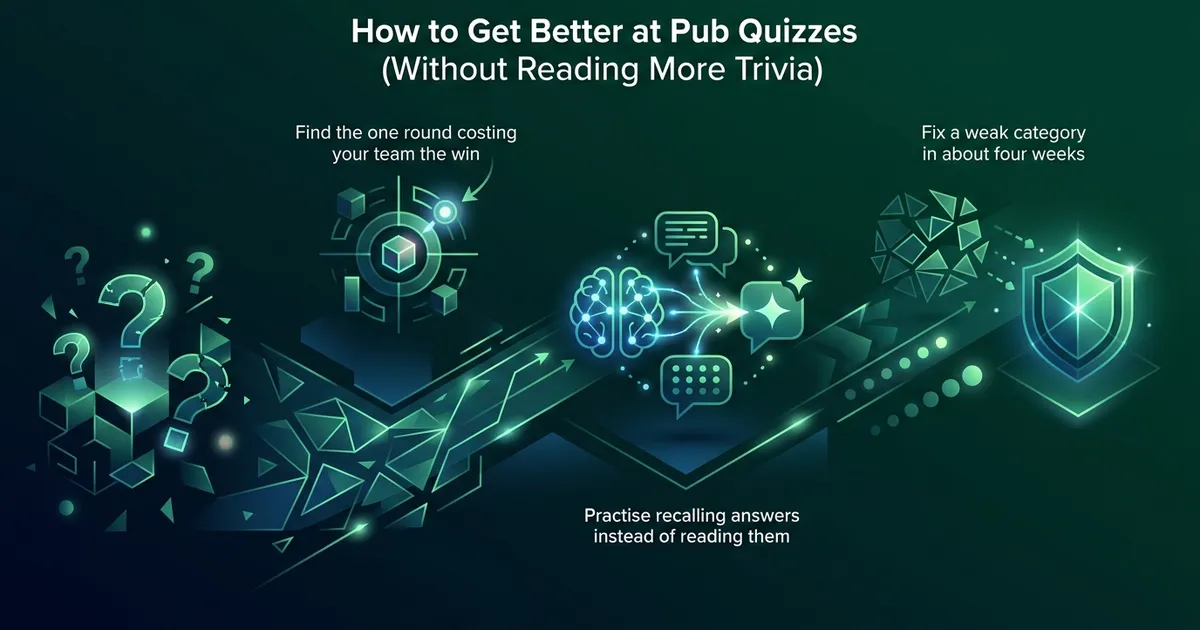
If you are asking yourself which pub quiz round should I focus on first, the answer is not the one you find most interesting. It is the one you score worst in.
This sounds obvious and almost nobody does it, because studying your weak round is unpleasant and studying your strong round feels productive. If you play a scored round on our interactive pub quiz, the breakdown at the end tells you exactly where the points are leaking, which removes the guesswork and the self-flattery in one go.
If two rounds are equally weak, pick geography. It is finite, it is fast, and it is the only round where you can realistically reach the end of the material.
Once you know the target, the method matters more than the hours. Read how to actually train for a quiz for the four week plan, and why you blank at quiz night for the reason reading lists of facts does so little.
If You Are Hosting Rather Than Playing
A good round has a difficulty curve: two easy openers so nobody feels stupid, six in the middle, two that separate the top teams. Vary the answer format so it is not ten surnames in a row. Read every question twice, once for the room and once for the people who were talking.
And avoid questions with arguable answers. The longest river in the world sounds like a great question until three tables produce sourced arguments for different rivers and you lose fifteen minutes. A hard question costs nothing. An ambiguous one costs the room.
For themed nights, we have ready made rounds on Oktoberfest, solar eclipses and the Nobel Prize, each with forty questions and answers.
A themed round is the easiest way to break up a standard ten-round night. The Halloween round is ready to read out, and the interactive version scores itself. December brings a Christmas round, and 100 Christmas trivia questions cover it from carols to films.
Running the whole night yourself? Here is how to host a pub quiz, step by step, and a ready-made sports round in 60 sports trivia questions with answers.
Frequently Asked Questions
What rounds are in a typical pub quiz?
Six to eight rounds of ten questions. The near universal ones are general knowledge, music, film and TV, sport, geography and history. Common additions are food and drink, science and nature, literature and art, technology, a picture round and a wildcard chosen by the host.
How many questions are in a pub quiz?
Usually sixty to eighty, arranged as six to eight rounds of ten. A quiz that runs about two hours will typically have seven rounds plus a picture round handed out at the start and collected at the end.
What is a picture round?
A printed sheet of images, usually faces, logos, landmarks or film stills, handed out at the start and collected at the end. It rewards patience rather than knowledge, because it sits on your table for the whole quiz and most teams leave it until they are rushed.
Which pub quiz round is easiest to improve at?
Geography, by a wide margin. Capitals, rivers, borders and extremes are finite sets you can genuinely finish learning, unlike music or pop culture where the material keeps expanding. Sport is second, because quiz sport questions are about records and rules rather than about following matches.
What is a pub quiz tiebreaker?
A question with a numerical answer nobody is expected to know, such as the height of a building or the number of items in a collection. The team closest wins. Always write something, because a blank guarantees you lose the tiebreak and a wild guess sometimes wins it.
How do you host a good pub quiz round?
Ten questions with a difficulty curve: two easy openers, six mid, two hard. Mix answer formats so it is not all names. Read every question twice. Avoid anything that turns on a single date unless it is famous, because arguments about ambiguous answers cost more goodwill than a hard question ever gains.
Every NerdSip course clears a four-layer fact-checking pipeline before it reaches the app: grounded in live sources, scored nightly, gated on failure, and reviewable by a person at one tap. Articles on this blog are drafted with AI assistance, then researched, verified, and edited by our team.
Editorial responsibility: ai51 UG (haftungsbeschränkt). Responsible editor named in the imprint.
📚 Keep Learning
- Best Quiz App in 2026: 4 Tested (And What Happens When You Get One Wrong)
- How to Get Better at Pub Quizzes (Without Reading More Trivia)
- Why You Blank at Quiz Night on Answers You Definitely Know
- 150 General Knowledge Questions and Answers (With the Top 10 First)
- How to Improve Your General Knowledge: A Daily System That Works
- 40 Oktoberfest Trivia Questions (With Answers)
- 50 Geography Trivia Questions and Answers
Explore the NerdSip learning hubs
The blog is our editorial layer. When you want to move from reading into doing, these hubs organize the rest of NerdSip by format, including the app itself and the press that has written about it.
Fix the Round You Keep Losing
NerdSip turns any weak category into a short course you finish in about five minutes, and every lesson ends in a question so the answer sticks.
4.7 stars from 510 reviews · 10,000+ learners